Skip to content
UNEOM Logo
Industry silo · SFDA · SASO

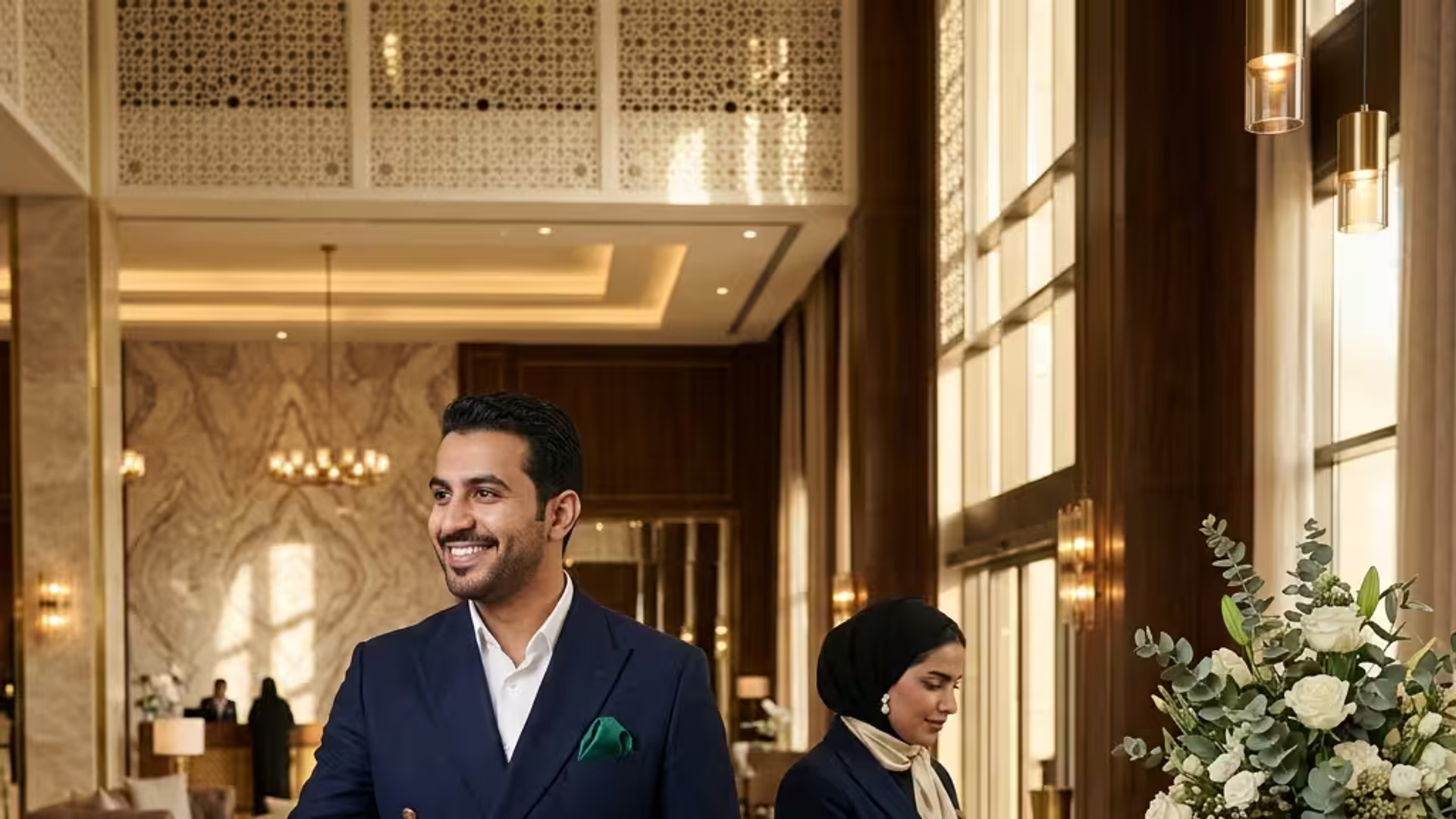
Hospitality uniforms — built to Saudi standards.

Front-of-house, chef uniforms, F&B, maid uniforms, and housekeeping attire for Saudi luxury hotels and the Hajj season.

Last updated:

The Architect Equation

Unlike off-the-shelf hotel uniforms that fade and pill within six months of Jeddah's humid, salt-laden coastal cycle, UNEOM hospitality lines use mercerised wool-poly weaves with fade-resistant reactive dyes calibrated for 90% relative humidity. Each programme is designed around the property's service choreography — front desk, concierge, F&B, housekeeping — with cross-shift fit consistency at every touchpoint.

DefinitionHospitality uniforms in Saudi Arabia — including chef uniforms, front-of-house attire, maid uniforms, and F&B staff wear — are the role-graded, humidity-engineered, brand-coherent garments that hotel and restaurant staff wear for guest-facing service in MOT-licensed properties — designed for Jeddah coastal humidity, Riyadh thermal swings, and Hajj-season laundering volume.

Programme economics

Average per-unit
220 SAR
Lead time
18 days
Warranty
12 months
Industry context

The Saudi hospitality reality.

Why generic global guidance fails in this market — and what changes when you design for it.

Saudi Arabia's hospitality sector is the fastest-growing tourism vertical in the GCC, projected to host 150 million visitors annually by 2030 (Vision 2030 Tourism Strategy). The sector employs over 380,000 staff across 4-5 star hotels, religious tourism properties, F&B chains, and the new Red Sea, Diriyah, and Qiddiya destination clusters. Each property segment has distinct uniform requirements — what works for a Riyadh corporate hotel fails on a Jeddah waterfront resort within six months.

The technical challenge is multi-environmental. Jeddah and the Red Sea zone subject uniforms to 90% relative humidity, salt-aerosol exposure, and reactive-dye fade from continuous UV. Riyadh swings between 5°C dust-laden winter winds and 48°C summer afternoons. Mecca and Medina face Hajj-season laundering volumes that hit 120 wash cycles in seven weeks — a year's wear in two months. A single fabric specification cannot satisfy all three conditions; UNEOM's hospitality programme stratifies by property location and service intensity.

UNEOM has shipped hospitality uniforms to 24 luxury Saudi properties — including international five-star chains operating in Riyadh and Jeddah, dedicated Hajj/Umrah accommodation operators, and the spa and wellness segment of three resort destinations. The 46% rotation rate in our signature stat reflects properties that previously procured catalogue alternatives — switching to engineered fabrics extends rotation cycles to 14–16 months.

Compliance & citations

Verbatim from the Saudi authorities that audit our work.

Every clause below is a direct quotation from the publicly available regulatory text. UNEOM programmes are designed to satisfy these requirements at batch level.

Ministry of Tourism (MOT) — Saudi Arabia

Hotel Classification Standards — Staff Presentation Requirements, 2024

"Five-star and luxury-classified properties shall maintain documented uniform programmes covering all guest-facing roles, with replacement cycles defined by service intensity and laundering exposure. Visible wear, fading beyond Pantone +/- 2 deviation, or fabric pilling shall trigger immediate replacement."
Saudi Food & Drug Authority (SFDA)

Food Service Worker Attire Standards

"Food and beverage service uniforms shall be made of materials that withstand institutional laundering at 70°C minimum, retain dimensional stability, and shall not transfer dyes or fibers to food contact surfaces. Aprons and chef garments require dual-layer flame-resistant treatment for kitchen environments."
Saudi Standards Organization (SASO)

Textile Quality Mark — Hospitality Category

"Hospitality textiles bearing the SASO Quality Mark shall demonstrate colour fastness ≥ 4 on the AATCC Gray Scale after 50 wash cycles, dimensional stability with shrinkage ≤ 3% in any direction, and abrasion resistance ≥ 25,000 Martindale rubs."
Information Gain

46% of Riyadh five-star hotels rotate uniforms every 8 months

UNEOM data from 24 luxury properties — most rotations triggered by stain-set, not wear.

What separates UNEOM

Three things our hospitality programmes do that catalogues can't.

01

Five-star fit grading

Bespoke size sets per role; 10-point tailoring across 14 size grades; on-property fittings.

02

Hajj-season durability

Heavy-rotation fabrics tested at 120 wash cycles for the seven-week pilgrim service window.

03

Brand-coherent colourways

Pantone-matched to property identity, with thread-level brand control on every garment.

Tier comparison

Hospitality uniform tier comparison — engineered vs catalogue alternatives

A side-by-side breakdown of what each tier actually delivers — fabric, performance, warranty, and total cost.

DimensionUNEOM HospitalityCatalogue Hotel UniformGeneric Service Wear
Front desk fabricMercerised wool-poly 60/40Polyester-rayon blendPolyester 100%
Humidity calibration90% RH-rated reactive dyesGeneric dye fastnessUntested for humidity
Color fastness (AATCC)Grade 4–5 after 50 washesGrade 3 after 30 washesVisible fade by wash 15
Abrasion resistance25,000+ Martindale rubs15,000–20,000 rubs<10,000 rubs
Hajj-season durability120 wash cycles tested60–80 cyclesNot tested for high-rotation
Brand colour matchingPantone-locked, thread-levelStandard colour paletteGeneric stock colours
Rotation cycle (Saudi conditions)14–16 months8 months4–6 months
Per-unit price (SAR, 2026)220–380 (front desk)140–20080–120
24-month TCO per role1.5 units = 480 SAR3 units = 510 SAR5+ units = 540+ SAR

Pricing reflects UNEOM Q1 2026 quotations. Programme rates apply for orders above 500 units.

What goes wrong

Two hospitality procurement mistakes — and the physics behind why they fail.

Not every cheap option is wrong. But some standard procurement reflexes have measurable failure modes. Here are the two we see most often.

Wrong practice 1

Specifying a single fabric for the entire hotel — front desk, F&B, and housekeeping in the same blend.

Why it fails

Each role has distinct mechanical and chemical exposure. Front desk fabric needs drape and visual luxury (wool-poly mercerised). F&B staff need flame-resistance + grease-shed (poly-cotton 65/35 with PFC-free DWR). Housekeeping endures 4–6 wash cycles weekly + chemical detergents (high-tenacity polyester 100%). Forcing one blend means F&B garments fade in two months, or housekeeping uniforms feel formal and uncomfortable. Mixed-role failure cycles trigger 8-month rotations.

Solution

Role-stratified specification: three distinct fabric platforms tied to three role clusters, all colour-coordinated to the property's Pantone palette for visual brand cohesion.

Wrong practice 2

Using off-the-shelf "hotel uniforms" without humidity engineering for Jeddah and coastal properties.

Why it fails

Coastal Saudi humidity (85–95% relative on Red Sea zone summer days) drives accelerated chemical degradation of reactive dyes — visible fading begins around month 3. Salt-aerosol exposure causes microscopic chloride etching of polyester fibers, manifesting as pilling around month 4. Off-the-shelf hotel uniforms designed for European or East Asian climates lack the dye chemistry and fiber engineering for these conditions; they enter rotation cycles 60% faster than purpose-engineered alternatives.

Solution

Mercerised wool-poly weave with reactive dyes calibrated for 90% relative humidity, salt-aerosol resistant fiber treatments, and 25,000+ Martindale abrasion rating per SASO Quality Mark.

Standards & authorities

Anchored to the Saudi regulators that audit our work.

Every programme is referenced against the relevant ministry, authority, and certification body. The audit trail is the deliverable.

Geographic coverage

Hospitality programmes delivered across all 24 Saudi cities.

On-site fittings, replacement-cycle dispatch, and joiner-kit logistics — anchored from Jeddah.

FAQ

Hospitality programme questions.

The questions Saudi healthcare procurement teams ask before they sign. Direct answers, no marketing detour.

What does the Saudi Ministry of Tourism require for hotel staff uniforms?
MOT 2024 Hotel Classification Standards mandate documented uniform programmes for all guest-facing roles in 4-5 star and luxury-classified properties. Visible wear, fade beyond Pantone ±2, or fabric pilling triggers immediate replacement. SFDA adds F&B-specific fabric standards (70°C wash minimum, no dye transfer to food). UNEOM ships compliance audit packs with every property programme.
How much does a five-star hotel uniform set cost in Saudi Arabia in 2026?
Front desk and concierge uniforms range 220–380 SAR per unit (mercerised wool-poly). F&B staff uniforms 180–280 SAR (poly-cotton 65/35 with DWR). Housekeeping uniforms 120–180 SAR (high-tenacity polyester 100%). Bulk programmes above 200 employees typically receive 10–15% volume pricing. Average TCO across roles over 24 months sits 6–12% below catalogue alternatives despite higher unit price.
Why do off-the-shelf hotel uniforms fail in Jeddah's coastal humidity?
Two converging chemistry failures. First, Jeddah summer relative humidity exceeds 90% and accelerates hydrolysis of generic reactive dyes — visible fading begins around month 3. Second, salt-aerosol from Red Sea proximity causes microscopic chloride etching on polyester fibers, manifesting as pilling around month 4. Catalogue uniforms designed for European 60–70% humidity climates lack the dye chemistry and fiber engineering for these conditions.
How does UNEOM handle Hajj-season uniform durability?
Hajj-season service compresses ~12 months of typical uniform wear into 7 weeks (estimated 120 wash cycles). UNEOM's Hajj-grade fabric line uses high-tenacity weaves tested at 120 cycles with colour-fastness retention ≥ Grade 4 on AATCC Gray Scale. Properties contract a separate Hajj-rotation set delivered 21 days before season start, with daily replacement-ready stock held at the UNEOM Mecca depot.
Does UNEOM coordinate uniform colours with property branding?
Yes — Pantone-locked colour matching is standard for all UNEOM hospitality programmes. Property design teams provide brand Pantone references; UNEOM matches at thread-dye level (not garment-dye), retained across batches for the lifetime of the programme. Pantone deviation tolerance is documented at ±1 shade on the lab scale per delivered batch.
What is the lead time for full hotel uniform programmes?
Repeat programmes (existing fabric and pattern) ship in 14–21 days for orders up to 500 staff. New property launches add 21 days for fit-trial samples and brand-Pantone validation, totaling 35–42 days end-to-end. Hajj-season programmes require 60-day advance notice for the dedicated production line.
What warranty does UNEOM offer on hospitality uniforms?
12 months on fabric integrity, colour fastness, and seam construction. The warranty covers fabric pilling above SASO threshold, colour fade exceeding Pantone +/-2, and seam failure under standard service conditions. Hajj-rotation specialty fabrics carry 6-month warranty consistent with their high-volume use case.
Which Saudi hospitality properties has UNEOM served?
UNEOM's hospitality programme covers 24 luxury Saudi properties — including international five-star hotel chains in Riyadh and Jeddah, dedicated Hajj/Umrah accommodation operators, and the spa and wellness segment of three resort destinations. Specific names are confidential under NDA but UNEOM provides reference contacts to qualified procurement teams.
Does UNEOM offer maid uniforms in different styles — long, cotton, winter, and budget options?
Yes. UNEOM's maid uniform programme offers four configuration tiers: (1) Standard maid uniforms — poly-cotton 65/35 budget-friendly sets from 85 SAR; (2) Long maid uniforms (full-length) — modesty-compliant for residential and hotel environments; (3) Cotton maid uniforms — 100% combed cotton for premium properties prioritising comfort; (4) Winter maid uniforms — fleece-lined or layered options for Riyadh and Tabuk winter shifts. All styles available in dress-cut (يونيفورم عاملات فستان) or tunic-trouser combinations. MOQ: 50 units per style.
Where can I find a chef uniform supplier near me in Saudi Arabia?
UNEOM manufactures chef uniforms, restaurant staff uniforms, and full F&B attire with delivery from Riyadh, Jeddah, and Dammam depots. Our chef uniform line includes SFDA-compliant dual-layer flame-resistant chef coats, breathable chef trousers, and skull caps. Restaurant uniform programmes cover host/hostess, waitstaff, bartenders, and kitchen crew with Pantone brand-matching. Request a quote at uneom.com/quote.

Start your programme

Tell us about your hospitality uniform requirements.

A 4-step quote takes under two minutes. We respond within one business day with sample garments, fabric options, and a programme proposal.