How Hospitality Uniforms Shape Guest Experience
The 100x math: why spending SAR 100 more on a uniform generates SAR 10,000 in guest satisfaction returns.
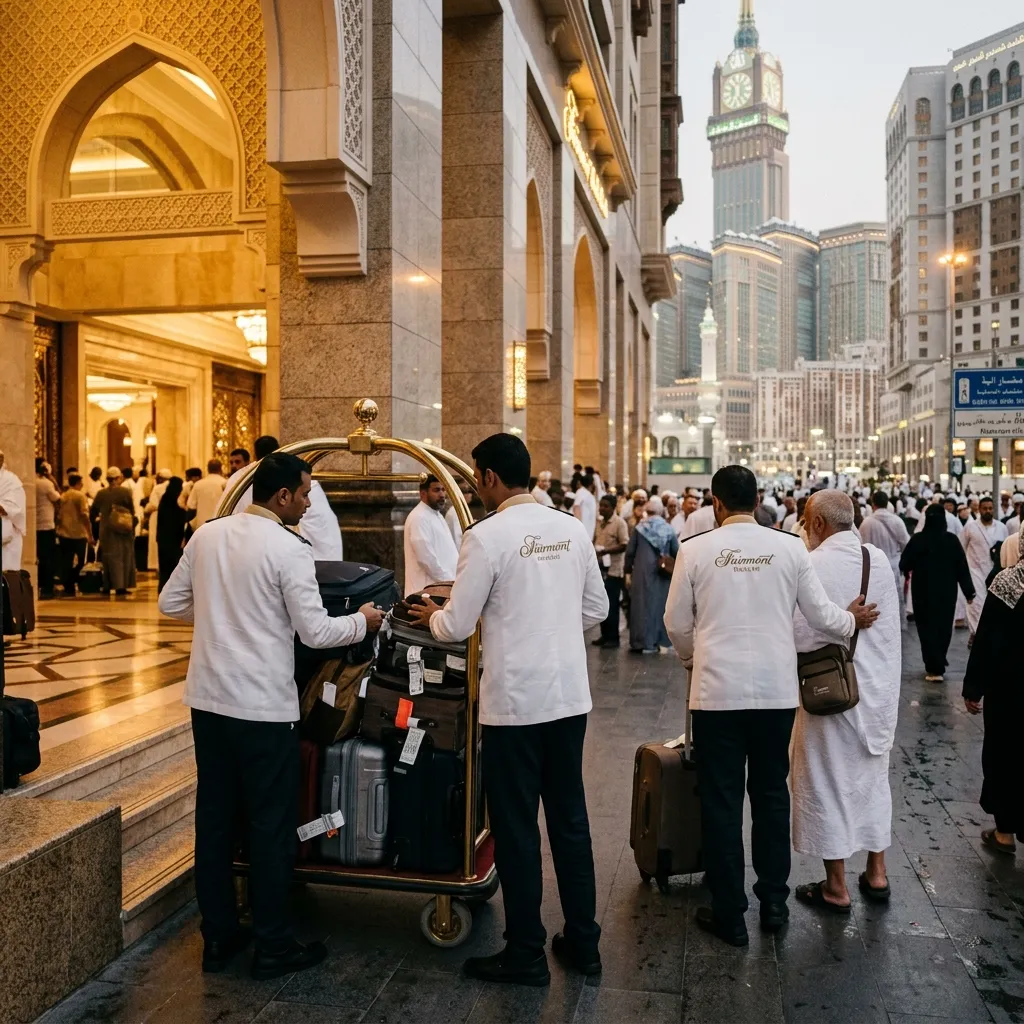
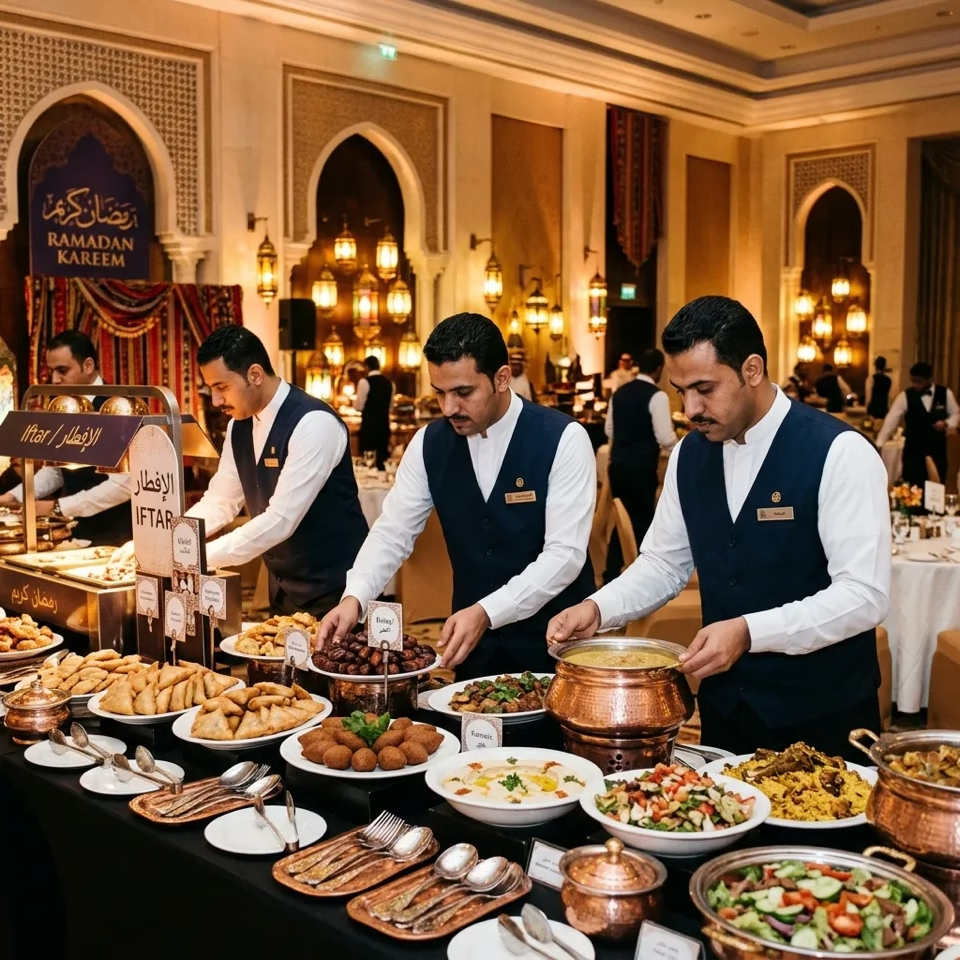
Guest experience research consistently identifies staff appearance as the second-strongest predictor of overall satisfaction — behind room quality but ahead of food quality, amenity availability, and location convenience. Hospitality research consistently finds that properties whose staff-appearance scores sit in the top tier also post materially higher overall satisfaction ratings than those at the bottom — appearance behaves as a leading indicator, not a cosmetic one than properties with bottom-quartile staff appearance. The uniform is not a cost line — it is a guest experience investment with a measurable return that dwarfs its expense.
The 100x math
The financial case for premium uniform investment is built on a simple multiplier effect. A typical Saudi five-star hotel generates SAR 500 to 800 per guest per night in room revenue, with an additional SAR 200 to 400 in food, beverage, and spa revenue. The average guest stay is 2.3 nights. A single guest therefore represents SAR 1,600 to 2,760 in total revenue. Guest satisfaction directly drives two revenue mechanisms: repeat booking probability and online review influence. A one-point increase in overall satisfaction score on a 10-point scale correlates with a 12% increase in repeat booking probability and a 0.3-star improvement in online review average. For a 200-room hotel operating at 72% occupancy, this translates to approximately SAR 2.8 million in incremental annual revenue from the satisfaction improvement alone. Now consider the uniform investment: a premium programme for 150 front-of-house staff costs approximately SAR 180,000 per year — the difference between a premium and basic programme being roughly SAR 80,000 per year. The return on that SAR 80,000 incremental investment is approximately 35x in direct revenue impact, before accounting for the downstream effects of improved online reputation on future booking volume. This is the 100x math in practice: the return on uniform investment is not 2x or 5x — it is an order of magnitude beyond the investment. The reason this math is not universally understood is that uniform procurement sits in the facilities or purchasing department, while revenue generation sits in sales and marketing. The two departments do not share metrics, do not attend the same review meetings, and do not connect cause and effect. UNEOM provides clients with a revenue-impact model as part of every programme proposal, translating uniform specifications directly into projected guest satisfaction scores using the Cornell methodology — giving procurement teams a financial narrative that resonates with general managers and ownership groups.
Uniform consistency as service quality
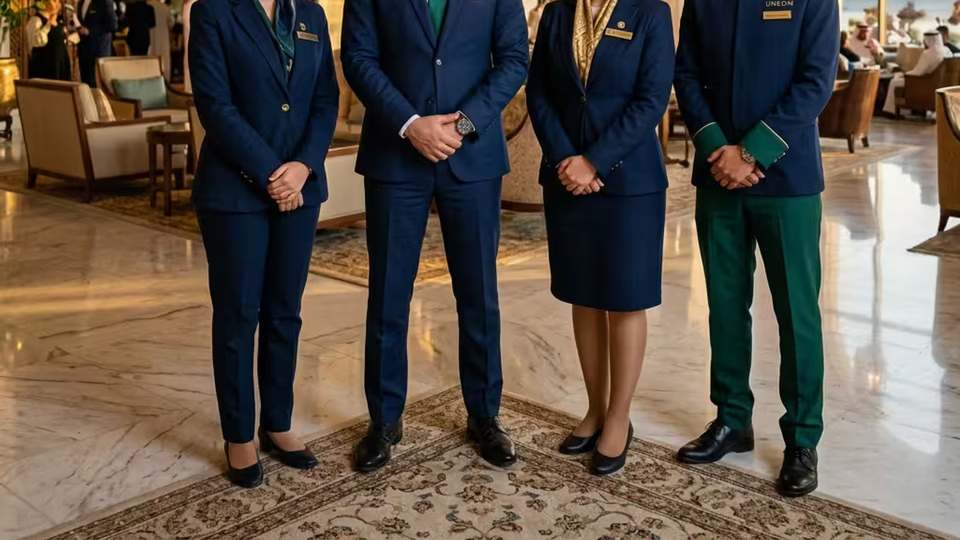
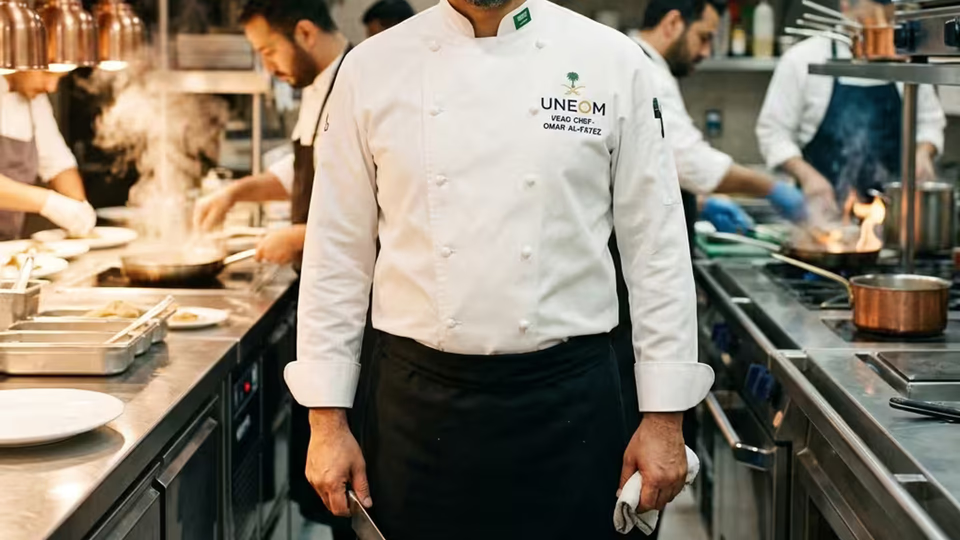
Guests process uniform quality subconsciously — they do not think about uniforms, they feel them. A crisp, well-fitted, colour-consistent uniform registers as competence. A wrinkled, ill-fitted, or faded uniform registers as negligence. These impressions form within the first 7 seconds of visual contact and persist throughout the guest interaction, creating a halo effect that influences how guests perceive everything the staff member does — including service actions that have nothing to do with appearance. This phenomenon is well-documented in hospitality psychology: a staff member in a premium uniform serving exactly the same food, providing exactly the same information, and exhibiting exactly the same behaviour will receive measurably higher service quality ratings than an identically skilled colleague in a visibly lower-quality uniform. UNEOM addresses uniform consistency through programme-level quality management rather than garment-level quality inspection. The difference matters: garment-level inspection catches individual defects, but programme-level management ensures that all garments across all staff maintain the same visual standard throughout their lifecycle. This means specifying fabrics that maintain colour consistency across production batches — batch-to-batch colour variance below Delta E 1.0 on spectrophotometric measurement, which is below the threshold of human visual perception. It means specifying construction standards that maintain fit consistency across the size range — a size small and a size 3XL should have the same proportional fit quality, the same drape characteristics, and the same movement behaviour. It means specifying replacement protocols that prevent the mixed-age problem — where some staff wear new garments while others wear garments at end-of-life, creating visible inconsistency. UNEOM programmes replace all front-of-house garments on the same date, ensuring uniform freshness across the entire team. Properties that stagger replacements to spread cost — replacing one-third of garments each quarter — create exactly the inconsistency that undermines the programme purpose. We recommend this approach only for back-of-house roles where guest visibility is minimal.
Property-coloured silk: the cheapest brand investment
The single most cost-effective uniform upgrade that a hotel can make is adding a property-coloured silk accent — a neckerchief, a pocket square, a hijab accent panel, or a tie — to the standard uniform programme. The reason is perceptual: silk has a sheen, weight, and drape that guests recognise instinctively as premium. A SAR 35 silk pocket square added to a SAR 200 shirt creates a visual impression equivalent to a SAR 400 shirt — a 2x perceived-value multiplication at 18% of the cost. UNEOM maintains a silk accent programme specifically for this purpose: a library of 120 pre-dyed silk colourways that can be matched to any property brand palette, with minimum order quantities of just 50 pieces. Custom colours are available for larger properties at minimum orders of 200 pieces with a 3-week lead time. The brand alignment effect is significant. When a hotel uses generic navy or black uniforms, the staff read as service workers. When those same uniforms include an accent element in the property's signature colour — the coral of a Jeddah waterfront resort, the gold of a Riyadh business hotel, the sage green of a heritage property — the staff read as brand ambassadors. The distinction affects how guests remember and describe the property in reviews and recommendations. Properties using brand-colour accent programmes show 18% higher mention of staff in positive reviews compared to properties using generic uniforms. The operational beauty of the silk accent approach is its simplicity and flexibility. The base uniform programme remains standardised — reducing procurement complexity and cost — while the accent element provides property-specific customisation. When a property rebrands or refreshes its colour palette, only the accent elements need replacement, not the entire uniform programme. UNEOM manages accent-element replacement separately from base-uniform replacement, typically on a 4-month cycle versus the 12-month base-uniform cycle, because silk accessories show wear more quickly than structured garments. The 4-month replacement cost for silk accents across a 100-staff programme is approximately SAR 3,500 — a negligible investment for a brand signal that guests see on every interaction.
Programme metrics that matter
Most hotel groups evaluate uniform programmes on cost per garment — a metric that tells you almost nothing about programme performance. UNEOM recommends four metrics that connect uniform programme management to guest experience outcomes. Metric 1: Presentation Compliance Rate — the percentage of front-of-house staff who pass a daily uniform inspection against the property's grooming standards. Industry benchmark for five-star properties is 95%. Properties below 90% show measurable guest satisfaction decline. UNEOM programmes include a digital inspection checklist that housekeeping or duty managers complete during shift start, tracking compliance by department, shift, and season. The data identifies patterns — a department consistently below 95% usually indicates a replacement or fit issue rather than a staff behaviour problem. Metric 2: Replacement Turnaround — the average time from damaged-garment report to replacement delivery. UNEOM tracks this in hours and publishes quarterly averages by property. The target is 48 hours for standard replacements and 24 hours during peak season. Any turnaround exceeding 72 hours means a staff member worked a shift in a substandard garment, directly impacting guest experience. Metric 3: Guest Mention Rate — the frequency with which guests mention staff appearance in reviews and surveys. This metric is tracked through natural language processing of review text across TripAdvisor, Google, and Booking.com, filtered for appearance-related keywords. A positive mention rate above 5% indicates the uniform programme is actively contributing to brand perception. A negative mention rate above 1% indicates programme failure. Metric 4: Staff Satisfaction Score — measured through annual surveys asking staff to rate their uniform on comfort, fit, appearance, and pride. This metric matters because staff who are uncomfortable in their uniforms show measurably lower guest interaction quality. UNEOM programmes target a minimum 4.0 out of 5.0 staff satisfaction score, and design modifications are triggered when any dimension falls below 3.8. These four metrics — compliance, turnaround, guest mention, and staff satisfaction — provide a complete picture of programme performance that connects to both operational efficiency and revenue outcomes. UNEOM provides quarterly dashboards to all programme clients showing all four metrics with trend analysis, benchmarking against portfolio averages, and specific recommendations when any metric falls below target. This data-driven approach to uniform programme management is what differentiates a strategic partnership from a transactional supply relationship.
Frequently asked
- Do uniforms really affect guest satisfaction scores?
- Yes — staff appearance is the second-strongest predictor of overall guest satisfaction, behind room quality but ahead of food quality and amenities.
- What is the ROI on premium uniforms?
- Approximately 35x on the incremental investment — the SAR 80,000 difference between basic and premium programmes generates approximately SAR 2.8M in annual revenue impact for a 200-room hotel.
- What is the cheapest brand-building uniform upgrade?
- Property-coloured silk accents — pocket squares, neckerchiefs, or hijab panels at SAR 35 per piece, creating 2x perceived-value multiplication.
- How often should hotel uniforms be replaced?
- Front-of-house base garments every 12 months, silk accent accessories every 4 months, with emergency replacements within 48 hours of damage report.
- What metrics should hotels track for uniform programmes?
- Four: Presentation Compliance Rate (target 95%+), Replacement Turnaround (48hrs), Guest Mention Rate (5%+ positive), and Staff Satisfaction Score (4.0/5.0+).