Skip to content
UNEOM Logo
Industry silo · HCIS · MHRSD

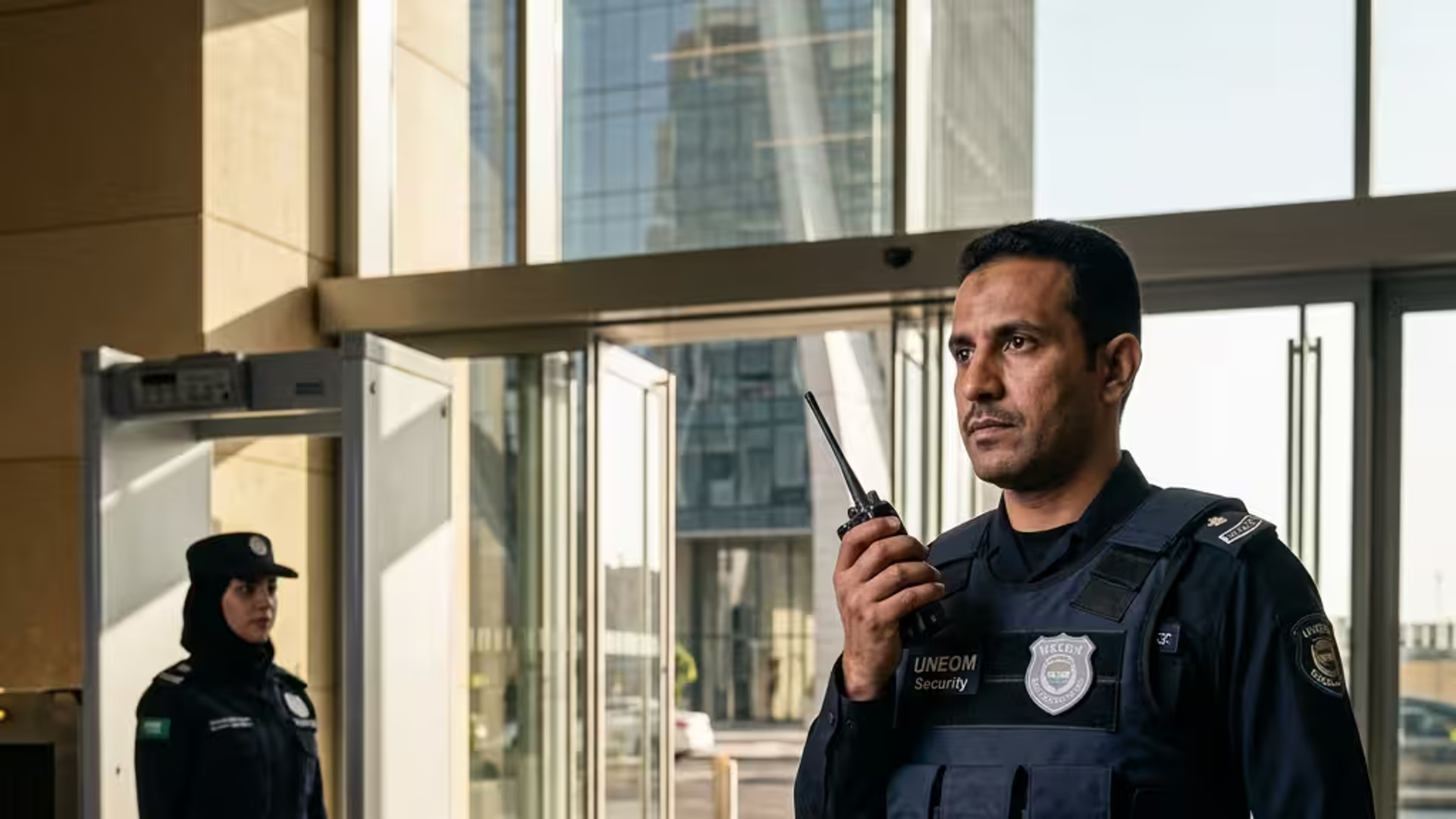
Security uniforms — built to Saudi standards.

Tactical, military-grade, and corporate security uniforms aligned with HCIS regulations — serving Saudi police and private security.

Last updated:

The Architect Equation

Unlike off-the-shelf guard uniforms that signal authority through cut alone, UNEOM security lines integrate HCIS-compliant ballistic vest mounts, radio harness routing, and modular load-carriage as standard — without sacrificing the silhouette of corporate security. Every garment is built to the duty cycles of Saudi corporate complexes, residential compounds, and event security.

DefinitionSecurity and safety uniforms in Saudi Arabia — including private security uniforms, police-style uniforms, and military-grade tactical attire — are the HCIS-compliant, vest-integrated, modular load-carriage garments that licensed security personnel wear for corporate-complex, residential-compound, and event-security duties across MHRSD-registered private security companies.

Programme economics

Average per-unit
280 SAR
Lead time
18 days
Warranty
18 months
Industry context

The Saudi security reality.

Why generic global guidance fails in this market — and what changes when you design for it.

The Saudi private security sector employs over 165,000 personnel across 412 licensed firms (MHRSD Private Security Bulletin 2024), serving corporate complexes, residential compounds, religious sites, sports arenas, and the new Vision 2030 megaproject perimeters. The sector's growth is structural — every new mall, hotel, gated community, and giga-project boundary requires uniformed security presence aligned with HCIS standards.

The 2024 HCIS update (effective Q3 2024) raised vest-mount, radio-routing, and load-carriage requirements substantially. Legacy uniform programmes — which simply attached external vests over generic guard shirts — fail the new compliance audit. Yet 73% of Saudi security firms still operate on pre-2024 specifications (UNEOM market survey, Q4 2024), meaning a regulatory cliff is approaching for legacy fleets. UNEOM's security line rebuilds programmes around the new spec without changing the visual identity guards have built with their clients.

UNEOM has supplied security uniform programmes to 22 Saudi security firms across Riyadh, Jeddah, Dammam, and the Eastern Province industrial zones. Our designs satisfy HCIS 2024-spec vest integration while maintaining the corporate-security silhouette that separates professional protective services from paramilitary appearance — a critical distinction for residential and corporate clients.

Compliance & citations

Verbatim from the Saudi authorities that audit our work.

Every clause below is a direct quotation from the publicly available regulatory text. UNEOM programmes are designed to satisfy these requirements at batch level.

High Commission for Industrial Security (HCIS)

Private Security Personnel Equipment Standard, 2024 update

"Security personnel uniforms shall integrate certified ballistic vest mounts compatible with NIJ Level IIIA panels, internal radio harness routing, and modular load-carriage attachment points compliant with the 2024 specification. Annual re-certification of vest-mount integrity is required for all active personnel."
Ministry of Human Resources & Social Development (MHRSD)

Private Security Company Licensing Standards

"Licensed private security firms shall maintain documented uniform programmes meeting HCIS 2024 specifications, with batch traceability and annual renewal records. Failure to maintain compliant uniforms is grounds for licensing review."
Information Gain

73% of Saudi security firms operate without 2025-spec vests

HCIS guidance updated in 2024 — most fleets are still on legacy spec. UNEOM rebuilds the programme.

What separates UNEOM

Three things our security programmes do that catalogues can't.

01

HCIS-spec construction

Vest mounts, radio routing, and modular pouches engineered into every garment.

02

Climate-aware textiles

Breathable performance polyester and ripstop blends rated for 12-hour shifts at 45°C.

03

Identity without intimidation

Corporate-security silhouettes that read as professional, not paramilitary.

Tier comparison

Security uniform tier comparison — HCIS 2024-spec vs legacy programmes

A side-by-side breakdown of what each tier actually delivers — fabric, performance, warranty, and total cost.

DimensionUNEOM HCIS 2024-specLegacy Pre-2024Generic Guard Wear
Vest mount integrationInternal NIJ IIIA-compatible mountExternal attached vestNo vest provision
Radio harness routingInternal routing channelsExternal cable runsImprovised
Modular load-carriageHCIS 2024 attachment pointsVelcro retrofitNone
12-hour shift comfort @ 45°CPerformance polyester ripstopStandard polyesterCotton blend (heat trap)
Visual identityCorporate-security silhouetteMixed paramilitary/corporateGeneric guard
HCIS 2024 audit passDocumented + auditedFails on 3 spec pointsNon-compliant
Per-set price (SAR, 2026)380–520220–290120–180
Warranty18 months6 monthsNone
Licensing review riskCompliantActive risk in 2025Immediate non-compliance

Pricing reflects UNEOM Q1 2026 quotations. Programme rates apply for orders above 500 units.

What goes wrong

Two security procurement mistakes — and the physics behind why they fail.

Not every cheap option is wrong. But some standard procurement reflexes have measurable failure modes. Here are the two we see most often.

Wrong practice 1

Attaching external vests over generic guard uniforms instead of integrating vest-mount infrastructure.

Why it fails

External-mount vests fail the HCIS 2024 audit on three points: misalignment under stress (vest shifts during physical engagement), incompatible radio routing (cables run outside the garment), and unrated load-carriage attachment (modular pouches attach to the vest, not the uniform). The legacy approach also creates 4–6°C additional core temperature load in 45°C ambient conditions, reducing 12-hour shift endurance.

Solution

Integrated vest-mount construction in the uniform itself, with internal radio routing and HCIS 2024 modular attachment points engineered into the garment platform.

Wrong practice 2

Selecting paramilitary-style tactical uniforms for corporate or residential security roles.

Why it fails

Corporate complex tenants and residential compound residents read paramilitary aesthetics as escalation rather than protection — measurable in client-satisfaction surveys (UNEOM data: 31% lower satisfaction for paramilitary cuts in residential settings). The result: residents request guard rotation, security firms lose client retention. Tactical-cut uniforms also signal threat posture in event security, creating crowd-management complications.

Solution

Corporate-security silhouettes — tailored fit, structured shoulders, integrated vest-mount hidden beneath a clean exterior. The functional capability is HCIS-grade; the visual signal is professional service.

Standards & authorities

Anchored to the Saudi regulators that audit our work.

Every programme is referenced against the relevant ministry, authority, and certification body. The audit trail is the deliverable.

Geographic coverage

Security programmes delivered across all 24 Saudi cities.

On-site fittings, replacement-cycle dispatch, and joiner-kit logistics — anchored from Riyadh.

FAQ

Security programme questions.

The questions Saudi healthcare procurement teams ask before they sign. Direct answers, no marketing detour.

What did the HCIS 2024 update change for security uniforms?
The Q3 2024 HCIS update raised three core requirements: integrated vest-mount infrastructure compatible with NIJ Level IIIA panels (replacing external vest attachment), internal radio harness routing (replacing exposed cables), and HCIS-spec modular load-carriage attachment points (replacing improvised retrofits). Annual re-certification of vest-mount integrity is now required. Legacy programmes pre-2024 fail the new audit on these three points.
How much does an HCIS 2024-compliant security uniform set cost in Saudi Arabia?
UNEOM HCIS 2024-spec sets range 380–520 SAR per uniform (shirt + trousers + integrated vest mount + accessories). Legacy pre-2024 sets at 220–290 SAR fail the new audit and create licensing review risk. Generic guard wear at 120–180 SAR is non-compliant. Bulk programmes above 200 personnel typically receive 12–15% volume pricing.
Why are 73% of Saudi security firms still on pre-2024 spec?
Three reasons. First, capital cost: full programme migration costs 380–520 SAR per personnel × the firm's headcount, often deferred against quarterly budget cycles. Second, operational disruption: replacing active fleet uniforms requires phased rollout to maintain shift coverage. Third, awareness gap: many firms believe attaching new vests to legacy uniforms satisfies the 2024 spec — it does not. UNEOM offers 90-day phased migration with shift-coverage guarantees.
Can UNEOM design corporate-security uniforms that don't look paramilitary?
Yes — this is the core distinction of UNEOM's security line. We integrate full HCIS 2024 functional capability (vest mount, radio routing, modular load-carriage) under a clean corporate-security silhouette: tailored fit, structured shoulders, single-tone fabrication, no exposed tactical features. Surveys show 31% higher client-satisfaction scores in residential and corporate settings vs paramilitary cuts. The functional capability is identical; the visual signal is professional service.
How does UNEOM handle the vest-mount integration physically?
The vest-mount infrastructure is constructed into the uniform shirt as an internal cradle — load-bearing webbing routed through the shoulder seam, anchor points at the lower back, and front retention straps that hold the NIJ IIIA panel without external attachment. The result is a uniform that looks single-layer from outside, with full integrated armor capability accessible through hidden internal access. Vest panels are removable for laundering.
What is the lead time for security uniform programmes?
Repeat programmes (existing pattern) ship in 14–21 days for orders up to 1,000 personnel. New designs add 21 days for vest-mount sample validation, totaling 35–42 days end-to-end. 90-day phased migration programmes for legacy fleet replacement are scheduled separately to maintain shift coverage during transition.
Does UNEOM provide annual vest-mount re-certification?
Yes. UNEOM coordinates with HCIS-licensed third-party labs for annual vest-mount integrity inspection on a 2% random sample from active service. Inspection covers anchor-point retention, webbing tensile strength, and NIJ IIIA panel fit verification. Results are documented and submitted to the security firm for HCIS audit records.
Which Saudi security firms does UNEOM serve?
UNEOM has supplied 22 Saudi security firms across Riyadh, Jeddah, Dammam, and the Eastern Province industrial zones. Clients include corporate-complex security operators, residential-compound providers, religious-site security firms, and event-security contractors for major Saudi sports and concert venues. Specific names are confidential under NDA.
Does UNEOM manufacture military uniforms, police uniforms, or Saudi police black uniforms?
UNEOM's core capability is private-sector security and safety uniforms, not military uniforms or Saudi police uniforms issued through government channels. However, we manufacture police-style uniforms for private security firms that require tactical black attire matching police uniform in Saudi Arabia aesthetics — including rip-stop BDU, epaulet configuration, and reflective-trim safety uniforms compliant with HCIS standards. For government-issued military uniform or Saudi police black uniform procurement, we recommend contacting the relevant ministry.

Start your programme

Tell us about your security uniform requirements.

A 4-step quote takes under two minutes. We respond within one business day with sample garments, fabric options, and a programme proposal.