Skip to content
UNEOM Logo
Industry silo · MOE · SASO

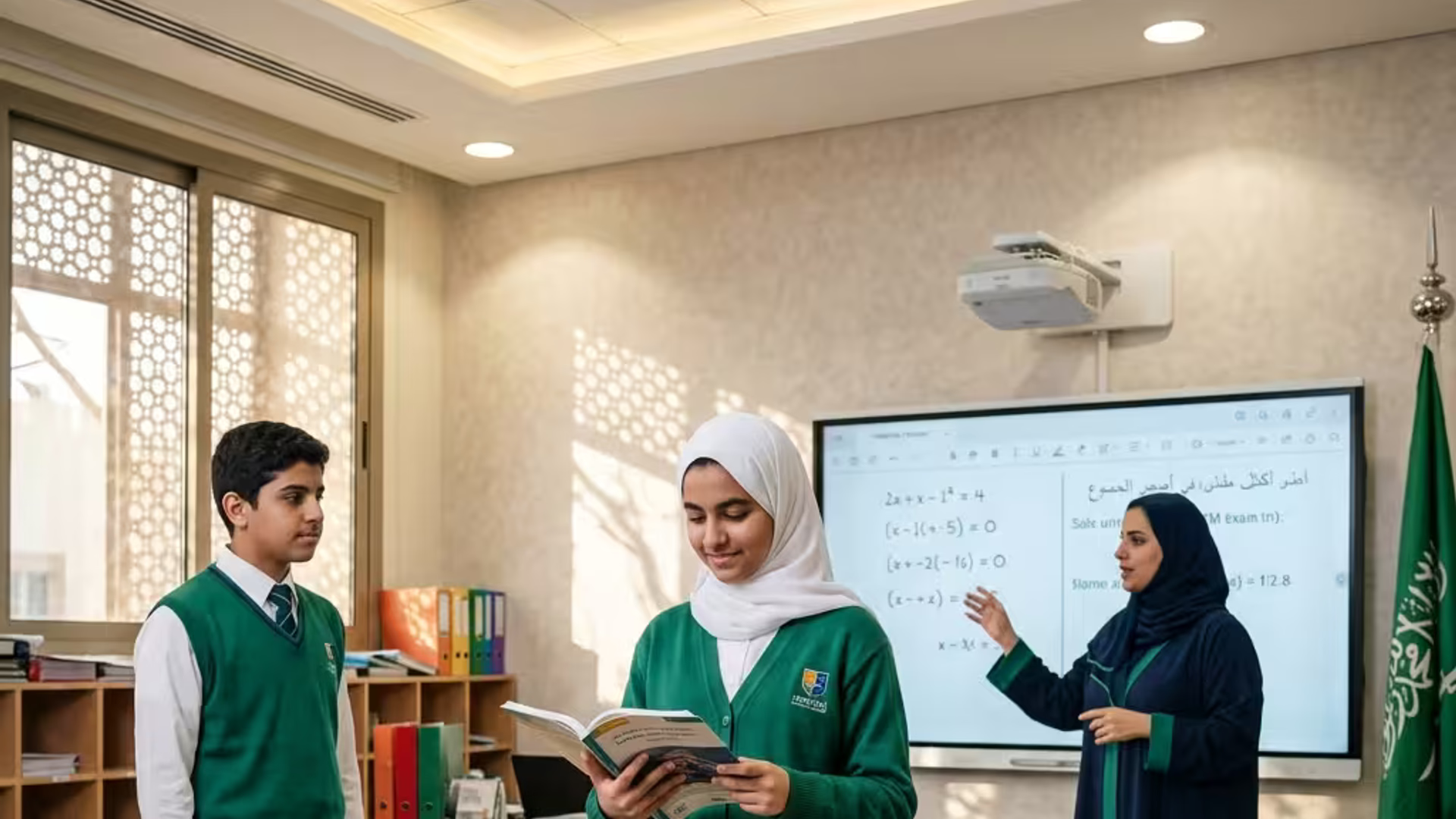
Education uniforms — built to Saudi standards.

School uniforms and university attire aligned with Saudi MoE guidelines — growth-engineered for the academic year.

Last updated:

The Architect Equation

Unlike imported school uniforms fitted for static body types, UNEOM education lines are sized to the Saudi school-year growth curve — twin-needle reinforcement at every stress point, hidden waist adjusters, and replaceable knee panels. MoE-compliant cuts in poly-cotton built for Saudi laundry realities, delivered ahead of every term at school-block volume.

DefinitionSchool uniforms in Saudi Arabia — the standard school uniform for Saudi public and private institutions — are the MoE-compliant, growth-engineered, modesty-graded poly-cotton garments that students wear in licensed Saudi schools — designed to extend service life across the school-year growth curve and synchronise procurement to the August intake cycle.

Programme economics

Average per-unit
95 SAR
Lead time
14 days
Warranty
12 months
Industry context

The Saudi education reality.

Why generic global guidance fails in this market — and what changes when you design for it.

Saudi Arabia's K-12 system serves over 6.4 million students across 35,000 schools — roughly evenly split between government and private operators (Ministry of Education Statistical Yearbook 2024). The system's defining operational reality is the August intake: every September, schools simultaneously dress 6.4 million students with new or replacement uniforms, creating a procurement window that Saudi-experienced suppliers plan around 8 months in advance.

The technical challenge of education uniforms is not the static fit — it is the moving target of student growth. Saudi school children gain an average 7–9 cm in height per academic year (Ministry of Health pediatric growth data, 2024), making uniforms designed for static body types unwearable by mid-year. The result: parents and schools replace uniforms 2.3 times per student annually on average. UNEOM's growth-aware sizing — hidden waist adjusters, replaceable knee panels, two-stage hems — is engineered to cut this replacement rate to 1.0–1.2 per year, halving the family economic burden.

UNEOM has supplied education uniform programmes to 47 Saudi schools and 6 private school networks across Riyadh, Jeddah, Mecca, Medina, and the Eastern Province. Our August-intake production capacity reserves 60-day lead windows for school-block orders, with on-campus fittings for joiner students at the start of each term.

Compliance & citations

Verbatim from the Saudi authorities that audit our work.

Every clause below is a direct quotation from the publicly available regulatory text. UNEOM programmes are designed to satisfy these requirements at batch level.

Ministry of Education (MoE) — Saudi Arabia

School Uniform Standards — Modesty & Cultural Identity Guidelines

"School uniforms shall reflect Saudi cultural identity through approved cuts and colour palettes, with gender-appropriate modesty grading per the published MoE standards. Fabric must withstand institutional laundering at 60°C minimum and retain dimensional stability for the full academic year."
Saudi Standards Organization (SASO)

Education Textile Quality Mark

"School uniform textiles bearing the SASO Quality Mark shall demonstrate dimensional stability with shrinkage ≤ 4% after 30 wash cycles, colour fastness ≥ 4 on the AATCC Gray Scale, and chemical safety per OEKO-TEX Standard 100 Class 2 (children's articles)."
Information Gain

2.3× replacements per student per academic year

Most driven by growth, not wear — UNEOM's extendable cuts cut this in half.

What separates UNEOM

Three things our education programmes do that catalogues can't.

01

Growth-aware sizing

Hidden waist adjusters, replaceable panels, two-stage hems for one-year wear extension.

02

MoE-compliant cuts

Modesty grading for boys and girls aligned with Saudi educational guidelines.

03

School-term logistics

Production windows synchronised to August intake; on-campus fittings and joiner-kit delivery.

Tier comparison

School uniform tier comparison — growth-engineered vs static-fit alternatives

A side-by-side breakdown of what each tier actually delivers — fabric, performance, warranty, and total cost.

DimensionUNEOM Growth-AwareStatic-Fit StandardCheap Imported
FabricPoly-cotton 65/35, OEKO-TEX Class 2Poly-cotton 50/50Polyester 100%
Growth allowance6 cm waist + 5 cm hem + replaceable panelsNoneNone
MoE modesty complianceDocumented + auditedCompliantOften non-compliant
Wash cycle durability80+ cycles, AATCC ≥ 440 cycles20 cycles
Service life14 months avg7 months avg4 months avg
Per-uniform price (SAR, 2026)85–11060–8035–55
Replacements per year1.0–1.22.33.0–3.5
12-year cumulative cost per child1,260 SAR1,800 SAR1,950 SAR
August-intake production capacity60-day reserved windowsOn-stock dependentStock-only

Pricing reflects UNEOM Q1 2026 quotations. Programme rates apply for orders above 500 units.

What goes wrong

Two education procurement mistakes — and the physics behind why they fail.

Not every cheap option is wrong. But some standard procurement reflexes have measurable failure modes. Here are the two we see most often.

Wrong practice 1

Buying static-fit school uniforms designed without growth allowance.

Why it fails

Saudi school children gain 7–9 cm height per academic year. Static-fit uniforms — designed to fit at September measurement — become unwearable by January for fast-growing children, and by March for nearly all students. Families replace 2–3 sets per year just to keep up with growth. The financial impact across a 12-year school career adds up to 24–36 uniform replacements per child, when growth-aware design could limit this to 12–14.

Solution

Hidden waist adjusters with 6 cm range, two-stage hems with 5 cm release, and replaceable knee panels — designed to extend single-uniform service life from 7 months (static fit) to 14 months (growth-aware).

Wrong practice 2

Selecting cheapest-cost uniforms by unit price, ignoring 12-year cumulative cost.

Why it fails

A 65 SAR static-fit uniform replaced 2.3 times per year = 150 SAR annual cost × 12 school years = 1,800 SAR per child. A 95 SAR growth-aware UNEOM uniform replaced 1.1 times per year = 105 SAR annual cost × 12 = 1,260 SAR per child. The unit-price gap of 30 SAR creates 540 SAR savings over the full school career — and reduces 11 fewer uniform replacement events for the family.

Solution

Total Cost of Ownership (TCO) modeling across the 12-year school career, factoring growth-driven replacement frequency. Schools that procure UNEOM's growth-aware programme save families ~30% on cumulative uniform costs.

Standards & authorities

Anchored to the Saudi regulators that audit our work.

Every programme is referenced against the relevant ministry, authority, and certification body. The audit trail is the deliverable.

Geographic coverage

Education programmes delivered across all 24 Saudi cities.

On-site fittings, replacement-cycle dispatch, and joiner-kit logistics — anchored from Riyadh.

FAQ

Education programme questions.

The questions Saudi healthcare procurement teams ask before they sign. Direct answers, no marketing detour.

What does the Saudi Ministry of Education require for school uniforms?
MoE School Uniform Standards mandate cuts and colour palettes that reflect Saudi cultural identity, with gender-appropriate modesty grading per published guidelines. Fabric must withstand 60°C institutional laundering and retain dimensional stability across the full academic year. SASO adds that fabrics must meet OEKO-TEX Standard 100 Class 2 (children's articles) for chemical safety. UNEOM ships compliance audit packs with every school programme.
How much does a school uniform set cost in Saudi Arabia in 2026?
UNEOM growth-aware school uniforms range 85–110 SAR per set (poly-cotton 65/35, hidden waist adjusters, replaceable knee panels). Static-fit standards at 60–80 SAR replace 2.3 times yearly. Cheap imported alternatives at 35–55 SAR replace 3+ times yearly and often fail OEKO-TEX Class 2 chemical safety requirements. School-block programmes above 500 students receive 8–12% volume pricing.
How does growth-aware sizing actually work?
Three engineered features. First, hidden waist adjusters: internal elastic with button-position locking, providing 6 cm of waist range without visible bulk. Second, two-stage hems: an internal seam allowance of 5 cm hidden in the inner-leg, releasable mid-year by the school tailor or parent. Third, replaceable knee panels: separately stitched panels at the highest-wear point, replaceable for 8 SAR vs 95 SAR full-uniform replacement. Combined, these extend single-uniform service life from 7 to 14 months.
When should schools place orders for August-intake uniforms?
UNEOM reserves 60-day production windows for August-intake school programmes, requiring orders confirmed by June 1st for delivery by August 15th. Larger schools (1,000+ students) should reserve capacity by April for guaranteed delivery. Joiner-kit orders for new students arriving mid-year ship within 7 business days from existing programme stock.
Are UNEOM school uniforms safe for sensitive children's skin?
Yes. All UNEOM education fabrics are certified to OEKO-TEX Standard 100 Class 2 — the highest tested-for chemical safety category for children's articles, covering azo dyes, heavy metals, formaldehyde, pesticides, and pH. Each batch is independently tested. Fabrics are also free of optical brighteners that can trigger sensitivity in some children.
Does UNEOM provide both boys' and girls' uniform options?
Yes. UNEOM's education line includes full size sets for both boys (white shirt + grey/navy trousers + school-specific accessories) and girls (modest top + skirt or trousers per school policy + hijab options for older students). All variants share the same growth-aware engineering, OEKO-TEX safety standards, and August-intake production capacity. Sizes range from KG (4 years) through Grade 12.
Can schools customise UNEOM uniforms with their crest or colours?
Yes. School-specific customisation includes crest embroidery (locked to school Pantone), trim colour matching, name-tag tape integration, and house-colour variants for sport-day uniforms. Customisation is included in school-block programmes; small private schools (under 100 students) pay a one-time setup fee for crest digitisation.
Which Saudi schools and networks does UNEOM serve?
UNEOM has supplied 47 Saudi schools and 6 private school networks across Riyadh, Jeddah, Mecca, Medina, and the Eastern Province. Clients include single-campus private schools, multi-campus international schools, and government school district pilots for growth-aware uniform programmes. Specific names are confidential under NDA.

Start your programme

Tell us about your education uniform requirements.

A 4-step quote takes under two minutes. We respond within one business day with sample garments, fabric options, and a programme proposal.