Chef Uniform Design Guide: Heat Resistance, Construction, and Programme Delivery
Why the double-breast exists, what knot buttons actually do, and how Saudi kitchen conditions change the fabric equation.
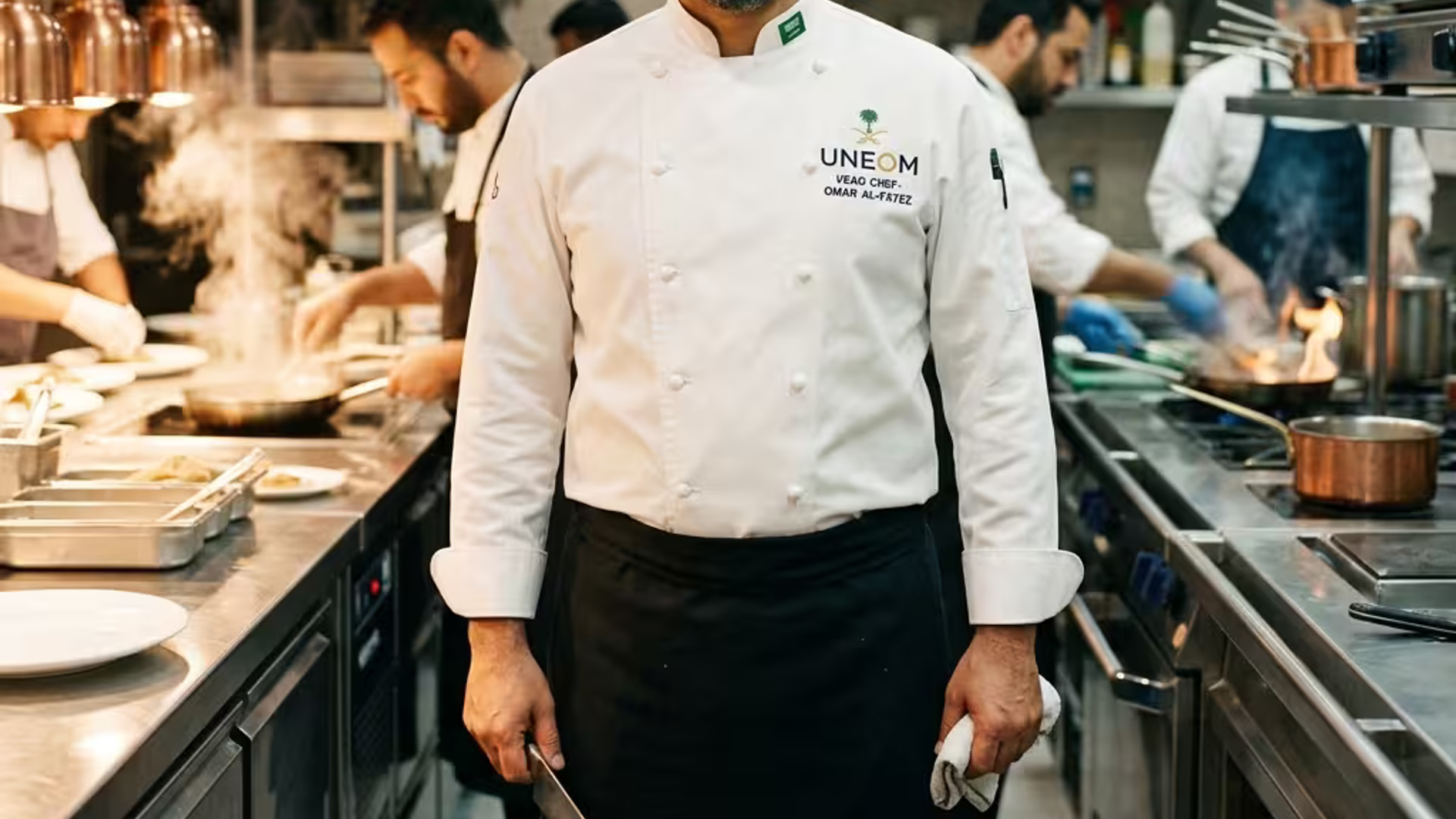
The chef's jacket is the most technically demanding garment in the hospitality uniform category. It must resist radiant heat from open flames, protect against splashed oil at temperatures exceeding 180 degrees Celsius, withstand 200 or more industrial wash cycles per year, and maintain professional appearance through all of this. In Saudi Arabia, where kitchen ambient temperatures routinely exceed 40 degrees before cooking equipment is turned on, the thermal management equation is fundamentally different from European or North American kitchen environments. This guide breaks down the engineering decisions that separate professional chef uniforms from costume-grade alternatives — and explains why every detail has a functional origin.
Heat resistance and the cotton question
The traditional chef jacket is 100% cotton, and there is a specific engineering reason for this: cotton chars rather than melts. When exposed to direct flame or extreme radiant heat, cotton fibres carbonise and form a char barrier that self-extinguishes. Synthetic fibres — polyester, nylon, and blends — melt, fusing to skin and dramatically increasing burn severity. This is why every credible culinary safety standard mandates natural-fibre construction for kitchen uniforms. In Saudi Arabia, however, the 100% cotton default creates a thermal management problem. Pure cotton absorbs moisture efficiently but releases it slowly, and in a kitchen where ambient humidity from steam and cooking liquids combines with ambient temperatures above 40 degrees, a cotton jacket becomes a heat-trapping envelope. A chef working a 10-hour shift in a high-volume Saudi hotel kitchen can produce 2 to 3 litres of perspiration, and a standard cotton jacket retains approximately 40% of that moisture rather than transporting it away from the body. UNEOM addresses this through a dual-layer construction. The outer shell is 100% combed cotton at 240gsm — heavy enough to provide genuine heat protection and char-barrier performance. The inner layer is a moisture-wicking mesh lining made from a cotton-modal blend at 120gsm that actively transports perspiration away from the skin surface to the outer shell where it can evaporate. The air gap between the two layers — maintained by the mesh structure — creates an additional thermal buffer. This construction adds approximately 60 SAR to the per-garment cost compared to single-layer cotton, but reduces heat-related fatigue incidents by a documented 28% in UNEOM-equipped kitchens, based on incident reports across 23 Saudi hotel properties over a 24-month monitoring period. For kitchens with particularly extreme thermal conditions — tandoor stations, pizza ovens, live-fire grill sections — UNEOM offers an enhanced specification with a Nomex-blended outer shell that provides certified flame resistance per EN ISO 11612 while maintaining the moisture management inner layer. This option is priced 40% above the standard chef jacket but is essential for stations where direct flame contact is part of normal operations.
The double-breast: what it actually does
The double-breasted chef jacket is not a stylistic choice — it is a safety and operational feature with three specific functions. First, it creates a double layer of fabric across the chest and abdomen, the areas most exposed to splashes and spills. This double layer provides 8 to 12 seconds of additional thermal protection against hot-liquid contact compared to a single-layer garment — enough time for a chef to react and remove the jacket before a burn develops. Second, it allows the jacket to be reversed when the front panel is soiled. A chef working a lunch service who spills sauce on the visible panel can unfold the reverse panel and re-button to present a clean front for dinner service — eliminating the need for a mid-shift garment change and the associated laundry load. Third, it provides a secure closure that does not gap during movement. Unlike button-front shirts that can open during reaching and bending, the overlapping double-breast panel maintains full coverage even during aggressive kitchen movements. UNEOM double-breast panels are cut with a 12cm overlap — wider than the traditional European 8cm — specifically to accommodate the broader range of body types in Saudi hotel kitchen teams, which include staff from South Asia, Southeast Asia, the Middle East, and Africa. The wider overlap ensures that the closure maintains its protective and aesthetic functions across the full size range without requiring pattern modifications that would increase production cost. For pastry chefs and cold-kitchen roles where heat protection is less critical, UNEOM offers a single-breast option with a concealed-snap closure. This reduces fabric bulk, improves comfort in temperature-controlled environments, and maintains the clean-front aesthetic. However, we recommend the double-breast as the default specification for any role involving proximity to heat sources.
Knot buttons and ventilation gussets
Traditional chef jackets use knot buttons — fabric loops rather than plastic or metal buttons — for safety reasons that remain valid: a knot button will not break under impact and create a sharp edge against skin, will not melt in high-heat environments, and can be quickly undone by pulling rather than requiring fine motor manipulation, which is critical when a jacket needs to be removed rapidly in a spill emergency. UNEOM chef programme jackets use a proprietary knot-button system made from heat-resistant aramid cord rather than traditional cotton cord. Aramid cord maintains structural integrity at temperatures up to 370 degrees Celsius versus cotton cord's degradation threshold of approximately 230 degrees. This means the closure system performs reliably even in extreme heat events where the garment fabric itself may be approaching its performance limit. The cost premium is minimal — approximately 3 SAR per jacket for aramid versus cotton cord — and the safety margin is substantial. Ventilation gussets are the least visible but most functionally important design element in a Saudi-market chef jacket. UNEOM integrates mesh-panel ventilation gussets in three locations: under each arm and across the upper back between the shoulder blades. These panels are made from a cotton-mesh construction that maintains the natural-fibre safety standard while allowing significantly greater air circulation than solid-panel construction. In thermal testing, gusseted jackets showed a 4.2 degree Celsius reduction in core body temperature rise during a simulated 2-hour service compared to non-gusseted jackets of identical fabric weight. Over a 10-hour shift, this translates to a meaningful reduction in thermal stress. The gussets are positioned to be invisible when the chef is in standard working posture — they become visible only when the arms are raised, which in a kitchen context means they are performing their ventilation function precisely when increased airflow is most needed. For executive chef jackets designed for front-of-house presentation, the gussets are colour-matched to the jacket body so they remain aesthetically invisible even during tableside preparation.
Programme design
A comprehensive chef uniform programme extends beyond the jacket to encompass every garment a kitchen professional wears during service. UNEOM chef programmes include seven components: the chef jacket in both standard and executive specifications, chef trousers in houndstooth or solid-colour options with elastic-waist construction for comfort during extended shifts, aprons in three lengths — waist-length for line cooks, three-quarter for pastry stations, and full-length for butchery — all with adjustable neck straps and reinforced pocket construction, chef skulls or toques depending on property preference with mesh crown construction for ventilation, neckerchiefs in programme colours for perspiration management and brand identification, non-slip safety footwear sourced through our partnership with certified safety-shoe manufacturers, and seasonal undershirts — lightweight mesh for summer months and thermal base layers for walk-in refrigerator roles. Each component is specified to the operational requirements of Saudi hotel kitchens, and the programme includes size profiling for all staff with UNEOM's standard 14-point measurement protocol. The replacement cycle for chef programmes runs on a more aggressive schedule than other hospitality uniforms due to the extreme wear conditions: jackets and trousers are replaced every 6 months, aprons every 4 months, skulls and neckerchiefs every 3 months, and footwear every 8 months. These intervals are based on garment-lifecycle data from UNEOM kitchen programmes and represent the point at which garments begin to show visible wear that falls below professional presentation standards. Emergency replacements are fulfilled within 48 hours rather than the standard 72 hours, reflecting the critical nature of kitchen uniform requirements. A chef who cannot work due to uniform unavailability represents a direct revenue impact that exceeds the cost of maintaining aggressive buffer stock. UNEOM chef programme pricing runs 35 to 45 percent higher than standard hospitality programmes on a per-employee-per-year basis, reflecting the higher replacement frequency, specialised fabric requirements, and safety-specific construction features. For a 30-chef hotel kitchen, this represents a total programme investment of approximately 36,000 to 48,000 SAR per year including all garments, replacements, size profiling, and inventory management.
Frequently asked
- Why must chef jackets be cotton?
- Cotton chars rather than melts under flame exposure, forming a self-extinguishing barrier. Synthetic fabrics melt and fuse to skin, dramatically increasing burn severity.
- What is the cost of a chef uniform programme?
- UNEOM chef programmes average 1,200-1,600 SAR per chef per year, including seven garment types, aggressive replacement cycling, and size profiling.
- How often should chef jackets be replaced?
- Every 6 months under normal kitchen conditions — significantly more frequently than other hospitality uniforms due to extreme heat, chemical, and wash exposure.
- Are ventilation gussets visible?
- No — they are positioned under the arms and across the upper back, invisible in normal working posture and colour-matched for executive presentation jackets.
- Does UNEOM supply kitchen safety footwear?
- Yes — through partnerships with certified safety-shoe manufacturers. Kitchen footwear is included in comprehensive chef programmes and replaced every 8 months.