Saudi Hotel Staff Uniforms: A Programme Manager's Guide
Front desk, F&B, housekeeping, concierge — five role-by-role specifications for Saudi luxury hotels.
Five-star Saudi hotels rotate uniforms every 8 months on average — and the majority of rotations are triggered by irreversible stain-set rather than structural wear. This pattern reveals a systemic design failure: most hotel uniform programmes specify for appearance without specifying for the chemical and physical stresses that each role actually encounters. A front-desk agent's uniform fails differently from a housekeeping uniform, which fails differently from an F&B server's. This guide provides the role-by-role specification framework that UNEOM delivers to property general managers evaluating their programmes — including what goes wrong first in each role and what to specify to extend garment life by 40 to 60 percent.
Front desk: presence over performance
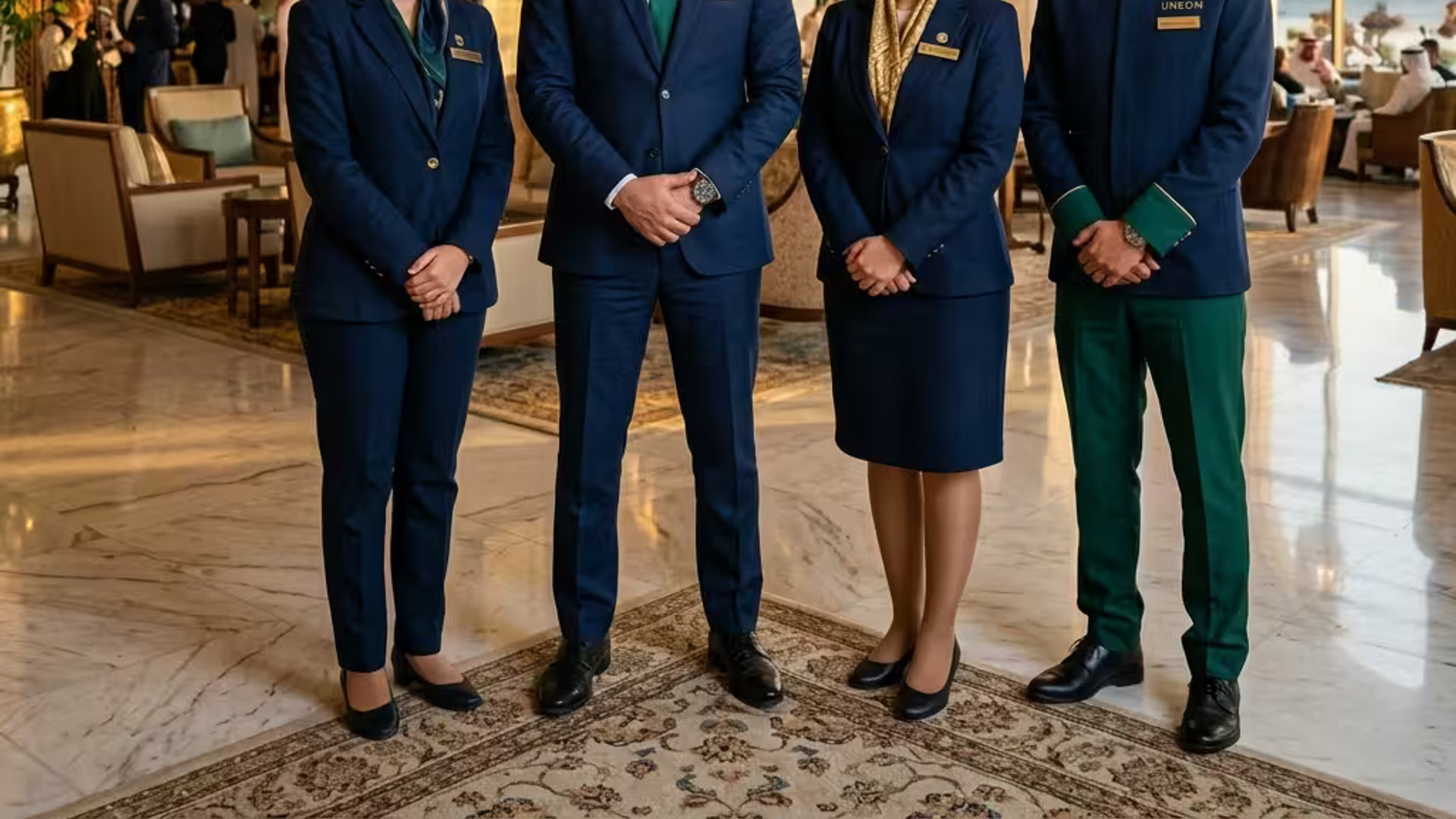
The front-desk uniform has the lowest physical-stress profile of any hotel role but the highest visual-stress profile. The garment spends 10 to 12 hours in direct guest line-of-sight, meaning any wrinkle, stain, or fit inconsistency is immediately visible. The primary failure mode is not fabric degradation but appearance degradation — wrinkle accumulation during long shifts, collar curling from perspiration and air-conditioning humidity cycling, and button-pull distortion at the chest from repetitive reaching across the reception counter. UNEOM's front-desk specification addresses these three failure modes through fabric selection, construction technique, and garment engineering. For fabric, we specify a wool-polyester blend at 60/40 ratio and 200gsm weight with a stain-shield nano-coating. The wool component provides natural wrinkle recovery — wool fibres have a molecular spring mechanism that returns the fibre to its original shape after deformation, reducing wrinkle accumulation by approximately 60% versus polyester alone. The polyester component provides dimensional stability, ensuring the garment maintains its shape through repeated laundering without the shrinkage that pure wool exhibits. The stain-shield coating prevents liquid absorption during the first 30 seconds of contact — enough time for a spill to be blotted rather than absorbed, preventing the stain-set that is the primary rotation trigger. For collar construction, we use a fused interlining with a thermoplastic adhesive that bonds at 165 degrees Celsius rather than the standard 140-degree bond. The higher bond temperature creates a more rigid interlining attachment that resists the curl-and-peel failure caused by humidity cycling between the air-conditioned lobby at 22 degrees and the outdoor entrance at 45 degrees. For button placement, we use a reinforced stress panel behind the front button band — a 3cm-wide strip of self-fabric fused to the garment body — that distributes the tension from reaching movements across a wider area, eliminating the puckering that signals a worn garment.
F&B: stain chemistry
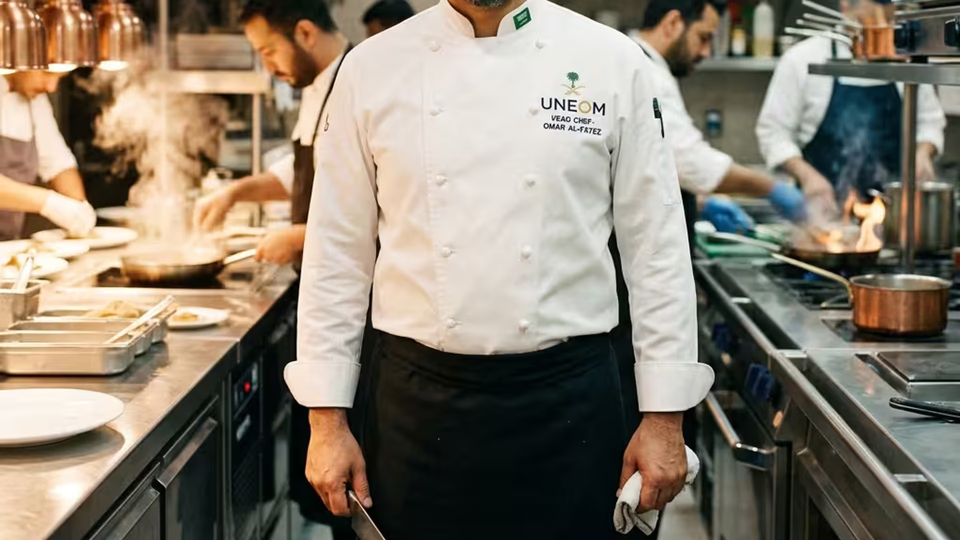
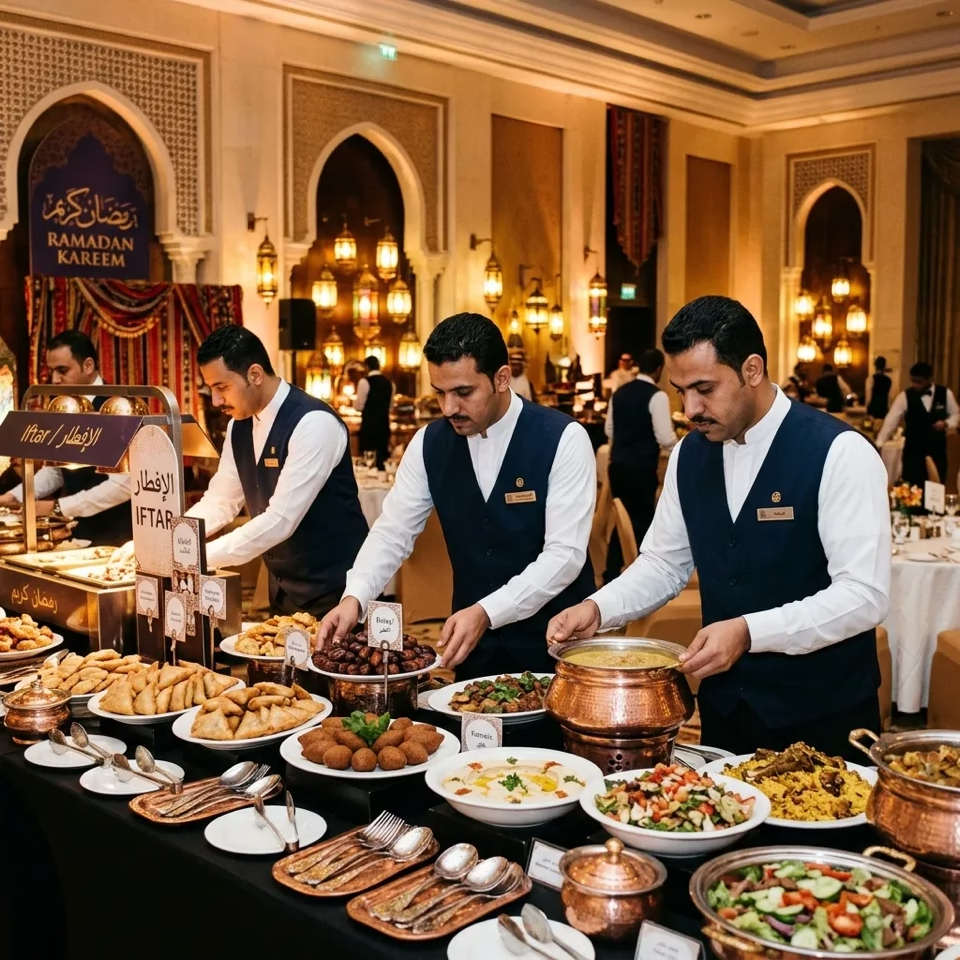
Food and beverage uniforms face the most chemically diverse stain environment in the hotel. A single shift exposes the garment to protein-based stains from meat and dairy, tannin-based stains from coffee and tea and red wine, oil-based stains from cooking fats and salad dressings, and pigment-based stains from turmeric and tomato and berry sauces. Each stain category requires a different chemical removal pathway, and a fabric that resists one category may be vulnerable to another. The critical insight that most uniform specifications miss is that stain resistance and stain removal are different engineering problems. A stain-resistant coating prevents absorption — the stain sits on the surface and can be wiped away. A stain-release treatment facilitates removal during laundering — the stain absorbs into the fabric but releases during the wash cycle rather than setting permanently. For F&B uniforms, both are needed because service staff encounter both splash stains that can be wiped and contact stains that cannot. UNEOM's F&B specification uses a dual-treatment approach: a fluorocarbon-free stain-resistant coating on the outer face that causes liquid stains to bead and roll off, combined with a hydrophilic stain-release treatment on the inner fabric structure that facilitates removal of absorbed stains during standard-temperature laundering at 60 degrees. This dual approach extends garment life from the industry average of 6 months to UNEOM's documented average of 11 months for F&B staff — nearly doubling the replacement cycle and reducing annual programme cost per employee by approximately 35%. Colour selection for F&B uniforms is strategically important. Black is the traditional default but shows every lint particle, water spot, and chemical residue from cleaning agents. UNEOM recommends dark charcoal over black — visually similar in ambient restaurant lighting but significantly more forgiving of surface contamination — and specifies colour-matched thread and buttons so that minor colour variance from fabric ageing does not create a patchwork appearance.
Housekeeping: the fabric stress everyone underestimates
Housekeeping uniforms endure more physical stress per shift than any other hotel role, and most uniform programmes dramatically underspecify for these conditions. A housekeeper performing 14 to 16 room turnovers per shift repeats the same bending, reaching, kneeling, lifting and twisting patterns hundreds of times: bending, reaching, kneeling, lifting, and twisting. Each movement creates friction and tension at specific garment stress points — underarm seams, knee reinforcement zones, the lower back panel, and the waistband closure. The result is seam failure, fabric thinning, and elastic degradation at rates 3 to 4 times faster than front-of-house garments. UNEOM's housekeeping specification addresses this through three engineering approaches. First, stress-mapped construction: we identify the 12 highest-stress points on the housekeeping garment and apply targeted reinforcement at each — double-stitched seams with bar-tack anchors at the underarm, triple-stitched gussets at the knee, and reinforced panels at the lower back and hip where tool belts and supply caddy straps create localised friction. This stress-mapping approach adds approximately SAR 18 to the per-garment cost but extends average garment life from 5 months to 9 months — a net cost reduction when replacement frequency is factored in. Second, stretch-woven fabric: we specify a cotton-spandex blend at 97/3 ratio and 180gsm weight that provides 15% mechanical stretch in all directions. The stretch component absorbs movement forces that would otherwise be transferred to seams, reducing seam stress by approximately 40% and virtually eliminating the split-seam failures that are the primary housekeeping garment failure mode. Third, moisture-management construction: housekeeping staff in Saudi hotels work in environments that alternate between aggressively air-conditioned guest rooms at 18 to 20 degrees and unconditioned service corridors at 35 to 40 degrees. This thermal cycling creates rapid perspiration-and-chill sequences that standard cotton handles poorly. The stretch-woven blend incorporates moisture-wicking yarns in the inner face that transport perspiration away from the skin surface, preventing the clammy discomfort staff report during winter months when the indoor-outdoor temperature differential is most extreme.
Concierge: the brand conversation
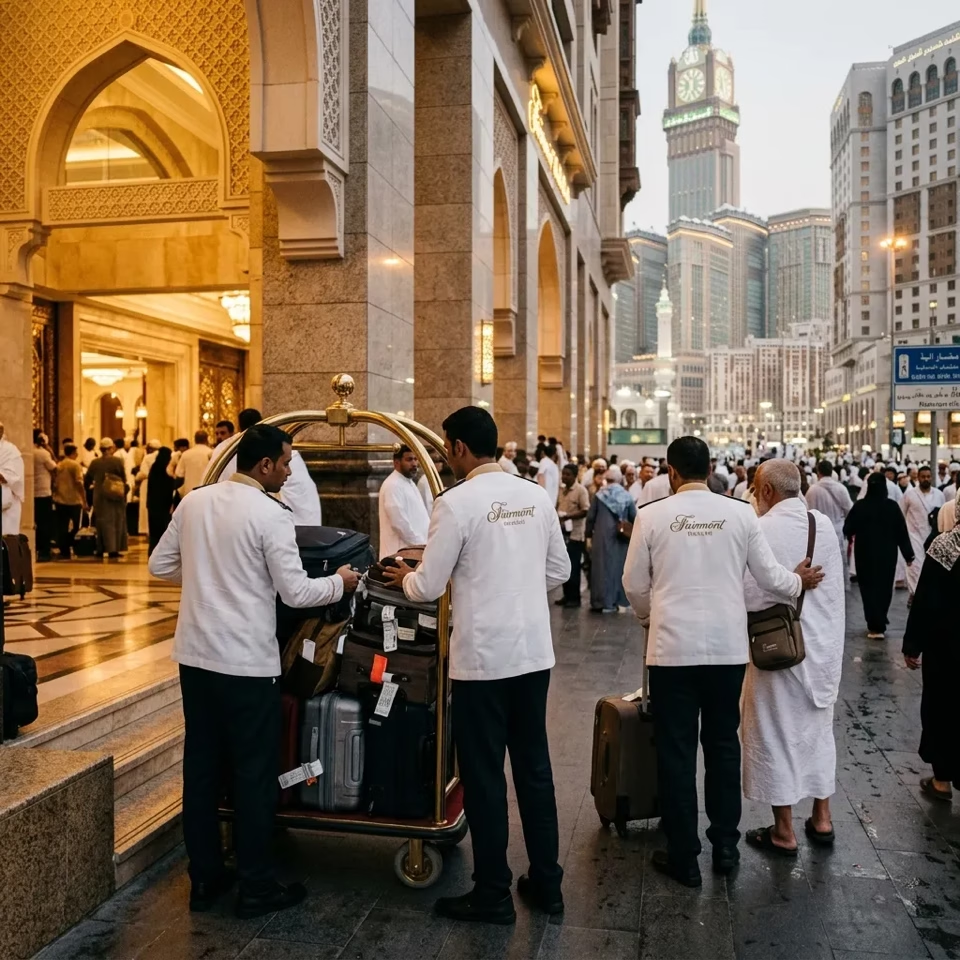
The concierge uniform occupies a unique position in the hotel uniform hierarchy: it must simultaneously convey personal authority, brand sophistication, and approachability. Unlike the front-desk agent who operates behind a physical barrier, the concierge works in open space — standing beside guests, walking through the lobby, escorting visitors to vehicles. The uniform is seen in full-body view, in motion, and at close range, making every detail visible and consequential. UNEOM's concierge specification is the highest-grade garment in the hotel programme, using fabrics and construction techniques that would be cost-prohibitive for high-volume roles but are justified by the concierge's brand-ambassador function. The jacket is constructed from a Super 120s wool-cashmere blend at 280gsm — a fabric weight that provides structure without stiffness, draping naturally during movement rather than creasing. The cashmere component adds a tactile luxury that guests perceive at handshake distance — a subtle but measurable brand signal. Lining is Bemberg cupro rather than polyester, providing superior moisture management and a cooler hand against the skin during the Saudi summer months when the concierge moves between the air-conditioned lobby and the outdoor porte-cochere. The trouser specification uses the same wool blend with a lighter construction at 220gsm and a concealed elastic waistband panel that accommodates the slight size variation that occurs during a 10-hour shift without requiring belt adjustment — maintaining a clean front line throughout the shift. Seasonal variation is built into the concierge specification: a summer-weight version at 220gsm jacket and 180gsm trouser, and a winter-weight version at 280gsm jacket and 220gsm trouser. Both versions use the same wool-cashmere blend, the same colour, and the same construction details, so the visual consistency is maintained year-round and the seasonal swap is invisible to guests.
Programme economics
The economics of a hotel uniform programme are best understood as a per-employee-per-year investment rather than a per-garment purchase price. This framing captures the total cost including initial garments, replacement cycling, alterations, and programme management — and allows direct comparison to the revenue impact of staff presentation quality. UNEOM's hotel programme pricing breaks down by role category. Front-desk and concierge fall in the premium tier at SAR 1,400 to 1,800 per employee per year, reflecting higher fabric grades, more complex construction, and lower replacement frequency of 10 to 12 months. F&B service falls in the mid tier at SAR 900 to 1,200 per employee per year, reflecting the dual stain-treatment specification and 8 to 11 month replacement frequency. Housekeeping falls in the performance tier at SAR 700 to 900 per employee per year, reflecting stress-mapped construction with higher replacement frequency of 6 to 9 months. Kitchen staff follow the chef programme specification at SAR 1,200 to 1,600 per employee per year due to safety-specific construction and aggressive 4 to 6 month replacement cycling. For a typical Saudi five-star hotel with 40 front-of-house staff, 60 F&B staff, 80 housekeeping staff, and 30 kitchen staff, the total annual programme investment ranges from SAR 195,000 to 258,000 — approximately SAR 930 to 1,230 per employee per year blended across all roles. This investment represents 0.3 to 0.4% of the hotel's annual revenue at typical Saudi five-star occupancy levels — a fraction of the marketing budget but with a measurably higher impact on guest satisfaction scores. The programme contract structure includes built-in cost efficiency mechanisms: volume pricing across the full programme rather than individual role pricing, consolidated sizing data that reduces alteration rates from the industry average of 28% to UNEOM's 6%, and scheduled replacement cycling that eliminates emergency procurement at premium prices. Over a three-year programme contract, these efficiencies typically deliver 12 to 18% total cost reduction compared to annual purchase-order procurement of equivalent-quality garments.
Frequently asked
- Which fabric is best for hotel front-desk uniforms?
- Wool-polyester blend at 60/40 ratio with stain-shield nano-coating — handles Saudi humidity cycling and provides natural wrinkle recovery that polyester alone cannot match.
- How often should hotels rotate uniforms?
- Varies by role: 10-12 months for front desk, 8-11 months for F&B with dual stain treatment, 6-9 months for housekeeping. UNEOM programmes plan these cycles into annual budgets.
- Can UNEOM colour-match to property identity?
- Yes — spectrophotometer-verified Pantone matching across the full programme, with batch-to-batch variance below Delta E 1.0 including thread-level brand control.
- Are Hajj-season programmes different?
- Yes — Hajj-line uniforms use 60/40 cotton-poly at two-ply construction, tested to 120 wash cycles at 75°C for the seven-week intensive service window.
- What is the total annual cost for a hotel programme?
- For a 210-staff five-star property: SAR 195,000 to 258,000 annually — approximately SAR 930-1,230 per employee per year blended across all roles.