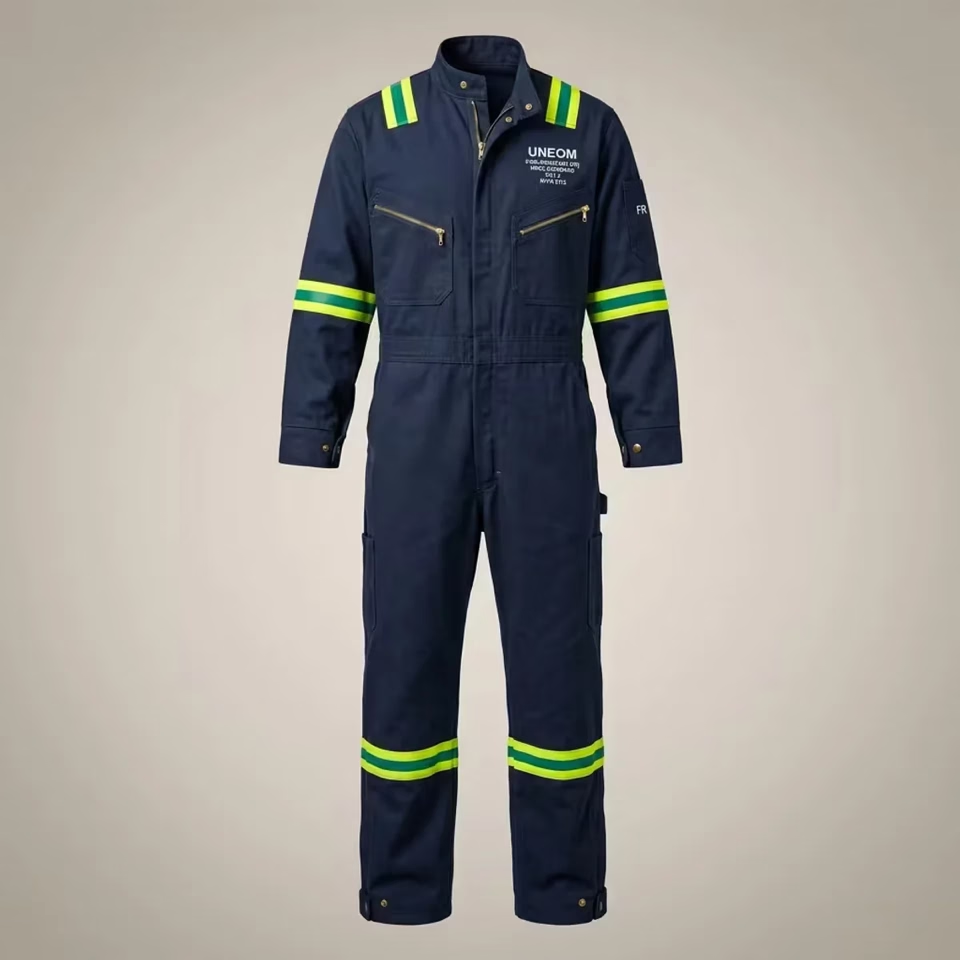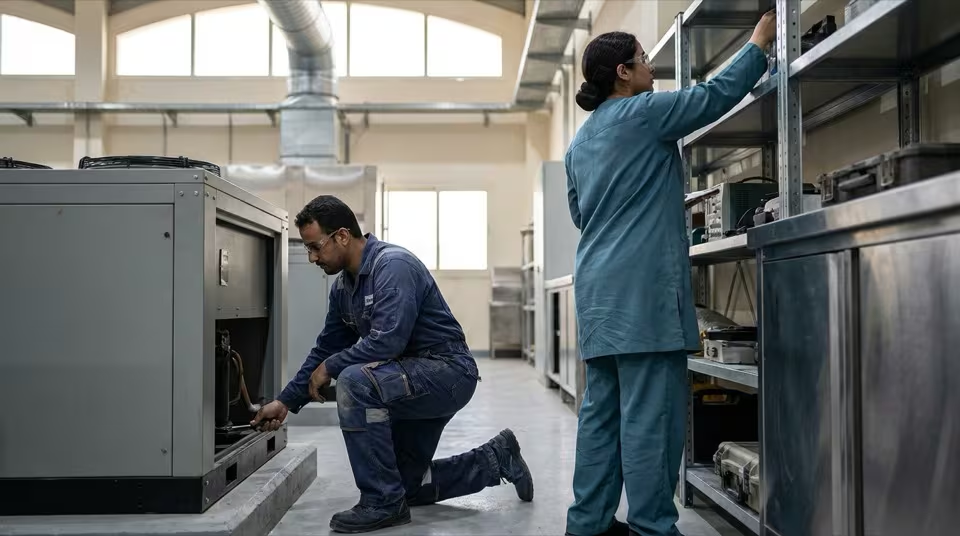
Why Uniforms Fade in the Saudi Sun: The Science of UV Colour Loss
Ultraviolet light breaks dye molecules apart. Here is why outdoor uniforms lose colour in Saudi conditions, how light and wash fastness differ, and how to specify better.
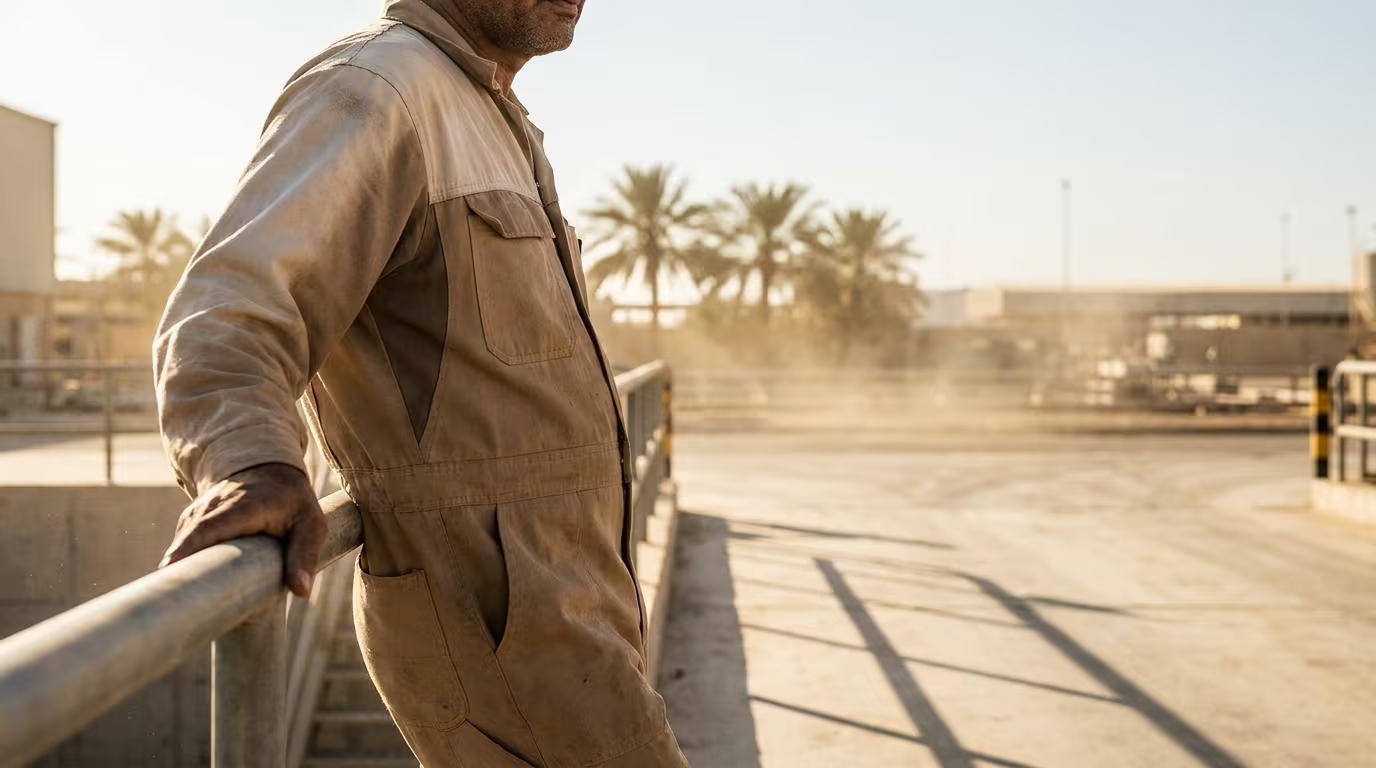
A navy shirt issued in March looks bronzed by September, two production lots no longer match on the same site, and someone is asked to explain why. Fading is not neglect. It is photochemistry, accelerated by Saudi exposure conditions, and it can be specified against far more effectively than most tenders attempt.
What Fading Really Is
Fading is not soiling and it is not wear in the mechanical sense; it is a chemical event that happens at the scale of a single molecule. Colour comes from the chromophore, the part of the dye whose bonding arrangement absorbs some wavelengths of light and reflects the rest back to your eye. Ultraviolet photons carry considerably more energy than visible ones, and when that energy lands on the chromophore it can break or rearrange the bonds the colour depends on. The molecule remains in the cloth as matter, but it stops functioning as colour. Heat, oxygen and moisture accelerate everything, because an excited dye molecule can hand its energy to oxygen and create reactive species that attack the dye and, in time, the fibre around it. That is why a badly exposed garment often looks chalky and feels weaker in the same season. Nothing has washed out. The dye is still there; it has simply stopped doing the one job it was made to do.
Why the Saudi Sun Is a Harder Test
Every outdoor uniform in the world meets ultraviolet light. What makes the Kingdom unusual is the combination of factors that arrive together and rarely let up. Skies are clear for most of the year, so exposure is direct rather than diffuse; daylight hours are long; and the sun sits high enough for much of the day that horizontal surfaces, shoulders, caps and the tops of sleeves take the heaviest dose. Sand, pale concrete and light paving reflect additional ultraviolet upward, so the underside of a garment is not fully sheltered either. Then there is heat: a dark fabric in direct sun runs far hotter than the air around it, and higher temperature speeds up almost every degradation reaction. Add perspiration salts, which sit in the cloth and change its local chemistry; fine airborne dust that abrades dyed surface fibres; and the very common practice of drying garments outside in full sun. None of these alone would be decisive. Together, they compress years of ordinary fading into a small number of Saudi summers.
Why Some Colours Surrender First
Procurement teams notice the pattern long before anyone explains it: the same order, issued on the same day, ages unevenly by role and by shade. Part of that is dose, since the yard team simply receives more sunlight than the workshop team. Part of it is chemistry. A deep shade carries a heavy load of dye and absorbs a great deal of the energy that reaches it, and it also runs hotter in the sun, which is why saturated navies, blacks and reds so often draw complaints. Many of those shades are not a single dye but a blend of two or three, and if one component degrades faster than the others the garment does not simply go paler, it changes hue: navy drifting bronze or purple, black turning brown. That shift is far more visible than uniform lightening, because the eye compares garments side by side. Fluorescent high-visibility colours deserve separate treatment; brightness is intrinsic to their safety function, and their standards treat colour retention as a safety property rather than an aesthetic one.
Light Fastness Is Not Wash Fastness
Colourfastness is not one number. It is a family of separate properties, each measured by a different method, and a fabric can be strong in one and ordinary in another. Fastness to light is assessed by exposing a specimen to a controlled artificial light source alongside reference materials and judging the change; fastness to washing is assessed by putting a specimen through a defined laundering cycle with a companion fabric to see whether colour is lost or transferred. There are further tests for rubbing, perspiration and, in some programmes, sequences that combine laundering with light exposure to imitate real service. This matters commercially, because a supplier who says the fabric is colourfast has told you almost nothing. Ask which property, tested by which method, and assessed against which reference scale, and ask for the actual report rather than a claim. The right grade for a given role is a decision for you, your test house and your risk assessment; it is not a universal number anyone can quote you over the phone.
Where Durability Is Really Decided
Fastness is a property of the specific dye and how it was applied, not of a fibre family as a whole, so treat any blanket ranking with suspicion. That said, structure matters. Disperse dyes sit inside polyester; reactive dyes bond chemically to cotton; vat dyes are formed inside the cotton fibre and have long been favoured where hard service and heavy laundering are expected. Solution-dyed or dope-dyed yarns take a different route again: pigment is added to the polymer before the fibre is extruded, so the colour is distributed through the filament rather than applied to its surface, which is why the approach is common in demanding outdoor textiles. Blends complicate the picture, because a polycotton is effectively two dye systems ageing at different rates in the same garment. Finishes add another layer: ultraviolet absorbers and certain softeners, optical brighteners and residual alkalinity from laundering can all shift outcomes. The honest answer is that the specification, the dye selection and the laundry protocol have to be designed as one system.
Specifying for Outdoor Roles
Start by telling the supplier the truth about exposure: which roles are outdoors, for how much of the shift, in which season, and whether garments are line-dried in the sun. A fabric chosen for an indoor role and then issued to a yard crew was never going to hold. Require documented light fastness testing to a named method, ask for the report, and hold a sealed reference sample so that batch two can be judged against batch one rather than against memory. Specify shade continuity across production lots in the contract, because most fading complaints in practice are really shade-matching complaints. Run a wear trial through one full summer with a control set kept indoors, and photograph both under the same lighting. Set a replacement trigger based on appearance and, for high-visibility garments, on the safety standard rather than on a fixed number of months. At UNEOM we manufacture inside the Kingdom, and have done since 2013, which shortens the loop between a shade complaint and a corrected production run.
Frequently asked
- Why do two garments from the same order fade at different rates?
- Usually because they receive different doses. A yard technician's shirt sees far more hours of direct sun than a storekeeper's. Laundry routine matters too: sun-drying, bleach and high temperatures all add stress. Shade and dye system can also differ between production lots, which is why a sealed reference sample and lot continuity belong in the contract.
- Is fading caused by sunlight alone, or does laundering matter?
- Both, and they interact. Light breaks down the dye molecule, while laundering removes loosely held dye, strips finishes and can leave alkaline residues that make the fabric more vulnerable to the next exposure. Chlorine bleach and drying garments in direct sun are the two habits that most often turn a manageable problem into a visible one.
- Are dark colours always the wrong choice outdoors?
- Not always, but they carry more risk. Deep shades absorb more energy and run hotter, and they are often built from several dyes that can degrade at different rates, producing a visible hue shift. If corporate identity requires a dark colour, put the effort into dye selection, tested light fastness and lot-to-lot shade continuity instead of changing the palette.
- Can a finish or treatment stop fading completely?
- No. Ultraviolet absorbers and protective finishes can slow the reaction, and a well-chosen dye system helps far more, but no textile keeps its original shade indefinitely under Saudi sun. Treat fading as a rate to be managed through specification, laundry protocol and a planned replacement cycle, not a defect that can be eliminated.
- What should a tender actually ask for?
- Ask for the fastness properties you care about, each named with its test method, supported by an actual laboratory report rather than a claim, plus written shade tolerance between production lots and a retained sealed sample. Set the required grade with your test house. Certifications such as ISO 9001:2015 and OEKO-TEX Standard 100 address quality management and tested human-ecological safety, not colour retention.