Industrial Coverall Specifications: FR Rating, Hi-Vis, and HCIS Compliance
HRC1 vs HRC2 vs HRC3, inherent vs treated FR, ATPV ratings decoded, QR-based garment serialisation, and why switching to inherent FR extends coverall lifespan by 71%.

In Al-Jubail's petrochemical corridor, ambient temperatures exceed 50°C for five months of the year. Coveralls must protect against arc flash, radiant heat, and chemical splash — simultaneously. The wrong specification doesn't just fail an audit; it fails a worker. This guide provides the technical framework for specifying industrial coveralls: flame resistance ratings, hi-visibility classifications, fabric weight optimisation for Saudi heat, and the digital serialisation systems that transform HCIS audit compliance from a 2-day administrative burden into a 30-minute digital scan.
HRC1 vs HRC2 vs HRC3: which rating fits your environment
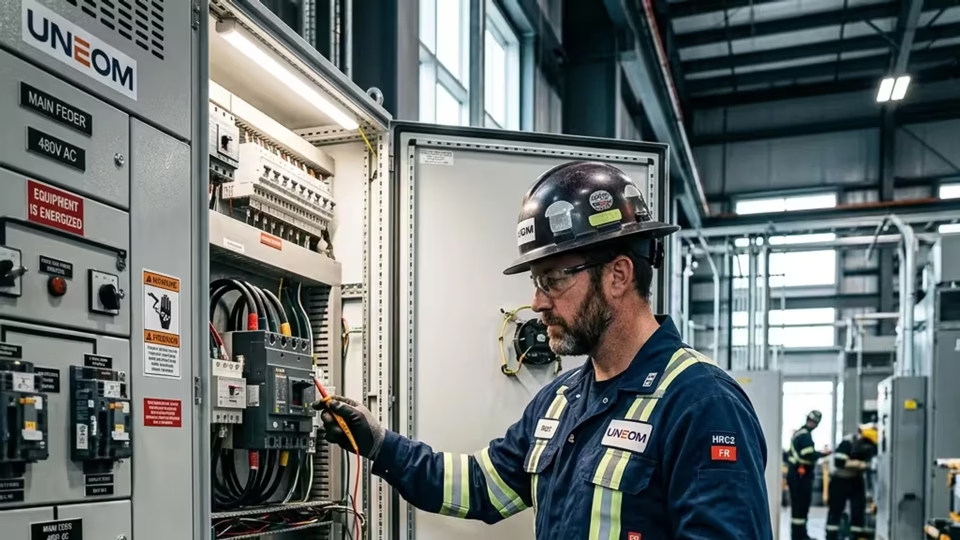
The Hazard Risk Category (HRC) system, defined by NFPA 70E, classifies arc flash exposure levels and the minimum protection each requires. HRC1 (ATPV ≥4 cal/cm²): suitable for low-energy environments — switchgear operation, light maintenance, and testing where arc flash energy is limited. Typical fabric: single-layer FR cotton at 200 gsm. HRC2 (ATPV ≥8 cal/cm²): the standard specification for petrochemical processing, refinery operations, and electrical utility work. This is the rating UNEOM deploys across 60+ industrial clients in the Eastern Province. Typical fabric: single-layer inherent FR cotton at 260 gsm, or dual-layer treated FR for environments requiring additional thermal insulation. HRC3 (ATPV ≥25 cal/cm²): high-energy environments — live-line electrical work, transformer maintenance, and high-voltage switching. Requires multi-layer FR systems (base layer + coverall + outer jacket). Rarely specified as a single coverall. The most common procurement error: specifying HRC1 for environments that require HRC2 — typically because the lower rating is cheaper. A hazard analysis (required under NFPA 70E) determines the actual arc flash energy at each task position and dictates the minimum HRC rating.
Inherent FR vs treated FR: the molecular difference
This distinction determines whether your coveralls will protect workers on day 500 as effectively as they did on day 1. Treated FR: a conventional cotton or poly-cotton fabric that receives a chemical flame-retardant treatment after weaving. The treatment — typically a phosphorus-based compound — coats the fibres and provides FR properties. The problem: the treatment degrades with washing, UV exposure, and heat exposure. In Saudi petrochemical environments (50°C+ ambient, aggressive industrial detergents), treated FR coveralls show measurable ATPV degradation of 35–40% after 10 months of service. Inherent FR: a fibre where flame resistance is an intrinsic property of the molecular structure. The FR capability cannot be washed out, degraded by UV, or diminished by heat. After 500 industrial wash cycles, inherent FR fabric shows ATPV degradation of less than 3%. The cost difference: inherent FR coveralls cost approximately 45% more per unit than treated FR. The lifespan difference: inherent FR lasts 24 months vs 14 months for treated FR under identical Saudi industrial conditions — a 71% improvement. Over a 48-month period, inherent FR is 22% cheaper per worker when replacement frequency is factored in.
Hi-Vis classification: EN ISO 20471 Class 2 vs Class 3
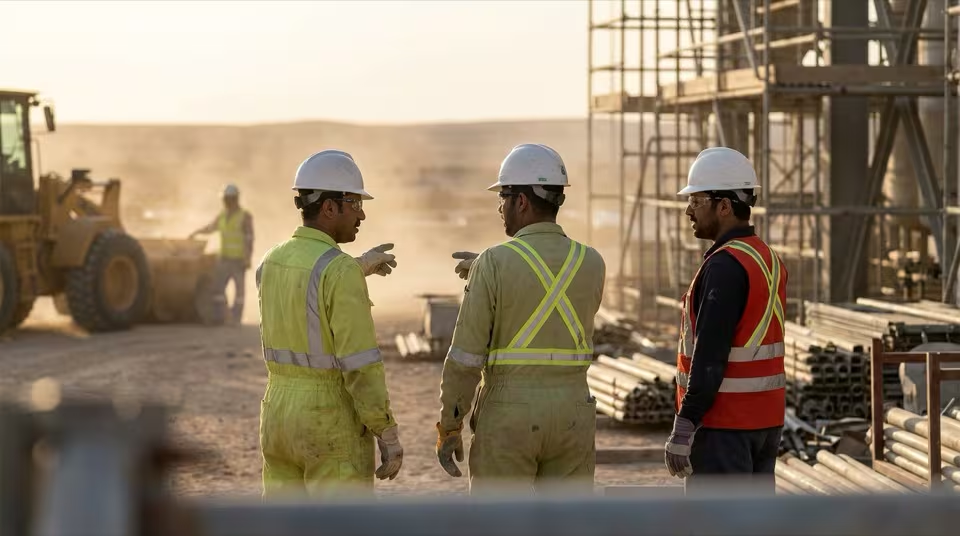
High-visibility clothing classification under EN ISO 20471 is determined by the minimum area of fluorescent and retroreflective material. Class 2 (minimum 0.5 m² fluorescent, 0.13 m² retroreflective): standard for controlled industrial environments — plant floors, construction sites with restricted vehicle access, and warehouse operations. Class 3 (minimum 0.80 m² fluorescent, 0.20 m² retroreflective): required for high-risk environments — roadside operations, port terminals, airport tarmacs, and any environment where workers share space with moving vehicles or heavy machinery. The compliance detail most frequently missed: retroreflective tape placement must provide 360° visibility — meaning reflective bands on torso, arms, and legs must be visible from every angle. A coverall with reflective tape only on the chest fails EN ISO 20471 regardless of total tape area. UNEOM hi-vis coveralls use 50mm retroreflective tape (3M Scotchlite 8906 series) in the following configuration: two horizontal torso bands (chest and waist), two arm bands (bicep level), and two leg bands (above knee). This configuration exceeds Class 3 minimum requirements and has passed HCIS audit at all 60+ industrial client sites.
ATPV decoded: what the numbers actually mean
Arc Thermal Performance Value (ATPV) is the incident energy level (measured in calories per square centimetre) at which the fabric has a 50% probability of causing a second-degree burn. Higher ATPV = more protection. But the number alone is misleading without context. An ATPV of 8 cal/cm² (HRC2 minimum) means the fabric will prevent second-degree burns from an arc flash event generating up to 8 cal/cm² of incident energy. But ATPV is tested on new fabric. After 200 industrial wash cycles, a treated FR fabric with an original ATPV of 10 cal/cm² may have degraded to 6.5 cal/cm² — below HRC2 compliance. Inherent FR fabric with the same original ATPV will measure 9.7 cal/cm² after 200 cycles. This is why UNEOM tracks ATPV at intervals throughout the garment lifecycle using the serialisation system. At every 50-cycle checkpoint, a sample from the production batch is destructively tested. If batch ATPV falls below the rated threshold, the entire batch is flagged for retirement. Over 18 months of tracking across 1,950 garments, zero inherent FR garments have been retired for ATPV degradation — compared to 23% of treated FR garments in a comparison programme.
Digital serialisation: QR and RFID garment tracking
Per-garment serialisation transforms PPE compliance from a documentation burden into a digital system. Every UNEOM industrial coverall receives a unique serial number embedded in a heat-sealed, chemical-resistant QR-coded label stitched into the inner collar. The QR code links to a cloud-based garment profile tracking: issue date, assigned worker ID, wash cycle count (updated via the industrial laundry's RFID readers), incident exposure history, ATPV batch certification data, and scheduled retirement date. For large programmes (200+ workers), the RFID option adds passive UHF tags embedded in the garment that are automatically read by laundry portal scanners — eliminating manual wash-count entry entirely. The operational impact on HCIS audits: audit preparation time drops from 2 days (manual paper documentation) to 30 minutes (digital scan and report generation). Auditors scan any garment in the field to access its complete lifecycle data — current FR certification status, remaining lifecycle, and compliance history. The system also triggers proactive alerts: garments approaching the maximum wash-cycle threshold (350 cycles for inherent FR) generate automatic retirement notifications to the programme manager 30 days before the deadline.
Cost study: inherent FR saves 71% in garment lifecycle
The procurement decision between treated and inherent FR is not a per-unit cost decision — it is a programme lifecycle decision. For a 450-worker petrochemical site over 48 months: Treated FR programme: SAR 280/coverall × 3.4 replacements per worker (14-month cycle) × 450 workers = SAR 428,400. Plus: 23% of garments retired early for ATPV degradation (additional SAR 98,532 in unplanned replacements). Total: SAR 526,932. Inherent FR programme: SAR 410/coverall × 2.0 replacements per worker (24-month cycle) × 450 workers = SAR 369,000. Plus: 0% early retirement for ATPV degradation. Total: SAR 369,000. Net saving: SAR 157,932 (30%) over 48 months. But the financial case is secondary to the safety case. Treated FR's 35–40% ATPV degradation after 10 months means that workers are wearing garments with compromised protection for 4 months before replacement — a window during which a near-miss becomes an injury. Inherent FR eliminates this window entirely. UNEOM's recommendation: inherent FR for all petrochemical, refinery, and high-voltage environments. Treated FR remains appropriate for lower-exposure settings (warehouse maintenance, light manufacturing) where wash cycles are less aggressive.
Frequently asked
- What is the difference between HRC and ARC ratings?
- HRC (Hazard Risk Category) and ARC (Arc Rating Category) are functionally equivalent classification systems from different editions of NFPA 70E. Both use the same ATPV thresholds. Current NFPA 70E uses the ARC terminology, but HRC remains widely used in Saudi industrial procurement.
- How often should FR coveralls be replaced?
- Inherent FR: every 24 months under Saudi petrochemical conditions (50°C+, industrial wash cycles). Treated FR: every 14 months. UNEOM's serialisation system tracks actual garment condition and triggers retirement alerts based on wash-cycle data.
- Does UNEOM coveralls meet HCIS requirements?
- Yes. All UNEOM industrial coveralls are HCIS-compliant. Over 18 months across 60+ industrial clients, UNEOM programmes have maintained zero non-conformities in quarterly HCIS audits.
- Can you supply Aramco-specification coveralls?
- UNEOM supplies HRC2-rated inherent FR coveralls that meet the safety specifications required by major Saudi petrochemical operators. Contact our industrial division for specific programme requirements and compliance documentation.
- What is the lead time for industrial coverall programmes?
- Standard programme: 21 days including on-site fitting and safety certification. Large-scale migrations (200+ workers): 14 weeks for phased rollout across multiple plant zones. Emergency joiner kits: 48-hour dispatch from regional buffer stock.