Heat Stress Workwear for Saudi Summer: What Clothing Can't Fix
How clothing actually interacts with heat load in a Saudi summer — evaporation, air permeability, fit and airflow, colour and radiant load — and where the fabric's contribution ends. Includes what to write into a specification, how to trial it, and which supplier claims should end the conversation.
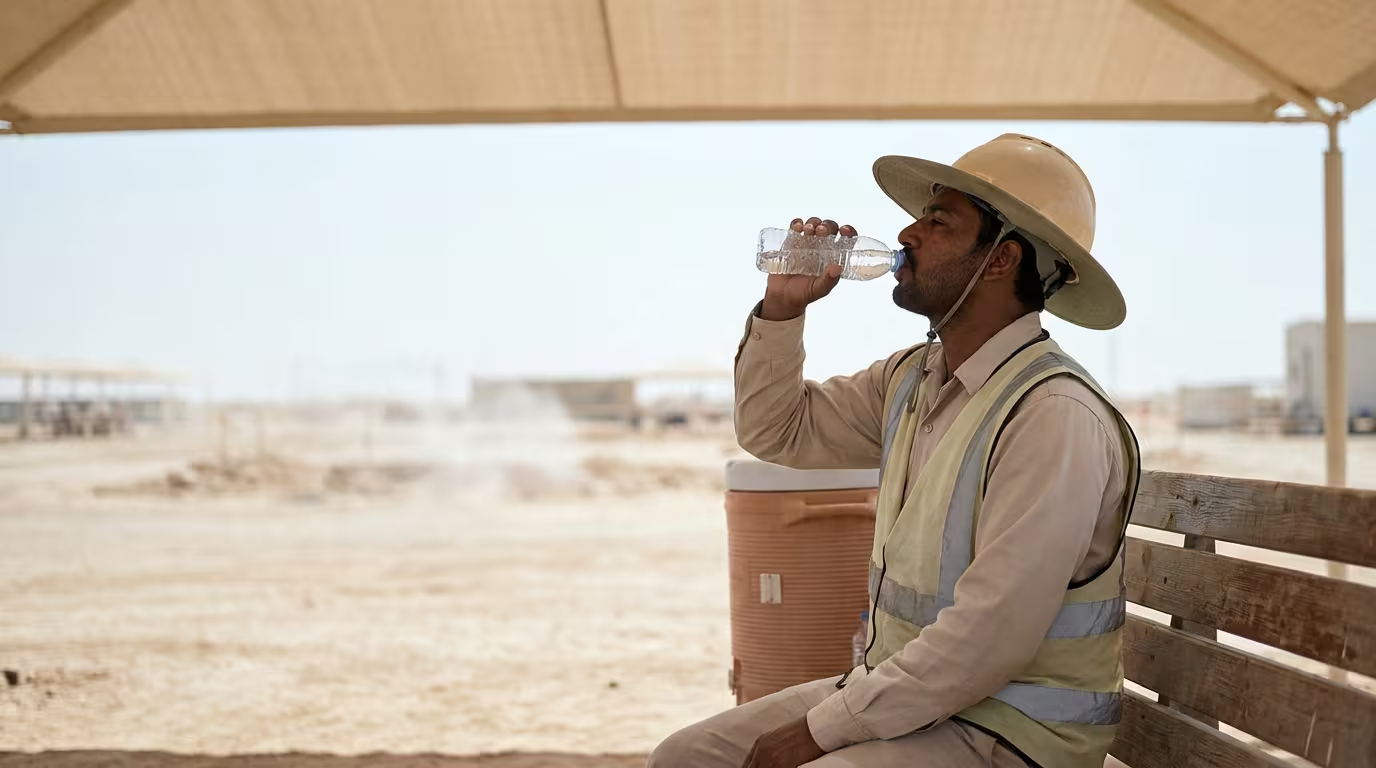
By late morning in June, the argument on site is always the same. Crews want lighter shirts. Safety wants sleeves down and vests on. Procurement wants one garment that works all year. Everyone is partly right, and everyone is overestimating what fabric can do. Clothing changes how fast a working body sheds heat by a margin worth having — but it is the last and weakest layer of heat control, and it is the one most often asked to do the work of the others.
Clothing Is the Last Control, Not the First
Start with the uncomfortable part: no uniform prevents heat stress. Not the lightest fabric on the market, not the most expensive moisture-management finish, not any garment we or anyone else manufactures. Clothing modifies how quickly a body sheds heat. It does not manage the heat load, and it cannot substitute for the controls that do. Those controls are unglamorous and well established in occupational practice: scheduling work away from the hottest part of the day, shaded rest areas, rest cycles that are enforced rather than optional, drinking water within a short walk of the task itself, acclimatisation for new and returning workers, supervisors trained to notice a worker whose performance has started to change, and a plan for what happens when someone is in trouble. In the Kingdom, the summer prohibition on outdoor work under the midday sun is the clearest expression of that logic: the control is the schedule, not the shirt. Uniform sits below all of that. Its real value is closer to negative than positive — a badly chosen garment makes an already difficult thermal situation worse, and pushes workers into opening fronts, discarding vests or defeating protective equipment. Getting workwear right mostly means not adding an unnecessary burden. Read what follows on that basis. It is about reducing the penalty clothing imposes, not about buying protection. Your heat-stress programme belongs to your safety function and your occupational health adviser; no procurement decision replaces it.
Four Heat Paths, and Where the Garment Interferes
The body loses or gains heat by radiation, convection, conduction and evaporation. In a Saudi summer, two of those flip direction. When air temperature rises above skin temperature, moving air stops cooling the body and starts heating it. Under direct sun, radiation adds load rather than removing it. That leaves evaporation of sweat as the dominant route by which a working body sheds heat outdoors — which is why clothing decisions in this climate are, before anything else, decisions about moving water vapour away from the skin. That single fact resolves most of the confusion in workwear marketing. A garment helps when it lets vapour leave the thin microclimate trapped between skin and fabric and reach the surrounding air, and when it lets air exchange refresh that microclimate. It hurts when it holds saturated air against the skin, because a humid layer stops sweat evaporating no matter how much of it the worker produces. Sweat that drips instead of evaporating costs the body water without cooling it. There is a second and competing job: shielding skin from solar radiation. Bare skin under direct sun absorbs more than covered skin, so covering up is thermally useful outdoors even though it slows evaporation. The two effects pull in opposite directions, and the resolution is not more fabric or less fabric. It is fabric and a cut that cover while still letting air and vapour move — a construction and fit problem far more than a fibre problem.
Fibre, Construction and the Moisture Story
Fibre content gets the marketing attention; fabric construction usually decides the result. Two shirts of the same blend can behave very differently depending on yarn, weave and mass per unit area. A dense twill built for abrasion resistance is a different thermal object from an open plain weave or a ripstop in the same fibre. Still, fibre matters in specific ways. Cotton absorbs a great deal of moisture and holds it, which keeps a damp layer against the skin and adds weight, but also means the fabric stays wet and keeps evaporating for longer. Worth correcting a persistent myth here: cotton gains strength when wet, it does not lose it. Polyester absorbs very little, dries faster and moves liquid along fibre surfaces, but it can feel clammy when saturated and it holds odour — which matters in fleets that are laundered in bulk. Polyester-cotton blends dominate industrial workwear because they compromise on both sides. Regenerated cellulosics are not one family for this purpose. Lyocell holds its strength well when wet, which is part of why it survives hard washing. Viscose is the fibre that loses a large share of its strength when wet, and it belongs nowhere near heavy industrial workwear regardless of how cool it feels in a showroom. Where flame resistance, arc protection or chemical protection is required, comfort is optimised inside the protective specification, never against it. That specification is owned by your safety function.
Fit and Airflow: The Most Under-Bought Variable
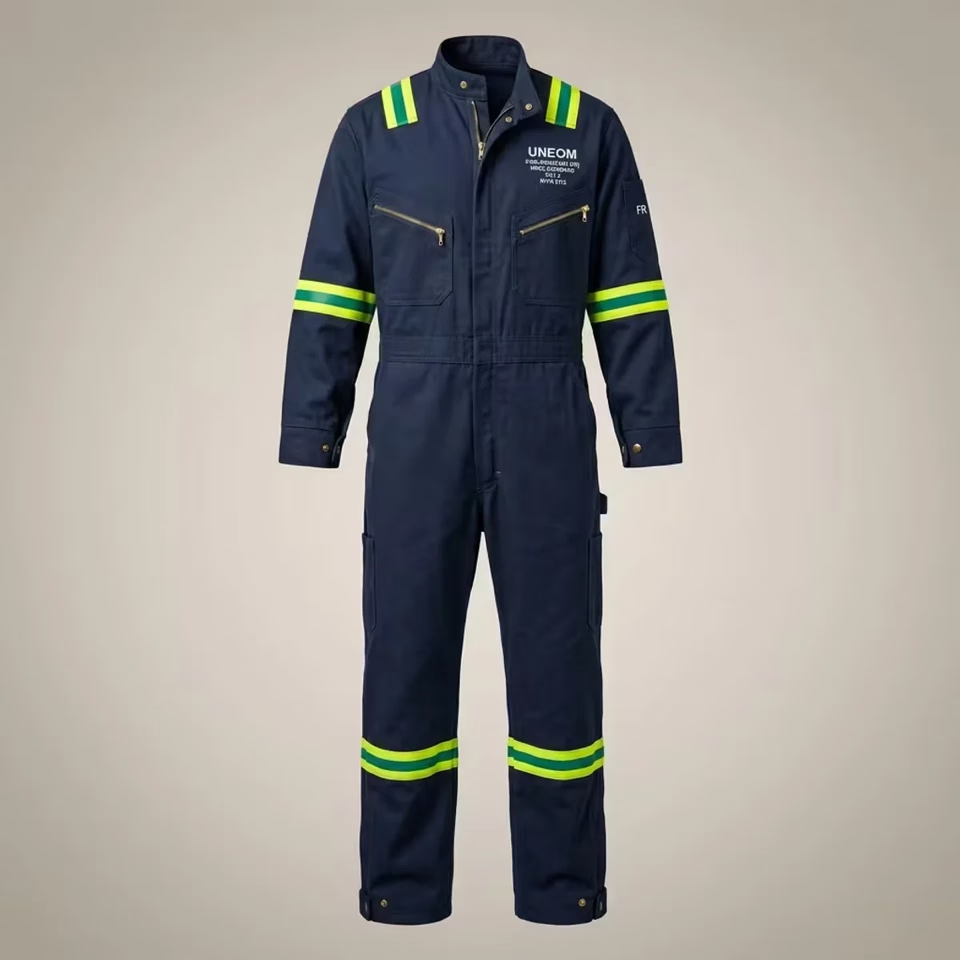
Fit is the variable buyers control most easily and consider least. A close-fitting garment presses fabric against skin, thins the air layer that carries vapour away, and turns the shirt into a wet membrane. A garment with genuine room through the chest and back leaves a channel for air to move as the body moves — walking, lifting and turning act as a real ventilation pump, and a tight cut removes it. Practical details that outweigh fabric brochures: real ease through the torso, action backs or pleats that let the shoulder blades move, underarm gussets, vented yokes where the risk assessment allows, and cuffs and hems that let air in and out rather than sealing it. Long sleeves are usually better than short ones outdoors, provided they are cut wide — they shade the arm without stopping airflow. Two constraints limit how far you take this. Loose clothing near rotating machinery, conveyors or moving vehicles is an entanglement hazard, and that hazard is not traded for comfort; the risk assessment decides. The second is layering — a high-visibility vest over a shirt is a second envelope around the body. Where the visibility requirement can be met by a garment with fluorescent and retroreflective elements built in, you remove a layer instead of adding one. And watch what crews actually do: rolled sleeves, opened fronts and abandoned vests are design feedback, not indiscipline.
Colour, Radiant Load and the Visibility Constraint
Lighter surfaces reflect more solar radiation and darker surfaces absorb more. That much is straightforward, and it is why traditional dress in hot regions looks the way it does. What is less straightforward is how much of that absorbed heat reaches the worker. Heat taken up at the outer surface still has to cross the fabric and the air gap beneath it, so a loose dark garment with air moving through it can be more comfortable than a tight light one — ventilation carries surface heat away before it conducts inward. Colour is therefore worth optimising, but it sits below fit and construction in importance, and it is rarely a free choice. High-visibility requirements specify particular fluorescent background colours, and that requirement exists to address a different and more immediate hazard — the worker not being seen. It is not traded against thermal comfort. Corporate identity narrows the choice further, and so does soiling: in workshops, yards and anywhere oils and greases are handled, darker colours keep looking presentable through more laundry cycles, which is why they survive despite the thermal argument. The workable sequence is to fix the non-negotiables first — visibility class, protective specification, the realities of soiling — then take whatever latitude remains toward lighter shades for outdoor roles. Where a workforce splits into indoor and outdoor populations, deciding colour by role usually beats negotiating a single compromise shade that suits nobody.
Specifying and Trialling Summer Workwear Without Over-Promising
A few things separate a specification that survives a Saudi summer from one that generates complaints in June. Split the range by season. A single all-year garment is a procurement convenience whose bill arrives in July. A lighter summer article and a heavier winter or indoor article is a more honest structure, and it usually extends garment life because neither is being worn outside its range. Specify what you can verify: fibre composition, weave type, mass per unit area, colourfastness after industrial laundering, and any protective standard the role requires — with the test method named, not just the standard. Ask suppliers what a claim was tested to. If a supplier tells you a fabric prevents heat stress, reduces heat illness, or protects the body from the sun's effects, that is a claim about human physiology which textile testing does not support, and it should end the conversation rather than win it. Trial in season, with the real crews, on the real tasks, through your actual laundry cycle. A garment that handles beautifully in an air-conditioned showroom in February tells you nothing. Collect what people say, but weight what they do more heavily. UNEOM has manufactured inside the Kingdom since 2013, works to ISO 9001:2015, and supplies fabrics certified to OEKO-TEX Standard 100. What we will not tell you is that a uniform manages heat. Your programme does that; we supply one component of it.
Frequently asked
- Is there a fabric that prevents heat stress in the Saudi summer?
- No. Fabric changes how easily sweat evaporates and how much solar radiation reaches the skin; it does not manage the body's heat load. Any supplier claiming a fabric prevents heat stress or heat illness is making a physiological claim that textile testing does not support. Judge fabrics on breathability, weight and durability, and manage heat through scheduling, shade, rest and hydration.
- Cotton or a polyester blend for outdoor summer work?
- Neither wins outright. Cotton absorbs and holds more moisture, so it stays damp and keeps evaporating, but it gets heavy; it also gains strength when wet, contrary to the common belief. Polyester dries faster and survives industrial laundering better but can feel clammy and holds odour. Most industrial fleets land on a blend, then face the real question: weave openness and fabric weight.
- Should outdoor workers wear short sleeves in summer?
- Usually not. Bare skin under direct sun absorbs solar radiation, so a loose long sleeve generally beats a bare arm outdoors — provided it is cut wide enough for air to move. A tight long sleeve gives you the worst of both. If crews keep rolling sleeves up, the issue is normally cut and fabric weight, not sleeve length itself.
- Can we choose lighter colours if high-visibility clothing is required?
- Only within the visibility specification. High-visibility garments require particular fluorescent background colours and retroreflective placement, and that requirement is owned by your safety function, not procurement. Where you have latitude — non-hi-vis roles, or the non-fluorescent portions of a garment — lighter shades help outdoors. Consider a garment with visibility built in rather than a vest layered over a shirt.
- How do we test summer workwear before committing to a fleet order?
- Trial in the season you are buying for, with the crews and tasks the garment is for, through your actual laundry cycle. Showroom handfeel in winter proves nothing. Record complaints, but weight behaviour more heavily: rolled sleeves, opened fronts and removed vests tell you the design failed. Let the trial run through repeated wash-and-wear before you extend the order.