What Is GSM? Fabric Weight Explained for Uniform Buyers
A practical guide to GSM for uniform buyers: what fabric weight really tells you about durability, opacity, breathability and drape, and why heavier is not automatically better.

GSM — grams per square metre — is the first number most uniform buyers see and the one most often misread. It measures how much a fabric weighs, not how good it is. Understanding what weight genuinely predicts, and what it cannot, is the difference between a specification that performs and one that merely sounds precise.
What GSM Actually Measures
GSM stands for grams per square metre, and it describes one thing: the mass of a one-metre square of finished cloth. It is a density figure, not a quality grade, and on its own it says nothing about fibre content, yarn structure, weave or knit construction, finishing chemistry, or how a garment will behave after months of industrial laundering. Two fabrics at identical weight can feel and perform very differently: one built from fine, tightly twisted yarns in a dense weave, the other from coarse yarns in an open structure that abrades quickly. Buyers often see a single figure on a quotation and treat it as a verdict, when it is closer to one line on a specification that only becomes meaningful beside the others. Some mills quote ounces per square yard instead, a different unit that converts directly, and knitted goods are frequently quoted per running metre, a figure that depends on fabric width. Confirm the unit and the width before comparing two offers, or you are not really comparing anything.
What Weight Predicts, and What It Doesn't
Within a single family of fabric, meaning the same fibre blend, construction and finish, adding weight generally buys abrasion resistance, tear strength, opacity, structure and a longer service life, while costing breathability, drying speed, packability and freedom of movement. That relationship is real, and it is why heavy cloth dominates trades where garments are dragged across steel and concrete. It breaks down the moment you compare across families. A well-engineered lighter fabric with high-tenacity filament yarn and a tight twill can outlast a heavier, loosely spun staple cloth, and a ripstop grid adds tear resistance that no amount of extra grams delivers on its own. Weight also interacts with finishing: mechanical softening, brushing and heavy resin treatments all change how a fabric feels and drapes without changing what the scale reads. The practical rule is to use weight for ranking options that are otherwise alike, and to fall back on tested performance properties such as abrasion, tear, seam slippage, dimensional stability and colourfastness whenever the candidates differ in fibre or construction.
Opacity, Coverage and Modest Dress
Opacity is where fabric weight becomes visible to everyone in the building, and it generates the most complaints in Saudi workplaces, where expectations of coverage are high and non-negotiable for many staff. Light shades, whites and pastels expose thin cloth immediately, while the same weight in a dark yarn-dyed twill may read as entirely opaque. Cover depends on weight together with yarn fineness, weave tightness, fibre lustre and colour, so a very light cloth can be made acceptable through tighter construction, and a heavier one can still disappoint if it is loosely built. Judge opacity the way the wearer will experience it: hold the sample against strong daylight, then stretch it over a hand as it would stretch across a shoulder, a seat or a knee, because elastane-containing fabrics thin out precisely where they are pulled. If a preferred cloth is marginal, the remedies are a tighter construction, a change of shade, a lining at the critical panels, or a documented undershirt policy, not a hopeful reliance on a number.
Heat: Why Heavier Rarely Helps
In Saudi summer conditions, comfort is governed less by grams than by air movement, moisture transport and radiant load. A very light fabric woven so tightly that it blocks airflow can feel hotter than a slightly heavier cloth with an open structure that lets vapour escape and allows evaporative cooling to work. Fibre choice matters as much: hydrophilic fibres hold moisture against the skin, while engineered polyester and blended constructions move it outward to evaporate. Cut plays its own part, since a looser garment creates an air layer that no fabric specification can replicate. Weight is not always the enemy, though. For work under direct sun, an extremely sheer cloth transmits more solar radiation to the skin and offers less protection, and where the hazard is flame, arc or radiant heat, mass and construction are part of how protective fabrics perform, with protection established by certified testing of the specific fabric and garment and never inferred from a weight figure. Heat performance is a system outcome, not a single number.
Office Shirt Versus Industrial Coverall
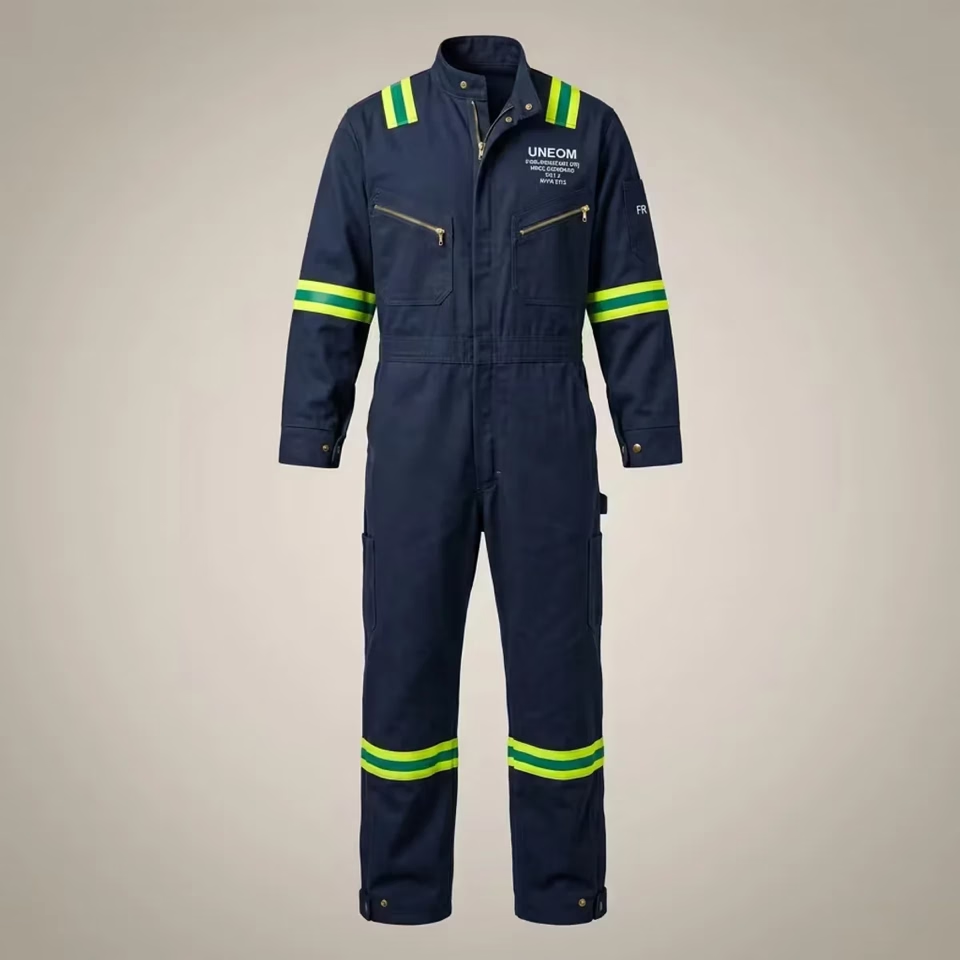
The same principle produces opposite answers for different roles. An office shirt lives in conditioned air, is judged on appearance across a full working day, and needs enough body to hold a collar, resist creasing and stay opaque under lighting, but not so much that it feels stifling on the walk from the car park in July. Too light and it collapses, shows through and looks tired by noon; too heavy and it reads as bulky and wears warm. An industrial coverall answers to abrasion at knees, elbows and seat, snagging, tool loads, welding spatter or chemical splash, and the punishment of industrial laundering, so it earns its extra mass. The engineering answer is rarely a uniformly heavy garment: reinforcement panels at the wear points, ventilation at the back yoke and underarm, action pleats and a considered cut deliver durability without dressing workers in a blanket. That matters for safety, because a coverall that runs too hot gets unzipped and sleeves get rolled.
Writing Weight Into the Specification
Treat weight as one clause among several rather than the headline. State whether the figure refers to finished cloth or greige, and name the test method used to determine mass per unit area; recognised methods such as ISO 3801 and ASTM D3776 exist so that two laboratories weigh the same way, after conditioning in a standard atmosphere, because textiles gain and lose moisture with humidity. Agree a tolerance band in the contract rather than a single absolute figure, since normal mill variation is a fact of production. Then surround weight with the properties that actually decide satisfaction: fibre blend and yarn type, construction, finish, dimensional change after repeated laundering, abrasion and tear performance, and colourfastness to washing, light and perspiration, each tested to its own standard. Keep a sealed reference sample and check incoming lots against it. Manufacturing in the Kingdom since 2013 under an ISO 9001:2015 quality system, UNEOM treats weight as one controlled variable inside a documented cloth standard, proven by a wear trial through a real Saudi summer.
Frequently asked
- What does GSM mean in fabric?
- GSM stands for grams per square metre: the mass of a one-metre square of cloth. It is a measure of how much fabric there is per unit of area, not a rating of quality or performance. Two fabrics of identical GSM can differ completely in fibre, construction, finish and service life, so it should never be read alone.
- Is a higher GSM always better for uniforms?
- No. Within one fabric family, more weight generally means more durability and opacity, but it also means more heat retention, slower drying and less freedom of movement, which are real costs in Saudi conditions. Across different fibres and constructions, a lighter engineered fabric can outperform a heavier one. Judge candidates on tested performance, not on weight alone.
- What fabric weight should I choose for a Saudi summer work shirt?
- There is no universal figure, and any single number quoted without context is marketing rather than specification. The right choice depends on the role, sun exposure, laundering regime, required opacity and any protective standard that applies. Ask your supplier for two or three candidate cloths, assess them side by side, and confirm the decision with a wear trial.
- Does GSM determine whether a uniform is see-through?
- It contributes, but it does not decide. Opacity comes from weight combined with yarn fineness, weave or knit tightness, fibre lustre and shade, and pale colours reveal thin cloth far faster than dark ones. Always check a sample against strong daylight and while stretched over a hand, since elastane fabrics thin where the body pulls them.
- How can I verify a supplier's stated GSM?
- Ask for a mill test report naming the method used for mass per unit area and confirming conditioning before weighing, and request a sealed reference sample retained by both parties. Write an agreed tolerance band into the contract, state whether the figure is finished or pre-wash, and check incoming lots against the retained sample.