
The Saudi Fabric Guide for Professional Uniforms
A practitioner's walkthrough of the eight fabric families that make up 95% of UNEOM's catalogue — when to choose what, and why.
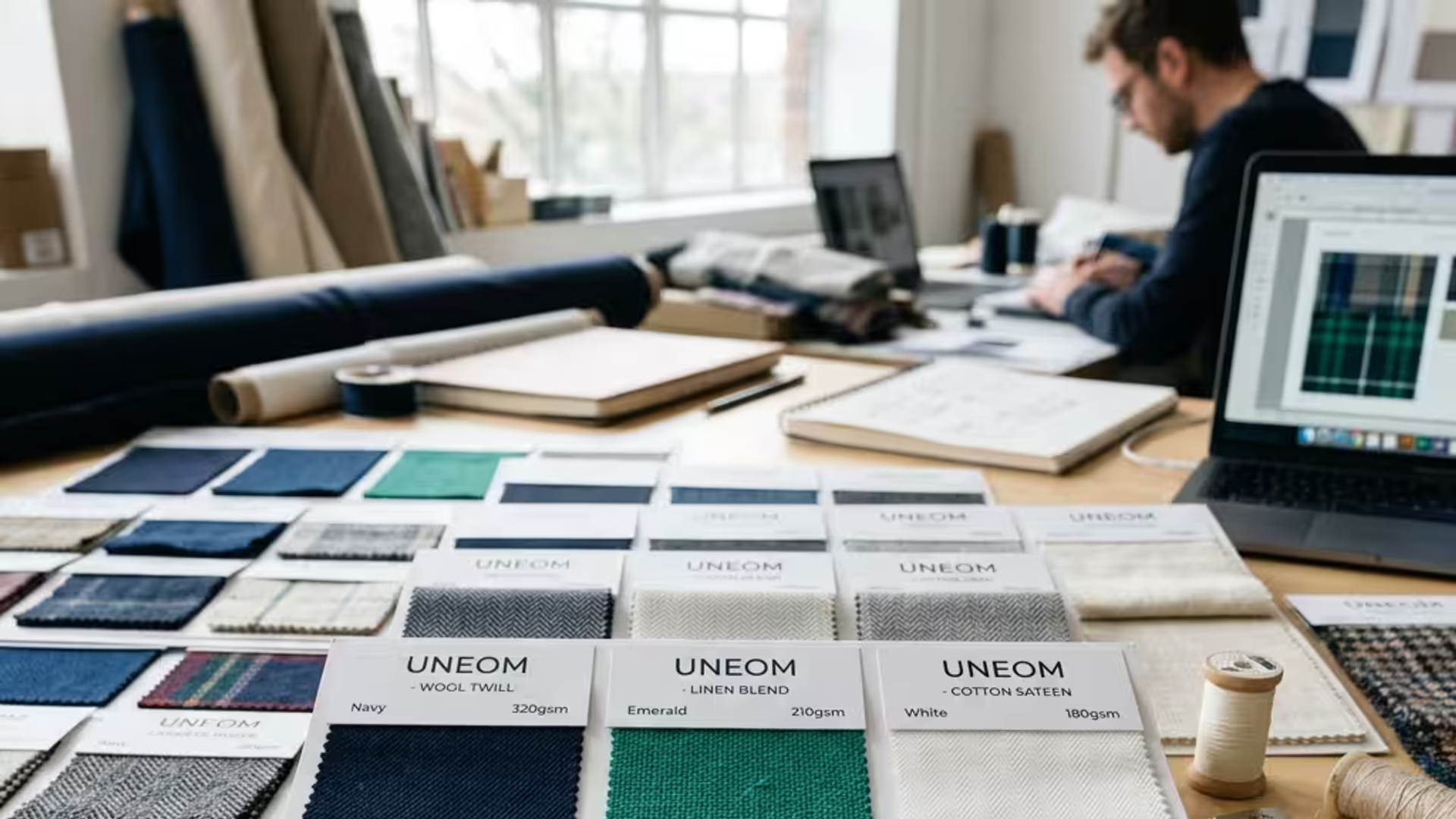
Most uniform decisions start with the wrong question. "What fabric should we use?" comes after "how does this garment get washed, by whom, and how often?" — and once that is answered, the fabric choice usually answers itself.
The eight fabric families
Eight fabric families cover 95% of every professional uniform programme UNEOM delivers across Saudi Arabia's 24 cities. Polyester-Cotton 65/35 for healthcare and education. Egyptian Cotton Poplin for executive presence. HRC2 FR Cotton for manufacturing safety. Wool-Polyester Tropical for corporate suiting. Performance Polyester for aviation ground crew. Cotton-Spandex Twill for premium scrubs and retail. OEKO-TEX Bamboo Blend for sustainability-forward programmes. Reflective Hi-Vis Polyester for site visibility. Each family is lab-tested against Saudi Arabia's three climate envelopes — Riyadh thermal swing (5–50°C), Jeddah coastal humidity (90% RH + 6,200 mg/m³ chloride), and Dammam industrial chloride (6,500 mg/m³) — before any garment ships.
Polyester-Cotton 65/35 (the workhorse)
The poly-cotton 65/35 blend is the backbone of institutional uniform programmes. The 65% polyester delivers wrinkle resistance and dimensional stability through 80+ industrial wash cycles validated to AATCC 100. The 35% cotton provides breathability and moisture absorption — critical for healthcare workers averaging 4.2 wash cycles per scrub per shift. GSM range: 180–220. When treated with bonded silver-ion antimicrobial (not surface-spray), this fabric maintains efficacy past 80 cycles — compared to 30 cycles for untreated cotton. The workhorse for healthcare scrubs, school uniforms, and security duty wear. It fails in high-heat industrial environments above 45°C, where FR-rated alternatives are mandatory. Saudi-spec variant: for Jeddah deployment, UNEOM adds hydrolysis-resistant dye chemistry to prevent colour bleed under 90% relative humidity.
Egyptian Cotton Poplin (where presence matters)
Egyptian Cotton Poplin — specifically Giza-86 long-staple fibre — is selected when visual authority matters more than industrial washability. The 60s-count yarn creates a surface lustre and hand-feel that polyester blends cannot replicate. GSM: 110 (lightweight, crisp drape). Used in doctor lab coats, business shirts, and executive uniforms where the garment represents institutional prestige. Institutional wash life: 70+ cycles with proper cold-water protocol. The trade-off: lower wrinkle resistance (requires pressing), no stretch, and limited stain resistance without additional C0 fluorocarbon-free coating. Saudi-spec variant: mercerised finish for Jeddah and coastal cities resists humidity-induced yellowing that degrades standard cotton within 4 months. Pantone tolerance: ±2 ΔE — critical for brand-colour consistency across multi-site hospital networks.
HRC2 FR Cotton (where safety matters)
HRC2 FR Cotton 88/12 (88% cotton, 12% nylon) is the Saudi industrial safety standard for electrical and flash-fire hazard environments. ATPV ≥8 cal/cm², UL-tested, compliant with NFPA 70E and NFPA 2112. GSM: 320 — heavier than poly-cotton, but the fibre chemistry dissipates heat faster in plant-floor conditions reaching 50°C. 100+ wash cycles at industrial temperature without degradation of the FR treatment, because the flame resistance is inherent in the fibre structure — not a topical spray that washes out. For Dammam petrochemical facilities where chloride levels reach 6,500 mg/m³, UNEOM specifies chloride-resistant brass hardware and reinforced seam tape to prevent corrosion failure. The cost of a certified FR coverall (380 SAR) is 8x less than the cost of replacement, compensation, and downtime after an electrical injury with a non-certified garment.
Wool-Polyester Blend (where the suit matters)
Wool-Polyester Tropical Blend (typically 55% wool / 45% polyester) serves the corporate executive suit and hospitality front-of-house segments. GSM: 210–260. The wool component delivers natural stretch recovery and temperature regulation; the polyester prevents sagging and reduces dry-clean frequency from every wear to every 5–7 wears. Wrinkle resistance: very high with half-canvas construction. Pantone tolerance: ±1 ΔE — the tightest in UNEOM's catalogue, critical for luxury hotel chains where front-desk staff must match brand colour across 20+ properties. 60+ wash cycles (dry-clean protocol). Saudi-spec variant: for Jeddah waterfront resorts, UNEOM specifies mercerised wool-poly with humidity-wicking inner lining and brass-free buttons to prevent salt-aerosol tarnishing. Italian mill sourcing ensures consistent batch-to-batch colour — a requirement that domestic mills cannot yet guarantee at ±1 ΔE.
Performance Polyester (where movement matters)
Performance Polyester (100% recycled or virgin polyester with hydrophilic moisture-wicking finish) is engineered for roles demanding continuous physical movement: aviation ground crew on 65°C tarmac at KAIA in July, retail staff handling 200+ customer interactions per shift, and sports facility personnel. GSM: 160 (lightweight). Breathability: high. Stretch: medium (mechanical, not elastane-based). 100+ wash cycles. The hydrophilic finish reverses standard polyester's hydrophobic tendency — pulling moisture from skin to fabric surface for rapid evaporation. For Dammam and Eastern Province deployment, UNEOM specifies ripstop weave with chloride-resistant hardware to prevent the fabric from degrading under coastal conditions. Pantone tolerance: ±2 ΔE. This is not a fashion fabric — it is an engineering material optimised for human thermoregulation under Saudi outdoor conditions.
Cotton-Spandex Twill (where comfort matters)
Cotton-Spandex Twill (typically 97% cotton / 3% spandex in 4-way stretch construction) is the comfort specialist. GSM: 200. Stretch: very high (4-way). 200+ wash cycles — the highest in UNEOM's catalogue — with resin-bonded wrinkle resistance that maintains garment structure through institutional laundering. Used in premium healthcare scrubs where 12-hour shifts demand unrestricted movement, retail polo shirts, and housekeeping uniforms. The C0 (fluorocarbon-free) stain-release finish repels oil and water-based spills without PFAS chemistry — compliant with OEKO-TEX Standard 100 Class 2 (children's skin contact safe, threshold: AZO ≤30 mg/kg). Pantone tolerance: ±2 ΔE. For Mecca and Medina Hajj-grade deployment, UNEOM validates this fabric to 120 wash-cycle compression equivalence — the 7-week Hajj season demands laundry throughput matching 18 months of standard institutional use.
OEKO-TEX Bamboo Blend (where sustainability matters)
OEKO-TEX Bamboo Blend (typically 60% bamboo viscose / 40% organic cotton) enters UNEOM's catalogue for sustainability-forward programmes — particularly education (child skin contact) and corporate CSR-aligned uniforms. GSM: 180. Breathability: very high (bamboo viscose is naturally thermoregulating). Stretch: medium. OEKO-TEX Standard 100 Class 2 certified. 50+ wash cycles — significantly lower than poly-cotton's 80+ — which means the sustainability equation is not straightforward. A bamboo polo that fails at 8 months generates more waste than a poly-cotton polo lasting 18 months. Genuine sustainability is duration first, material second. UNEOM's approach: specify bamboo only where wash frequency is low (2–3 cycles per week maximum) and replacement cycles are planned. Saudi-spec variant: for Abha and mountain regions where humidity + UV combine, UV-rated reactive dye prevents colour degradation under mountain-mist conditions.
Reflective Hi-Vis Polyester (where visibility matters)
Reflective Hi-Vis Polyester meets ANSI/ISEA 107 Class 2 or 3 requirements for manufacturing sites, aviation ramp operations, and construction environments. GSM: 200. Fluorescent base fabric (typically lime-yellow or orange-red) with retroreflective tape strips providing 360° visibility in low-light conditions. 80+ wash cycles for the base fabric; retroreflective tape requires inspection every 50 cycles per ANSI protocol. This is the only family in UNEOM's catalogue where colour is not specified by the client — it is mandated by safety regulation. For Saudi industrial environments where HCIS (High Commission for Industrial Security) compliance is mandatory, UNEOM integrates Hi-Vis elements with FR-rated base fabrics for dual-hazard protection. Saudi-spec variant: for Dammam and Jubail petrochemical complexes, chloride-resistant reflective tape bonding prevents delamination under salt-aerosol exposure.