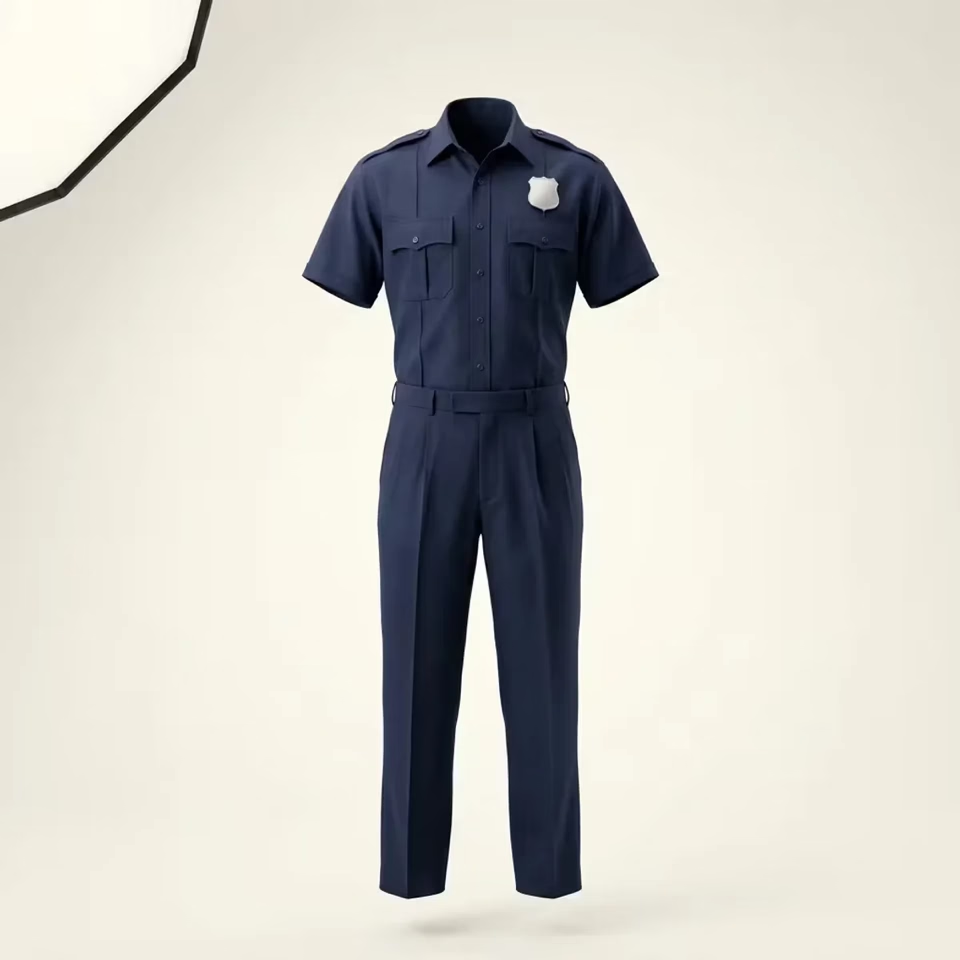
Cleaning Staff Uniform Supplier in Saudi Arabia: Programme Guide
Facility management contractors do not buy uniforms once; they issue, replace and reissue them continuously across sites. This guide covers what to specify for soil release and chemical staining, how to hold stock for a workforce that keeps changing, and how to keep garments redeployable when a contract moves.
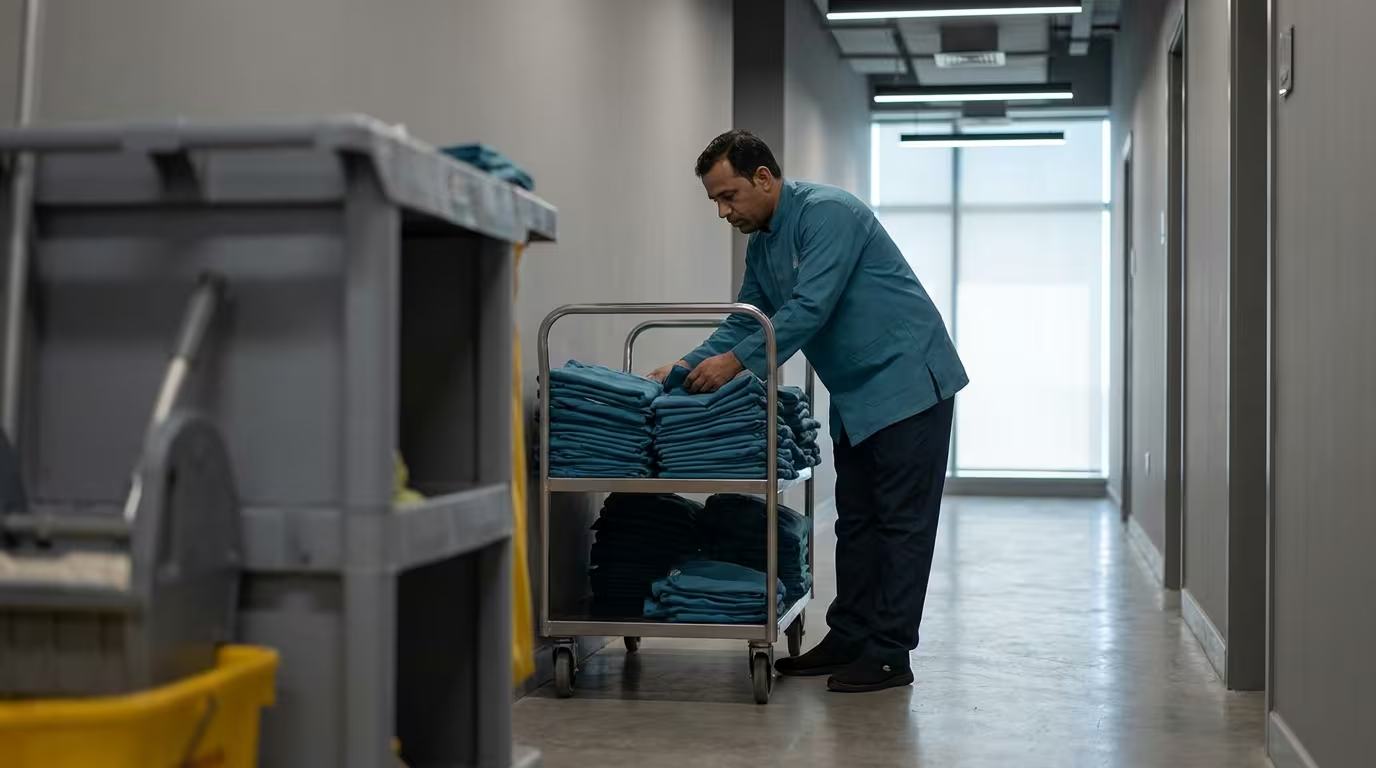
A cleaning contract is judged in the lobby. Long before anyone reads your monthly report, the client's building manager sees your team crossing the floor, and decides whether the contract looks controlled. That judgement is made on garments that are washed constantly, splashed with whatever chemical the site specifies, and issued to people who joined last week. Buying them well is a stock and logistics problem as much as a textile one. The specification that survives that reality looks different from the one that wins on unit price.
What the Garment Actually Faces on a Facilities Contract
A janitorial garment is not office wear in a different colour. Whether your contract is written as cleaning, housekeeping or soft services, the same garment goes through wet work, kneeling on hard floors, ladder and reach work, waste handling, and repeated contact with whatever cleaning chemicals the site specifies. It is worn in service corridors where the air conditioning stops at the staff door, and in loading bays where heat is the working condition, not an exception. Then it is washed — often, sometimes daily, sometimes in a shared machine with a mixed load and whatever detergent is on hand. Two consequences follow. Wear is concentrated rather than general: knees, seat, elbows, pocket mouths and cuff edges fail long before the body panel is worn out. And appearance fails before structure does. A garment that is still perfectly serviceable can look retired — greyed, spotted where bleach landed, faded along the shoulder line — and the client's building manager judges your contract on exactly that, in the lobby, in front of tenants. So the real specification is narrower than most tender documents make it. The uniform has to hold a controlled appearance under high wash frequency and chemical contact, and it has to survive concentrated abrasion at known points. Comfort and unit cost matter, but they sit downstream. Write the specification around appearance retention and stress-point construction, and most of the remaining decisions become straightforward.
Fibre Choice, Soil Release, and the Limits Worth Stating
Two different problems get mixed together under the word "stain". Soiling is material sitting on or in the fibre that laundering should remove. Damage is dye that has been destroyed — usually by chlorine bleach or an acidic descaler landing on the garment — and no wash brings it back. Ask about the two separately. Fibre choice sets the baseline. Polyester is hydrophobic and has a genuine affinity for oily soil, so oily marks that rinse out of cotton can stay locked in polyester; that is exactly the problem a soil-release finish is designed to address, by modifying the fibre surface so water can reach the soil during washing. Cotton behaves differently: it actually gets stronger when wet, which is useful in work that is wet all day. Regenerated cellulosics are not one family here — lyocell holds its wet strength very respectably, while viscose loses a large part of its strength when wet, which makes viscose-heavy fabric a poor choice for cleaning work and heavy laundering. Name the fibre in your specification; do not accept "cellulosic blend". Then be explicit about limits. A soil-release finish is a laundry-performance property; ask the supplier to describe in writing how it is applied and how it behaves through repeated washing. And say plainly what it does not do: it protects the appearance of the fabric, not the person wearing it. No finish should ever be presented, internally or to a client, as reducing infection or exposure. Hazardous chemical handling is protective-equipment territory, governed by the standard your client and your safety function name.
Construction Decides Your Replacement Rate
Unit price is the number that gets negotiated; replacement rate is the number that decides what the programme actually costs. A garment that comes back early — a burst back-rise seam, a pocket torn away from the panel, a broken closure — costs you the garment, the reissue admin, and a supervisor's time on a site where the person is already working the shift. Look at where cleaning work concentrates load. Trousers fail at the back rise and at the knee. Tops fail at the armhole and at the pocket mouth. So the details worth specifying are ordinary and unglamorous: reinforced or double-stitched seams at rise and inseam, bar tacks at pocket corners and belt loops, a generous seam allowance so a seam can be repaired rather than condemned, strong spun polyester thread, and pocket bags that are not thinner than the shell fabric. Closures deserve a decision rather than a default. Metal snaps take laundering well and suit fast changing between shifts; buttons come off and get lost; a jammed zip retires a garment that is otherwise fine. Elasticated or partly elasticated waistbands quietly remove a whole category of fit failures you would otherwise fix one person at a time. Finally, require the care label to stay legible after repeated laundering. When garments move between sites and laundries, an unreadable label is how the wrong wash temperature gets used and a whole batch loses its colour.
Size Inclusivity and the Stock You Actually Hold
The most common failure in facility management uniform programmes is not fabric. It is that a new cleaner started on Sunday, nothing in the store fitted, and they worked their first week in personal clothes on a client site that is paying for a uniformed team. Mobilisation and turnover mean you are always issuing, not just at contract start. That makes stock holding a design decision, not a warehouse afterthought. Build your size curve from what you have actually issued across existing contracts rather than a generic distribution, and hold buffer stock disproportionately in the sizes that move — including the top and bottom of the range, which are exactly the ones missing from the store when you need them. Fit range has to be genuinely wide. Extended sizes belong in the standard offer, not in a special order that arrives after the person has been on site for weeks. Where you employ women, a block drafted for women's proportions plus a modest option — longer tunic length, full-length sleeve, a cut that works with a hijab — is what keeps the team both comfortable and consistent in appearance. A few practical measures remove most of the guesswork: keep a fitting set on every mobilised site, record the issued size against the employee so a replacement is a lookup rather than a re-measure, and use adjustable or partly elasticated waistbands so a single size covers a slightly wider band of bodies.
Identification, Building Access, and Two Brands on One Garment
On most facility management contracts the uniform is an access control device before it is anything else. A tenant, a security officer or the client's duty manager should be able to tell at a glance that the person in the service corridor at night belongs there, and which company they answer to. That puts three demands on the design. It has to be recognisable at distance — a contrasting yoke, panel or trim reads across a lobby in a way a chest logo never will. It has to carry identity at close range — a name and role, and a badge or card holder positioned where it stays visible when the person bends and reaches, not where it swings into a mop bucket. And it has to stay legible after laundering, which is a decoration decision: embroidery and heat-applied transfers behave differently through repeated washing, so ask your supplier what they recommend for the wash regime you actually run. The second brand is the client's. Many building owners want their own identity on the team working in their asset, while you need your company recognisable for supervision and for the next tender. Solve it structurally: keep the base garment neutral and constant across your portfolio, and put the changeable element on a removable carrier — a badge, an epaulette slide, or a site-specific overtop. Then a garment can move to another site instead of being scrapped for the logo on its chest.
Reissue Between Sites, and What Belongs in the Supply Agreement
Contracts end, sites transfer, headcount moves. A janitorial uniform programme that cannot recover and reissue garments buys the same stock twice. Make garments traceable and returnable. Record what was issued, in what size, to whom, and on which site. Set written condemnation criteria — what condition means scrap, what means repair, what means launder and return to stock — so the decision does not depend on which supervisor happens to be standing there. Route returns through a laundering step before anything re-enters the store, and keep site-specific identity removable, as above, so a returned garment is redeployable rather than a souvenir. On the supply side, structure the agreement around how you actually consume. Ask for availability commitments at size level rather than a single headline lead time, because the constraint is almost always one or two sizes, not the whole order. Agree how repeat orders will be matched to the colour of the first production run, since dye lots differ and a team in two shades of the same blue reads as two teams. Ask what happens if a fabric is discontinued mid-contract. A note on scope: your obligations on uniform provision, deductions and replacement can be set by your own client contract and by employment rules — check them with your legal or HR adviser rather than assuming. UNEOM manufactures in Saudi Arabia and has done since 2013, works to ISO 9001:2015, and offers OEKO-TEX Standard 100 certified fabrics; ask any supplier, ourselves included, to put the specification and the certificate scope in writing.
Frequently asked
- What fabric should we specify for cleaning and janitorial staff in Saudi Arabia?
- Start from the wash regime, not the hand feel. Polyester-rich blends hold shape and dry fast but attract oily soil, which is why a soil-release finish belongs in the specification. Cotton content adds comfort and gets stronger when wet. Avoid viscose-heavy fabrics, because viscose loses much of its strength wet and this is wet work. Name the exact fibres and finish in writing, then run a wear trial on one site before committing the portfolio.
- Can a uniform be made chemical-resistant or stain-proof?
- No, and you should not accept that claim from any supplier. Finishes improve how well soil releases in the wash; they do not make a garment immune to chlorine bleach or acidic descalers, which destroy the dye rather than simply soil it. If the task genuinely involves hazardous chemical contact, that is protective equipment selected against a named standard by your safety function, worn with or instead of the uniform — not a fabric feature.
- How many sets should we issue per cleaner?
- Work it out from your own cycle rather than a rule of thumb. Count the days between laundry collection and return, add the shift pattern, and make sure a worker always has a clean set while another is in the wash, plus cover for the day a garment is condemned. Contracts with on-site laundry can run leaner than sites where staff wash at home. Write the number into the mobilisation plan.
- How do we handle sizing when staff turnover is high?
- Treat sizing as inventory, not as a fitting event. Build your size curve from sizes you have actually issued across existing contracts, keep a fitting set on every mobilised site, and record the issued size against each employee so a replacement is a lookup rather than a re-measure. Hold buffer stock deliberately at the extremes of the range, and include extended sizes and a women's cut in the standard offer, not as a special order.
- Can we reissue uniforms when a contract moves to a different client site?
- Yes, if you design for it. Keep the base garment neutral across your portfolio and put client-specific identity on a removable carrier — a badge, an epaulette slide, or a site overtop — so a sound garment is never scrapped for its logo. Route returns through laundering before they re-enter the store, apply written condemnation criteria, and keep an issue-and-return record per employee and per site.