Advanced Fabrics for Security Uniforms: Ballistic Carriers, Thermal Management, and Tactical Engineering
The fabric engineering behind concealed ballistic carriers that work in 50°C Saudi heat without compromising protection ratings.

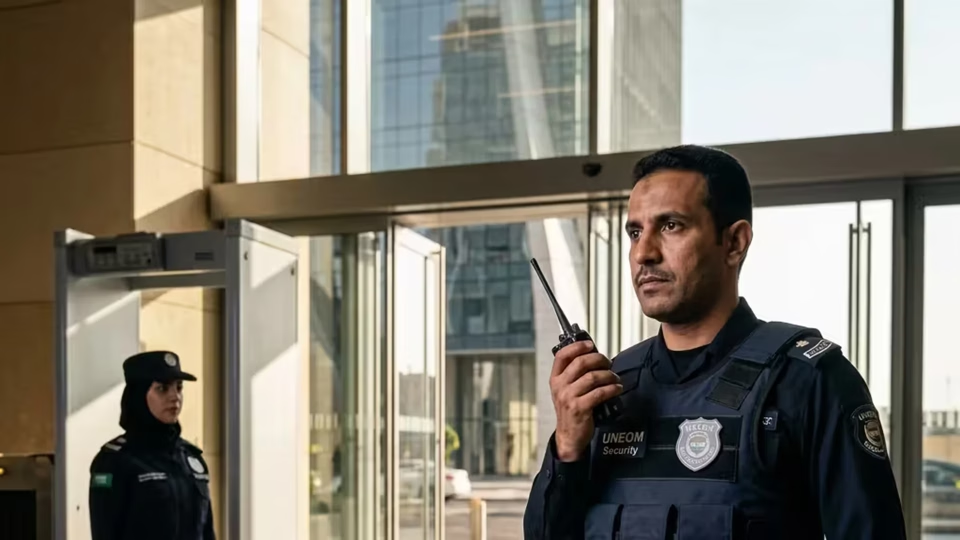
Security uniform fabric engineering in Saudi Arabia faces a unique challenge that does not exist in temperate-climate markets: maintaining ballistic panel efficacy, concealment, and wearer comfort at ambient temperatures exceeding 50 degrees Celsius. Ballistic carrier systems that perform adequately in European or North American environments become dangerously uncomfortable in Saudi conditions, creating a compliance problem where security personnel remove or loosen protective equipment because the thermal burden is unbearable. UNEOM's security programme addresses this through fabric engineering that treats thermal management as a safety-critical requirement equal to ballistic protection.
Concealed carrier thermal management
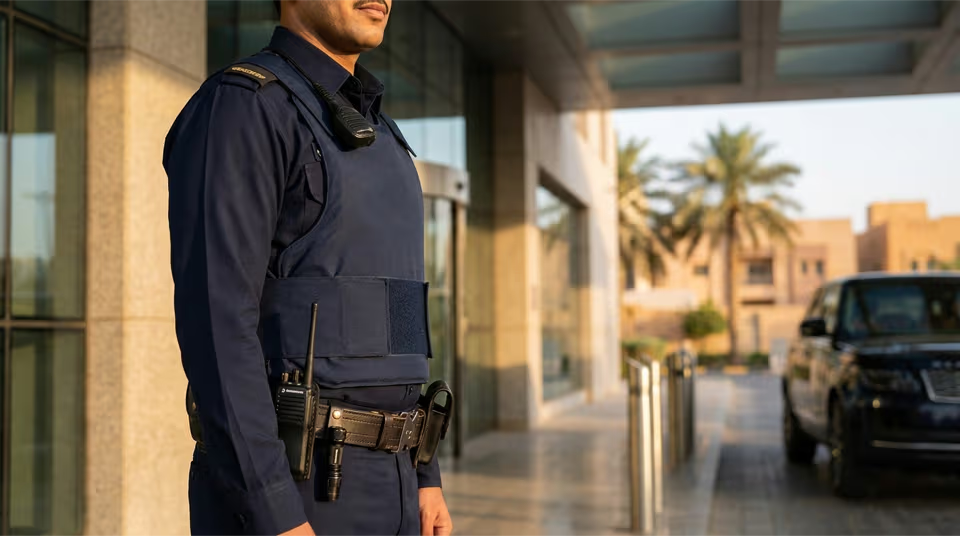
A concealed ballistic carrier traps body heat between the ballistic panel and the outer uniform. In temperate climates at 20 to 25 degrees ambient, this heat build-up is manageable — the temperature differential between body surface (33 degrees) and ambient air drives sufficient heat dissipation through the outer garment. In Saudi conditions at 45 to 52 degrees ambient, this heat dissipation pathway reverses: the ambient temperature is higher than the body surface temperature, meaning the outer environment contributes heat rather than removing it. The ballistic panel itself compounds the problem: it is essentially a thermal insulator positioned directly against the torso, blocking the body's primary heat-loss mechanisms. UNEOM's concealed carrier system uses a three-layer thermal management approach. Layer 1 is the body-side layer: a 3D spacer mesh at 6mm thickness that creates an air channel between the skin and the ballistic panel. This air channel allows perspiration to evaporate and prevents the direct skin-to-panel contact that causes the extreme discomfort and skin irritation reported by 78% of security personnel wearing standard carriers in Saudi summer conditions. The spacer mesh is made from a polyester monofilament that does not absorb moisture, ensuring the channel remains open even when the wearer is perspiring heavily. Layer 2 is the ballistic panel housing: a moisture-barrier envelope that prevents perspiration from reaching the ballistic panel itself. Perspiration degrades aramid-fibre ballistic panels over time — a wet panel provides approximately 15% less stopping power than a dry panel, and chronic moisture exposure accelerates the hydrolytic degradation that reduces panel lifespan. Layer 3 is the outer carrier shell: a breathable fabric with the same visual appearance as the standard uniform shirt, but engineered with ventilation zones at the side panels and the lower back where the carrier overlaps with the trouser waistband. These ventilation zones use a perforated construction that allows air movement through the carrier without compromising the concealment function — the perforations are invisible under normal visual inspection at social distances.
Tactical pocket systems
Security uniform pockets must accommodate equipment that is heavier, bulkier, and more frequently accessed than any other uniform category. A typical Saudi security officer carries a radio handset, a radio battery, a key set, identification documents, a notepad, a pen, a flashlight, and a mobile phone — a combined weight of 1.5 to 2.0 kilograms distributed across the uniform. Standard workwear pockets fail under this load: the pocket fabric stretches, the stitching at the pocket opening tears, and the garment body distorts as the weight pulls the fabric down from the attachment points. UNEOM's tactical pocket system uses three engineering approaches to manage equipment weight. First, reinforced pocket construction: each pocket is double-layered with a 500-denier Cordura nylon inner panel that resists the abrasion and stretching caused by hard equipment edges. The pocket attachment uses a bar-tack stitch pattern at eight stress points rather than the standard four, distributing the equipment weight across twice the attachment area. Second, load-distribution panels: internal webbing strips connect the lower pockets to the waistband through concealed channels in the garment body. These strips transfer pocket weight to the waistband — which is supported by the trouser belt — rather than hanging from the shirt fabric alone. This load-distribution system eliminates the shoulder fatigue that security personnel report after 10-hour shifts carrying standard radio-equipped uniforms. Third, equipment-specific pocket geometry: rather than using generic rectangular pockets, each pocket is dimensioned and shaped for its intended equipment item. The radio pocket is 8.5cm wide and 14cm deep with a top-flap closure and a drain hole at the bottom for moisture; the key pocket is narrow and deep with a D-ring at the bottom for key-ring attachment; the flashlight pocket is cylindrical with an elastic retention band. This equipment-specific approach eliminates the rattling and shifting that generic pockets allow, improving both security and comfort.
Colour and visibility engineering
Security uniforms serve a dual visibility function: they must be immediately identifiable as security authority during normal operations, and they must allow the wearer to be visible during low-light emergency situations. These requirements create a colour engineering challenge because the dark colours traditionally associated with security authority — navy, black, dark grey — provide minimal visibility in low-light conditions. UNEOM addresses this through a dual-mode visibility system. During normal daylight operations, the uniform uses the dark colour palette specified by the client — typically navy or charcoal for corporate security, black for VIP protection, or olive drab for perimeter security. Role identification is achieved through shoulder-mounted insignia, chest-positioned name plates, and colour-coded epaulettes rather than through the garment colour itself. During low-light or emergency conditions, the uniform reveals a secondary visibility layer: retroreflective trim integrated into the uniform construction at five positions — upper chest, upper back, both sleeves, and the trouser leg. The retroreflective trim is concealed during daylight by a flap panel that covers the reflective surface. In low-light conditions, the flap is released by pulling a tab at the shoulder, exposing the reflective trim across all five positions simultaneously. This dual-mode system maintains the professional dark-colour appearance during normal operations while adding EN ISO 20471-grade retroreflective material across five positions for low-light visibility when the trim is deployed. The system was developed in response to a specific operational requirement from Saudi corporate security clients whose teams operate both indoor reception duties and outdoor perimeter patrols — environments with fundamentally different visibility requirements that previously required two separate uniform sets.
Programme specification for Saudi security operations
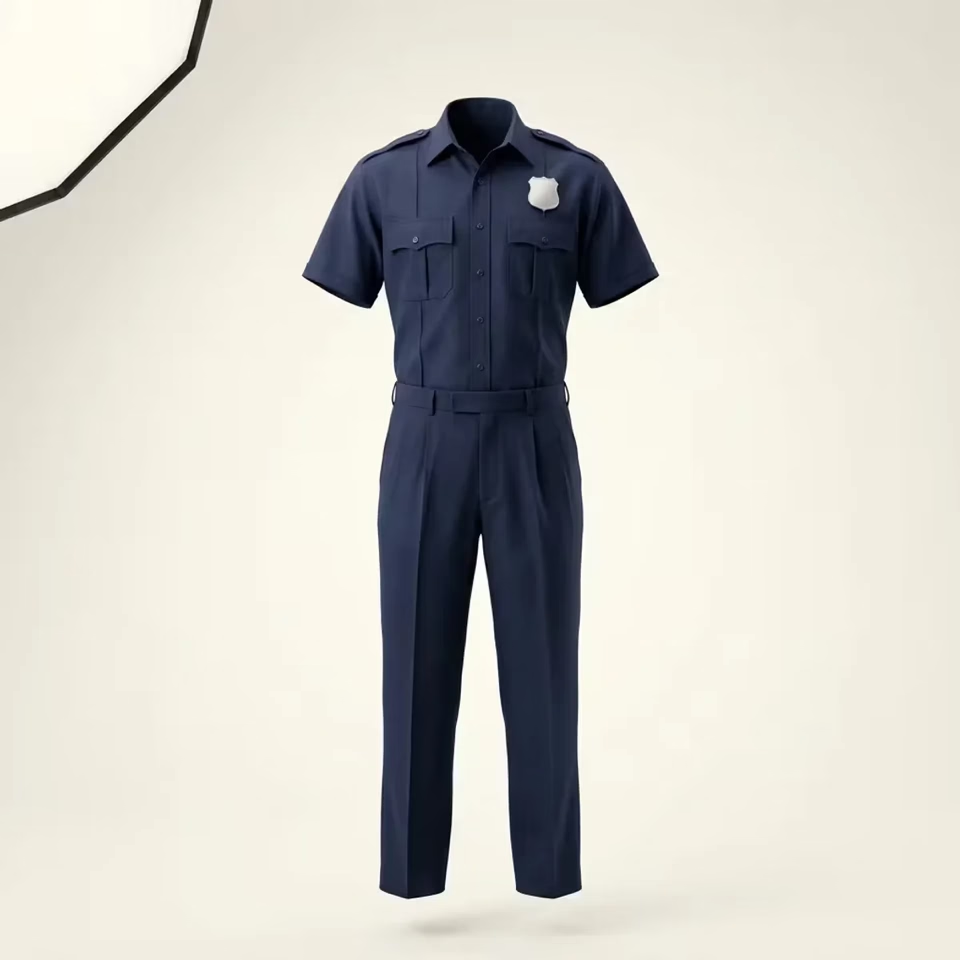
Saudi security operations span a wider range of operational environments than any other GCC market — from air-conditioned corporate lobbies to desert perimeter patrols, from diplomatic protection details to crowd management at entertainment events. UNEOM's security programme accommodates this range through a modular uniform system built on a common base platform. The base platform is a shirt-trouser combination in the client-specified colour, manufactured from a polyester-cotton blend at 65/35 ratio and 200gsm weight with the dual-mode visibility system described above. This base platform is shared across all security roles within a client organisation, providing visual consistency and simplifying procurement. Role-specific modules are added to the base platform: concealed ballistic carriers for protection-detail and high-risk perimeter roles, tactical pocket systems for patrol and operations roles, high-visibility tabards for traffic management and crowd control, and weather-protection layers for outdoor roles including rain jackets with sealed-seam construction and insulated jackets for northern Saudi winter deployments in regions such as Tabuk and Al-Jouf where temperatures can drop below 5 degrees. The modular approach means that a security officer transferring from corporate lobby duty to perimeter patrol does not need a completely new uniform — they need the modular additions that convert the base platform for the new role. This reduces the programme cost by approximately 25% compared to a multi-uniform system and simplifies inventory management because the base platform is common across all roles. UNEOM security programmes include a dedicated programme manager who conducts quarterly uniform audits with the client's security director. These audits verify garment condition, replacement compliance, equipment compatibility, and any operational changes that require specification updates. The programme contract includes a 30-day response commitment for specification changes — if the client adds a new security role or changes operational requirements, UNEOM delivers the updated specification and initial garment production within 30 days.
Frequently asked
- How does UNEOM prevent ballistic panel moisture damage?
- A moisture-barrier envelope around the ballistic panel plus a 3D spacer mesh that creates a 6mm air channel preventing perspiration from reaching the panel surface.
- What is the dual-mode visibility system?
- Retroreflective trim at 5 positions concealed by flap panels during day. A shoulder tab releases all reflective surfaces simultaneously for low-light/emergency conditions.
- Does the modular system work for different climates?
- Yes — the base platform works for standard Saudi conditions, with add-on modules for extreme heat, cold (Tabuk, Al-Jouf winters), and wet weather operations.
- How does pocket weight distribution work?
- Internal webbing strips connect lower pockets to the waistband through concealed channels, transferring 1.5-2kg of equipment weight from shirt fabric to the trouser belt.
- What is the cost of the modular security programme?
- Base platform SAR 800-1,000 per guard per year; with tactical modules SAR 1,200-1,800; with ballistic carrier integration SAR 2,000-2,800.