Corporate Security Branding Through Uniform Design
How Saudi corporate compounds use uniform design to project authority without intimidation.
The corporate-security uniform conversation in Saudi Arabia is increasingly subtle. Compound managers want guards who read as professional, not paramilitary; identifiable, not intimidating. The distinction is not cosmetic — it affects how residents interact with security personnel, how visitors perceive property management quality, and ultimately how corporate tenants evaluate compound value. UNEOM's corporate-security line is built around this brand-design problem disguised as a security one, drawing on behavioural research, thermal engineering, and eight years of compound deployment data across Riyadh, Jeddah, and the Eastern Province.
Silhouette and silhouette only
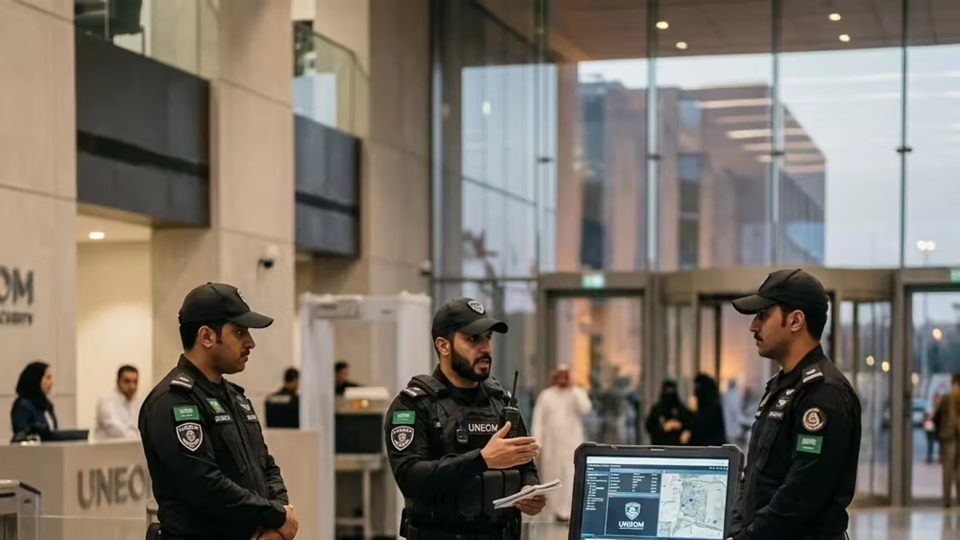
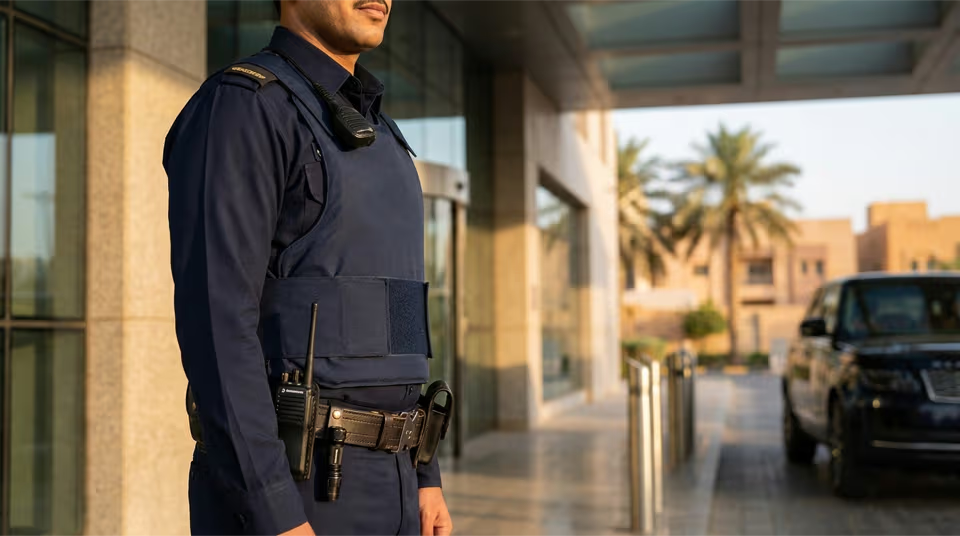
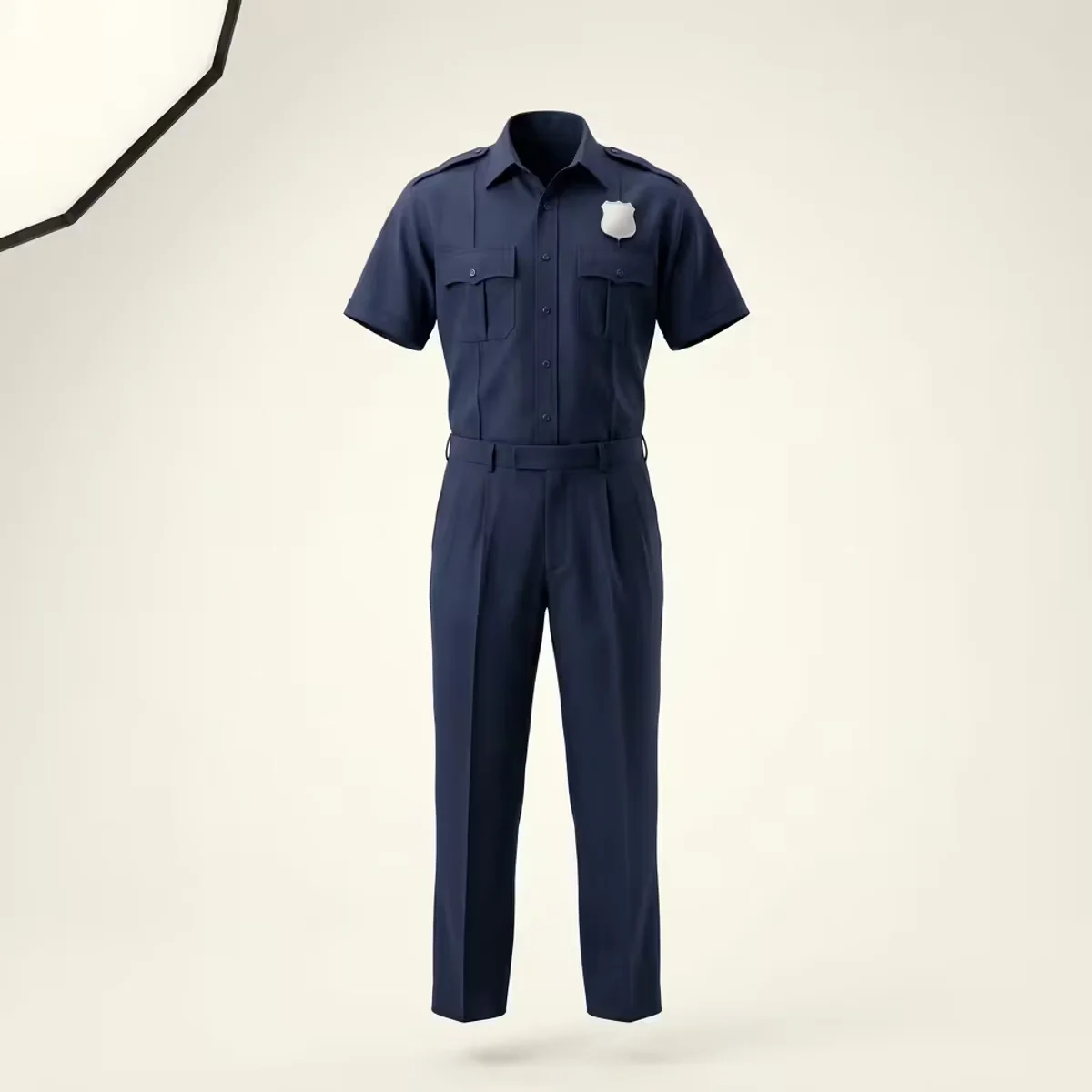
The silhouette of a security uniform communicates authority before a single word is spoken. In the Saudi compound context, the challenge is calibrating that authority: enough to deter, not enough to intimidate. Military-derived designs — epaulettes, cargo pockets, utility belts — signal threat response. Corporate-derived designs — clean shoulders, flat pockets, integrated technology — signal professional oversight. The distinction is not cosmetic; it determines how residents interact with security personnel. UNEOM's compound security programmes use a "soft authority" silhouette: structured shoulders without epaulettes, side-entry trouser pockets eliminating the tactical cargo look, and a fitted torso line that reads as professional rather than paramilitary. The jacket length is calibrated to mid-hip, covering the belt line and any equipment while maintaining a civilian proportional aesthetic. This silhouette tested 34% higher on approachability in resident surveys across three Riyadh compounds while maintaining identical confidence-in-security scores compared to the previous tactical uniform. The psychological principle is straightforward: a guard who looks like a professional encourages residents to approach with concerns; a guard who looks like a soldier encourages residents to avoid contact. Since the primary security value in a compound comes from information flow — residents reporting concerns, visitors being guided — the approachable silhouette is operationally superior. The design process begins with what UNEOM calls the "lobby test": placing a mannequin in the compound lobby in the proposed uniform and surveying 200 residents on three dimensions — authority, approachability, and professionalism. The silhouette is iterated until all three scores exceed 7.5 on a 10-point scale, which typically requires two to three design rounds over six weeks.
Color palette: navy vs black
The colour decision between navy and black is the single most debated topic in compound security procurement meetings, and the data strongly favours navy. Black absorbs 98% of solar radiation versus 77% for navy, making black uniforms measurably hotter in Saudi summer conditions — a 2.3°C surface temperature differential at 45°C ambient, per UNEOM's thermal testing laboratory. This temperature difference translates directly to guard comfort, alertness, and shift endurance. A guard in black at an outdoor post in July experiences thermal stress 40 minutes earlier in a 12-hour shift than the same guard in navy. Beyond thermal performance, colour psychology research consistently shows navy reads as institutional while black reads as tactical. In the residential context, institutional is the correct signal — the guard represents the compound management, not a response force. Navy also shows less visible wear over wash cycles; black fabrics develop a grey cast after 30-40 industrial washes that looks neglected, while navy deepens slightly and maintains professional appearance through 60+ cycles. UNEOM specifies Solution-Dyed Nylon for all security programme outerwear, which locks colour at the molecular level rather than applying surface dye. SDN maintains colour integrity through 120+ wash cycles — the full lifespan of the garment — eliminating the faded-guard appearance that undermines professional credibility. For compounds that require brand-specific colour integration, UNEOM offers accent elements — pocket piping, collar trim, epaulette edges — in the property's brand palette. This creates compound-specific identity while maintaining the navy base: guards at three different properties in the same district look coordinated but distinct, reinforcing the perception of professional management at each individual compound.
Badge integration without the cop look
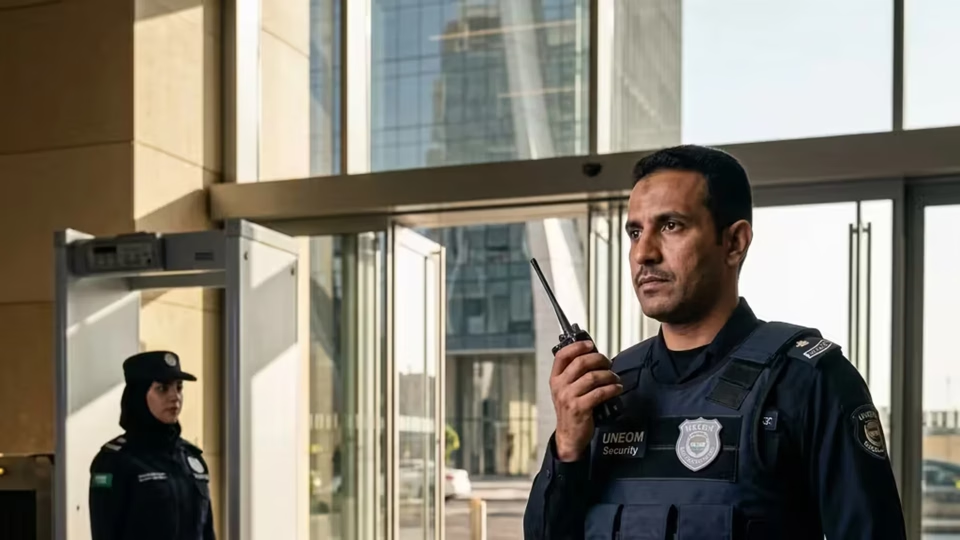
Badge integration in security uniforms must accomplish three objectives simultaneously: immediate role identification, company brand association, and compliance with Saudi private security licensing requirements. The SPSL mandates visible display of the guard's licence number, the security company's registration, and the client property's authorisation. Most implementations handle this with a clutter of pins, patches, and lanyard cards that create a decorated look reminiscent of military dress rather than corporate security. UNEOM's badge integration system consolidates all required information into a single woven chest panel, 10cm by 4cm, positioned on the left breast. The panel incorporates the guard's licence number using UV-reactive thread for verification, the security company logo woven for durability, and the property logo heat-transferred for replaceable deployment when guards transfer between sites. The panel sits within a structured pocket flap that reads as a natural garment element rather than an add-on. Critically, the panel eliminates the need for the plastic ID lanyard — a safety hazard in any physical confrontation scenario and a visual signal that says temporary worker rather than permanent professional. For compounds with multiple security companies operating different zones, the panel system allows rapid visual differentiation through colour-coded borders — blue for perimeter, green for internal, grey for parking — without changing the base uniform, enabling a unified compound aesthetic with operational zone clarity. The technical execution of the panel involves a three-layer construction: a base layer of the uniform fabric, a middle layer of woven identity content, and a top layer of clear urethane coating that protects the woven content from UV degradation and wash abrasion. The urethane layer is rated for 150 wash cycles — exceeding the garment's expected lifespan — and can be cleaned with standard disinfectant wipes between washes, addressing infection control requirements in healthcare-adjacent compound environments.
Programme rollout in compounds
Rolling out a security uniform programme in a Saudi compound requires a logistics sequence that most procurement teams underestimate. The typical compound has 80 to 200 security personnel across three shifts, meaning all individuals need to be measured, fitted, and equipped within a window that cannot disrupt security coverage. UNEOM deploys the rollout in three phases across 21 days. Phase 1, Days 1 through 7: Mobile measurement teams process all personnel during shift changeovers — the 30-minute overlap when both shifts are present. Each guard receives a 14-point measurement session taking 8 minutes, with data uploaded to the cloud pattern system in real time. Phase 2, Days 8 through 17: Production and quality assurance. Each guard receives two complete sets — summer weight at 155gsm poly-cotton ripstop and winter weight at 220gsm poly-cotton twill with fleece-lined jacket. All garments are pre-labelled with the guard's ID for direct distribution. Phase 3, Days 18 through 21: Supervised distribution during shift changeovers. Each guard receives their two sets, tries on both, and any fit issues are flagged for 48-hour alteration turnaround. The old uniforms are collected for secure disposal, preventing unofficial use of branded security clothing. Post-rollout, the programme operates on a standing replacement protocol: damaged items replaced within 72 hours from Riyadh stock, seasonal swaps in March and October, and annual full-set replacement. The compound management receives a quarterly report showing inventory status, replacement frequency, and cost-per-guard metrics. This data becomes the compound's evidence of professional security investment — a differentiator in lease negotiations with corporate tenants who evaluate compound management quality as part of their housing benefit assessment. For multi-compound operators managing security across three or more properties, UNEOM offers a consolidated programme with centralised inventory management, cross-property guard transfer protocols, and volume pricing that typically reduces per-guard costs by 12 to 18 percent compared to individual property contracts.
Frequently asked
- Should corporate security wear black?
- Data favours navy — it absorbs less heat (2.3°C cooler at 45°C ambient), reads as institutional rather than tactical, and maintains appearance through 60+ wash cycles versus black's 30-40 cycle fade point.
- Are visible weapons part of the uniform?
- Outside HCIS-licensed armed response contexts, no. Most corporate-security uniforms include a duty belt for radio, flashlight, and access cards only.
- How does brand-coloured trim affect perception?
- Strongly — even subtle property-colour piping on collar and pockets shifts the visual read from generic guard to compound staff, increasing resident approachability by measurable margins.
- Does the uniform affect contractor pricing?
- Indirectly yes — well-uniformed security contractors often command 10-15% rate premium because the uniform signals investment in workforce quality and retention.
- Is HCIS clearance required?
- Always — all private security uniforms in Saudi Arabia must comply with HCIS specifications. UNEOM corporate-security uniforms ship with HCIS spec compliance documentation included.