Radiology Staff Uniform Requirements: A Practical Guide for Saudi Imaging Departments
Practical guidance on radiology staff uniform requirements for Saudi imaging departments: colour differentiation, department rules on metal and fasteners, comfort under protective aprons, hygiene, and sizing.
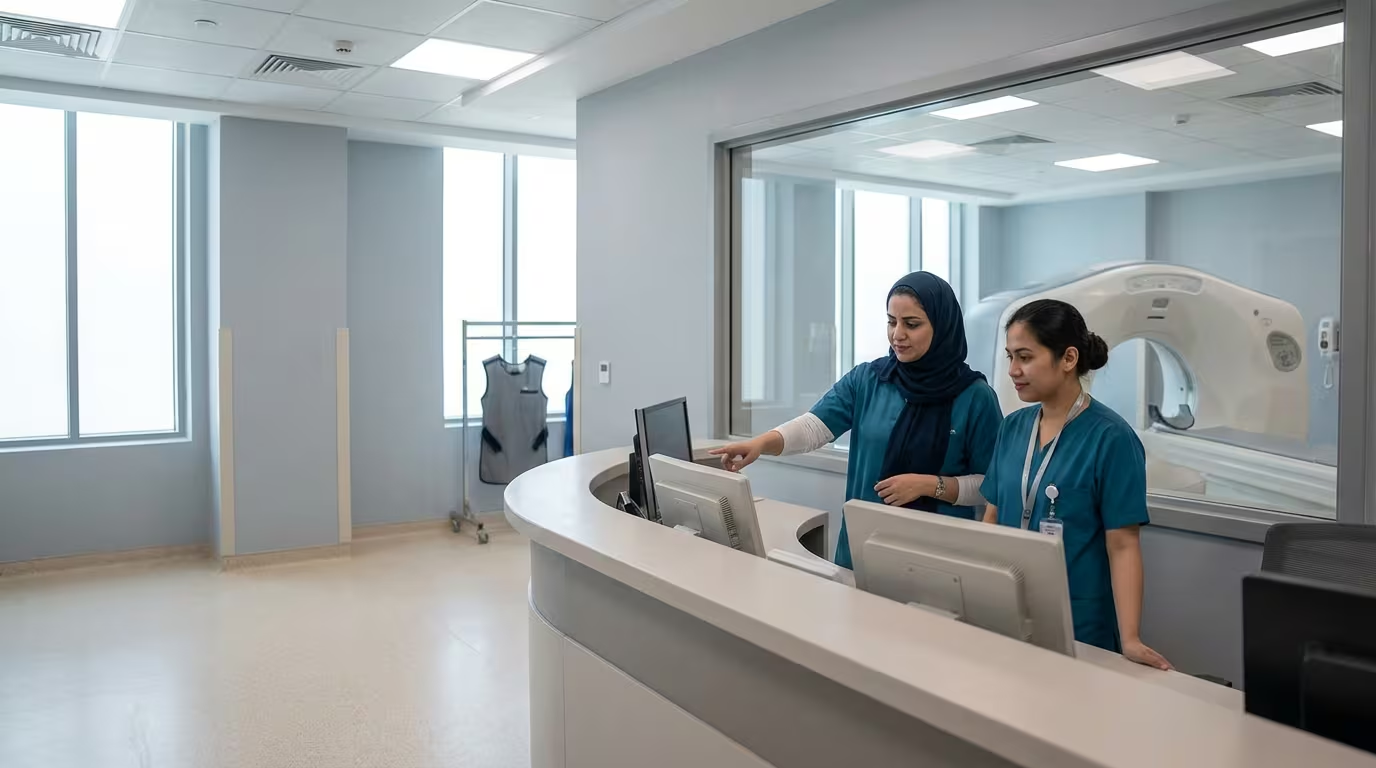
Radiology sits awkwardly in most hospital uniform programmes. The department needs to be visually distinct, its staff work long periods under heavy protective aprons, and its own procedures may restrict what can be worn in specific rooms. This guide sets out the practical uniform decisions a Saudi imaging department and its procurement team should make together.
Why imaging needs its own spec
Most hospital uniform programmes treat radiology as an extension of general clinical scrubs, and that is where the trouble starts. An imaging department is not a ward. Staff move between control rooms, procedure rooms, portable examinations on other floors, and interventional suites where they stand for long stretches under protective aprons. They handle patients who are anxious, immobile, or in pain, and they work around equipment that imposes its own access rules. A garment that performs well on a medical floor can fail here for reasons that never appear in a standard scrub specification: it traps heat under an apron, it carries fasteners the department's own procedures restrict in certain rooms, or it looks identical to every other uniform in the building, so patients cannot tell who is escorting them. The practical answer is to write imaging into the uniform programme as its own line, with its own colour rule, construction notes, and review cycle, instead of inheriting whatever the wards were issued.
Colour that people can read
Colour is the cheapest wayfinding tool a hospital owns, and imaging departments benefit from it more than most. Patients arriving for a scan are often moving through an unfamiliar corridor with a porter, a nurse, and a radiographer in sequence, and a distinct department colour lets them, and everyone else, resolve who is who without reading a badge. Inside the department the same logic separates radiographers from radiology nurses, from sonographers, and from reception and portering staff. The rule that matters is consistency: one colour per role, documented in the dress code, applied to every site the organisation runs, and enforced when new hires are issued. Avoid choosing a shade that already carries meaning elsewhere in the facility, and avoid pale colours in areas where contrast media, gel, or blood are routinely handled, since visible marking drives premature replacement. Where the department wants a subtler signal, trim colour, piping, or a contrast yoke on a neutral base garment gives differentiation without committing the whole wardrobe to a colour that may be revised later.
Metal and fasteners: the department decides
Questions about metal components come up in every imaging uniform conversation, and this is the one area where the garment specification must follow the department rather than lead it. MRI suites operate under controlled access and screening procedures administered by the facility's MR safety personnel and medical physicist; what may cross into each zone is defined by those procedures and by the equipment manufacturer's documentation, not by a uniform supplier. The same is true of any rule the department applies around its other modalities. Procurement's job is therefore to ask the question early and in writing: does the department require garments with no metal fasteners, no zips, no metal badge clips, or no embedded RFID for staff working in specified rooms, and does that apply to all staff or only to those entering particular areas? Once the department answers, the specification can be built to match, because non-metallic closures, plastic snaps, and fully sewn constructions are all straightforward to manufacture. What is not acceptable is a supplier inventing the requirement.
Working under a protective apron
Staff who spend time in protective aprons describe two consistent problems: load and heat. The apron transfers weight onto the shoulders, neck, and lower back, and it seals a layer of still air against the torso, so the microclimate under it stays warm and humid even in a room air-conditioned for the equipment rather than for people. Uniform design cannot remove the apron, but it can stop making things worse. A lighter-weight fabric with good moisture transport moves sweat away from the skin instead of holding it against it; a smooth, low-friction face reduces the dragging and bunching that happens when a heavy apron sits on textured cloth; and mechanical or elastane-assisted stretch lets staff reach and lift without the garment pulling at the shoulder. Seam placement matters too, because a bulky shoulder seam under an apron strap becomes a pressure point over a long list. Keep collars and plackets low-profile so nothing sits under the apron's neckline, and let staff trial the combination before the order is committed.
Hygiene and patient contact
Imaging is a high-contact environment. Staff position patients by hand, help transfers on and off tables, and work with gel, contrast media, and occasionally blood and other body fluids. The uniform is therefore part of the department's hygiene practice, and the specification should support the laundering regime the infection prevention team sets rather than assume one. In practice that means fabrics and construction that survive repeated institutional washing without shrinking out of fit, greying, or losing their finish, and colours that hold after many cycles so the department's colour coding does not drift across intake batches. It also means issuing enough sets per person that a soiled garment can be changed immediately instead of worn out of necessity, and agreeing where changing and storage happen so home laundering is not the default by accident. Skin comfort matters in a garment worn against the body under an apron for hours, which is one reason UNEOM works with OEKO-TEX Standard 100 certified fabric and manufactures in the Kingdom under an ISO 9001:2015 quality system.
Fit, modesty and programme control
A radiology uniform programme also has to fit the people wearing it. Saudi imaging departments employ women across radiographer, sonographer, and nursing roles, and modest cut is a working requirement rather than an accommodation: full coverage at the arm and neck when the wearer raises them, tunic length that stays low when reaching across a table, fabric with enough opacity that a single layer is sufficient, and a hijab-compatible neckline that does not pull. Offer long-sleeve options and a matching under-layer so nobody improvises with a garment that was never specified. On the programme side, treat sizing as a project: run a fitting session with real garments before the first order, hold a size set on site for new joiners, and keep a documented replacement cycle so worn or stained items leave circulation on schedule rather than when someone complains. Write the whole thing into the department dress code, review it annually with the imaging lead, and record what changed.
Frequently asked
- What should a radiology staff uniform specification cover?
- Five things: a documented colour rule that distinguishes imaging from other departments and separates roles within it; construction that complies with whatever the department's own procedures require in specific rooms; comfort under protective aprons; fabric and colour that survive institutional laundering; and a sizing and replacement process, including modest-cut options, that is written into the dress code.
- Are metal zips and fasteners allowed on radiology uniforms?
- That is decided by the department, not by the uniform supplier. MRI areas in particular are governed by the facility's access and screening procedures and by its MR safety personnel and medical physicist, and equipment documentation applies as well. Ask the department to state its rule in writing, then specify garments to match — non-metallic closures and sewn constructions are readily manufactured.
- Why use a different colour for imaging department scrubs?
- Because patients and colleagues navigate by colour before they read badges. A distinct imaging colour helps a patient identify who is escorting them for a scan, and a second shade or trim separates radiographers from radiology nurses and support staff. Keep the rule consistent across all sites, document it in the dress code, and avoid shades already used elsewhere.
- What makes a radiographer uniform comfortable under a protective apron?
- Lighter weight, effective moisture transport, a smooth surface that does not drag under the apron, and enough stretch to reach and lift freely. Flat, low-bulk shoulder seams matter because apron straps turn thick seams into pressure points, and low-profile collars keep bulk away from the neckline. Trial the garment with the actual apron before committing an order.
- How should a radiology dress code address modest dress?
- Specify it, do not leave it to improvisation. Offer long sleeves, a longer tunic that stays covering when reaching across a table, fabric opaque enough to wear as a single layer, and a neckline that works with a hijab without pulling. Provide matching under-layers in the same colour family so staff are not sourcing their own.