Nursing Uniform Guide 2025: Functional Design for Saudi Clinical Environments
Why nursing uniforms fail at the shoulder seam, the pocket-depth problem, and the hijab integration standard that Saudi hospitals need.
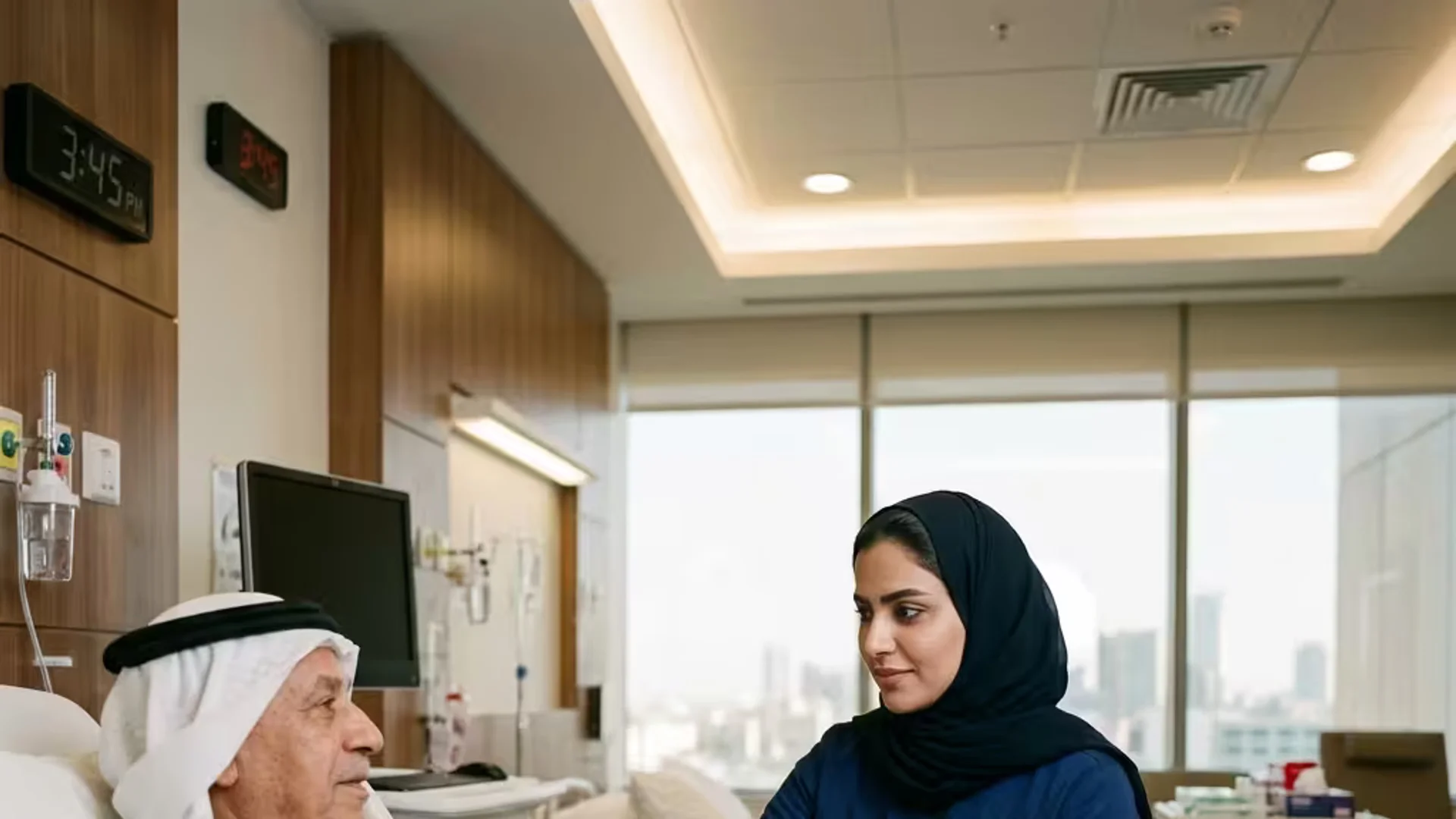
Nursing uniforms in Saudi Arabia serve a population that is 68% expatriate, representing body types from South Asia, Southeast Asia, the Philippines, the Middle East, and Africa — the widest anthropometric range of any nursing workforce globally. A uniform designed for a single body type fits none of them well. Add the hijab integration requirement for Muslim nurses, the 12-hour shift duration that is standard in Saudi hospitals, and the clinical demands of a healthcare system serving 35 million residents, and the specification requirements become genuinely complex.
The shoulder-seam failure pattern
UNEOM's garment return data from Saudi hospital programmes shows that shoulder-seam failure accounts for 34% of all nursing uniform structural failures — more than any other single failure point. The mechanism is specific to nursing: nurses reach overhead to adjust IV drip heights, reach forward to operate bed controls and patient monitors, and reach laterally to hand instruments and supplies. Each reaching movement places tension on the shoulder seam, and the cumulative effect over a 12-hour shift — estimated at 400 to 600 individual reaching movements — creates fatigue stress that standard construction cannot withstand beyond 4 to 5 months. The standard set-in sleeve construction places the seam directly on the shoulder point — the highest-stress location during reaching movements. UNEOM's nursing specification uses a raglan sleeve construction that moves the seam from the shoulder point to a diagonal line running from the neckline to the underarm. This diagonal placement distributes reaching forces across a longer seam line, reducing peak stress at any single point by approximately 40%. The raglan construction also provides a wider range of unrestricted motion — 15 degrees greater overhead reach and 20 degrees greater forward reach compared to set-in sleeves — because the sleeve and bodice move as a single panel rather than pivoting at a fixed seam point. For nurses who prefer the visual appearance of a set-in sleeve — which provides a more structured, formal look — UNEOM offers a hybrid construction with an articulated shoulder panel. This uses a set-in sleeve appearance from the front but incorporates a concealed gusset at the shoulder point that expands during reaching movements and collapses flat when the arm is at rest. The articulated shoulder adds SAR 12 to the per-garment cost but achieves 85% of the raglan construction's stress reduction while maintaining the visual aesthetic of a traditional uniform.
The pocket-depth problem
Standard nursing uniform pockets are 15 to 17cm deep — a dimension inherited from general-purpose workwear design that does not account for the specific items nurses carry. A typical Saudi hospital nurse carries a smartphone for clinical communication apps, a pen light for pupil assessment, 2 to 3 pens, a bandage scissors, an ID badge clip, and a personal phone. These items total approximately 18 to 22cm in combined depth when stacked, meaning standard pockets cannot contain them without items protruding above the pocket line — where they fall out during bending and patient transfer activities. UNEOM's nursing pocket specification uses 22cm depth as the minimum, with a divided internal structure that separates instruments from personal items. The left chest pocket is divided into three vertical cells: a narrow cell for pens with a pen-clip retention strip, a medium cell for the pen light with a retention loop at the bottom, and a wide cell for the smartphone with a concealed magnetic snap closure that prevents the phone from falling during bending while allowing single-hand access. The hip pockets are 24cm deep with a curved bottom that follows the thigh contour, preventing the angular bottom corner that standard rectangular pockets create — this angular corner catches on bed rails, wheelchair handles, and patient transfer equipment, creating both a snag hazard and a garment damage point. The pocket entry angle is tilted 15 degrees forward from vertical, matching the natural hand-insertion angle when the arm hangs at the side. This ergonomic angle allows pocket access without conscious hand-angle adjustment, which is important during rapid clinical responses when reaching for instruments must be automatic rather than deliberate. UNEOM also integrates a concealed interior pocket at the left waist — invisible from the outside — for personal valuables. This pocket uses a zip closure rather than magnetic snap for security, and is positioned to be accessible without pulling the uniform out of its tucked position. The pocket system adds approximately SAR 8 to the per-garment cost versus standard patch pockets, and nurse satisfaction surveys consistently rank pocket design in the top three features influencing uniform satisfaction — ahead of fabric colour and equal to overall fit quality.
Hijab integration: the standard Saudi hospitals need
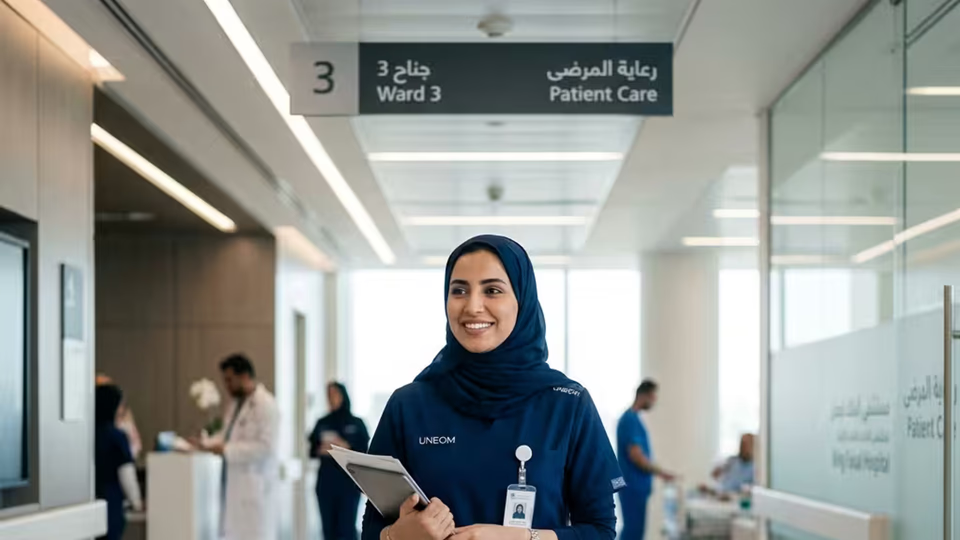
Approximately 45% of nurses in Saudi hospitals wear hijab, and the current approach at most facilities is to allow nurses to wear personal hijabs with their clinical uniform. This creates three problems. First, infection control: personal hijabs are laundered at home, outside the facility's controlled laundering programme and typically at far lower temperatures than clinical garments — which is why infection-control teams increasingly prefer headwear that enters the same industrial laundry cycle as the rest of the uniform. A hijab that enters and leaves the clinical environment daily, laundered at home temperatures, is a potential vector for pathogen transmission between the hospital and the community. Second, visual inconsistency: personal hijabs vary in colour, fabric, and style, creating a non-uniform appearance that undermines the professional presentation standard the uniform programme is designed to achieve. Third, safety: personal hijabs are not designed for clinical use — they can untuck during patient care activities, creating a contamination risk, or catch on equipment, creating a personal injury risk. UNEOM's clinical hijab specification addresses all three problems through a purpose-designed garment that is part of the uniform programme rather than a personal accessory. The clinical hijab uses the same antimicrobial-treated fabric as the uniform body, ensuring consistent infection control performance across all garments. It is included in the facility's industrial laundering programme at the same 60 to 75 degree wash temperature as other clinical garments. The design uses a three-panel construction: a front panel that frames the face, a back panel that covers the neck and upper back, and a chin-wrap panel that secures the hijab without pins. The chin-wrap closure uses a concealed magnetic snap system that provides secure closure during normal activity but releases under 2kg of pull force — a safety breakaway feature that prevents strangulation hazard if the hijab catches on moving equipment. The clinical hijab is colour-matched to the uniform programme and available in the department-specific colours that the facility uses for role identification. UNEOM provides the clinical hijab in three sizes — determined by head circumference and face-length measurements taken during the standard size-profiling session — ensuring proper coverage and fit without the bunching or gaping that generic one-size hijabs produce.
Size-profiling for multinational nursing teams
The anthropometric diversity of Saudi nursing teams makes standard sizing systems unreliable. UNEOM's healthcare size-profiling data shows that the bust-to-waist ratio for Filipino nurses averages 1.18, for Indian nurses 1.22, for Saudi nurses 1.25, and for Nigerian nurses 1.30 — a range that standard S/M/L sizing cannot accommodate without significant fit compromise for at least two of these populations. UNEOM addresses this through a graded-proportion system rather than a simple scaled-size system. The graded-proportion system maintains four proportion profiles — each optimised for one of the four dominant body-type categories in the Saudi nursing workforce. Within each proportion profile, the standard size range of XS to 3XL is available, but the proportional relationships between bust, waist, hip, and arm length are adjusted to match the population average for that profile. The practical result is that a size Medium in Profile A (optimised for South and Southeast Asian body types) has the same bust circumference as a Medium in Profile C (optimised for Middle Eastern body types) but a different waist circumference, different hip circumference, and different arm length. Both garments are labelled Medium, but they are cut to different proportional relationships. This system reduces the alteration rate from 28% under standard sizing to 6% under graded-proportion sizing — a reduction that saves approximately SAR 22 per employee per year in alteration costs and, more importantly, ensures that every nurse receives a garment that fits properly from first delivery. The size-profiling session for nursing teams takes approximately 3 minutes per nurse and is conducted by same-gender measurement technicians in a private measurement area within the facility. Measurements are recorded digitally and stored in UNEOM's pattern-grading system for automatic re-ordering — when a nurse's uniform needs replacement, the system generates a repeat order using the stored measurements without requiring re-measurement.
Frequently asked
- What is the most common nursing uniform failure?
- Shoulder-seam failure at 34% of all structural failures — caused by 400-600 reaching movements per 12-hour shift. Raglan sleeve construction reduces this stress by 40%.
- Does UNEOM provide clinical hijabs?
- Yes — purpose-designed clinical hijabs in antimicrobial-treated uniform fabric, with magnetic breakaway closure and three-panel construction. Available in three sizes and programme colours.
- How does UNEOM handle multinational body types?
- A graded-proportion system with four body-type profiles, each in XS-3XL. This reduces alteration rates from 28% to 6% compared to standard sizing.
- How deep should nursing uniform pockets be?
- Minimum 22cm for chest pockets with divided internal cells, 24cm for hip pockets with curved bottoms and 15-degree ergonomic entry angle.
- What is the cost of UNEOM's nursing programme?
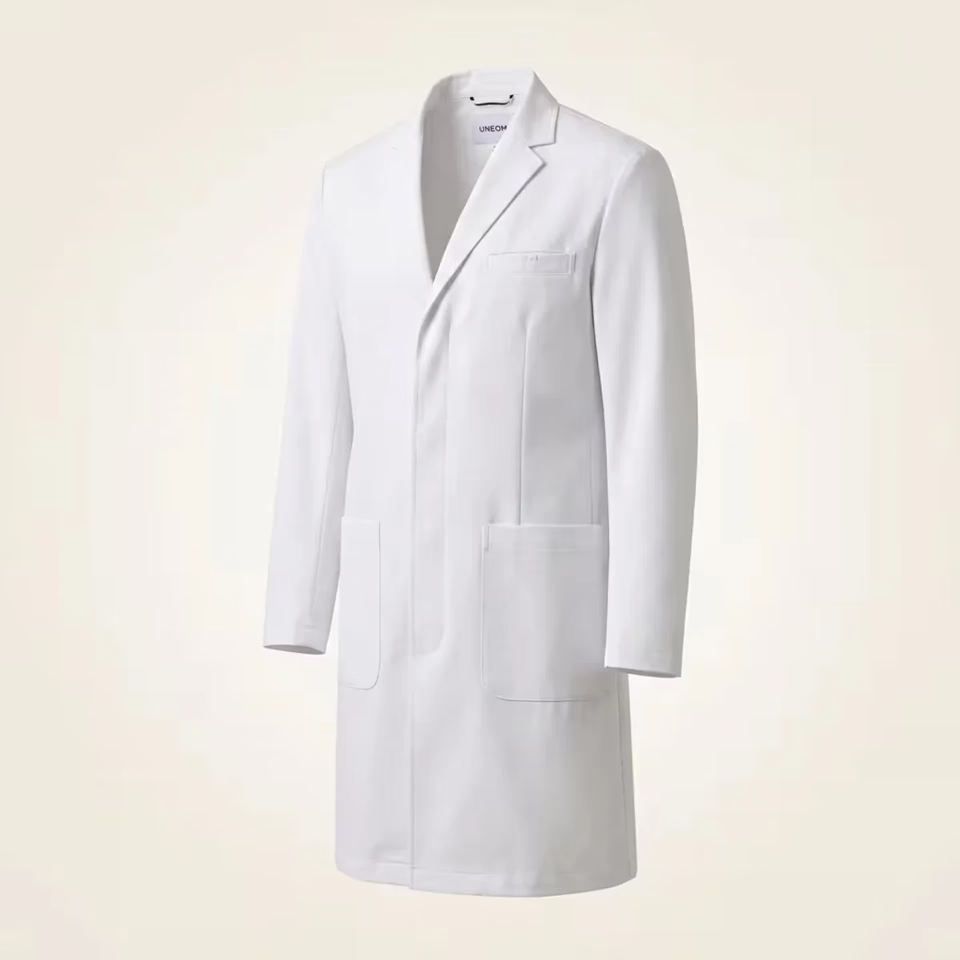
- SAR 900-1,200 per nurse per year including antimicrobial scrubs, clinical hijab, lab coat, and replacement cycling — with 6% alteration rate versus 28% industry average.