
Cleanroom Uniform Best Practices for Saudi Pharmaceutical & Electronics Sites
ISO 14644 cleanroom classifications, garment selection, and the operational protocols UNEOM ships with cleanroom programmes.
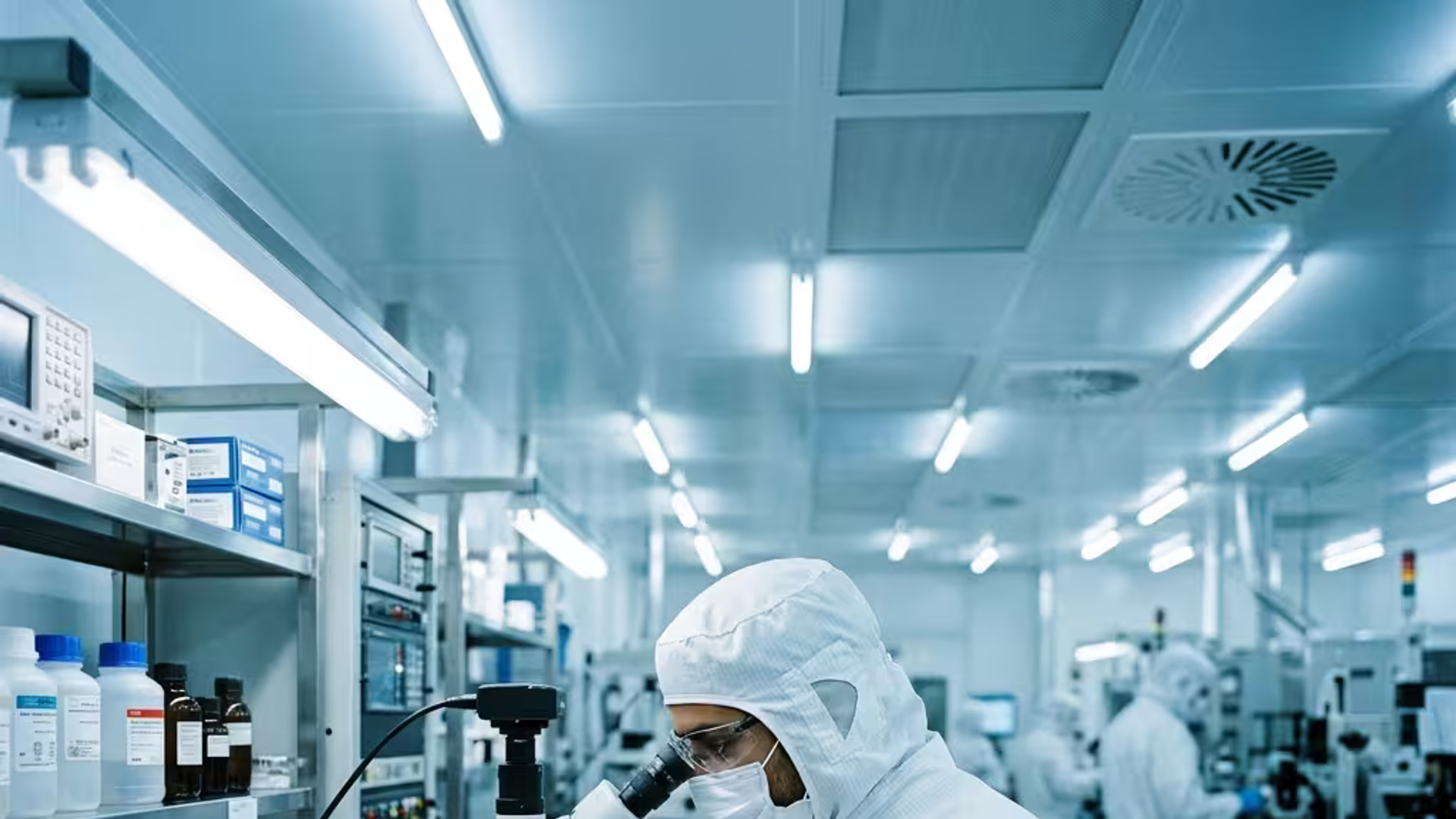
Saudi cleanroom programmes are growing fast — pharmaceutical, electronics assembly, advanced manufacturing. The garments that work in them are not catalogue products.
ISO 14644 classifications
ISO 14644-1 defines cleanroom classes by maximum allowable particle concentration per cubic metre. Class 5 (100 particles ≥0.5μm per m³) is the pharmaceutical standard for sterile manufacturing. Class 7 (352,000 particles ≥0.5μm per m³) is common in electronics assembly. Class 8 (3,520,000 particles ≥0.5μm per m³) covers general controlled environments. Each class requires different garment construction. Class 5 demands full-body coveralls with integrated hood, sealed seams, and boot covers — shedding rate below 10 particles per garment per minute. Class 7 allows smock-and-trouser combinations with non-sealed seams. Class 8 permits lab coats with hair covers. UNEOM's cleanroom garment range is tested to particle-shedding standards per ISO 14644-3, with third-party certification shipped with every order. For Saudi pharmaceutical sites operating under SFDA GMP requirements, the ISO classification must align with the production zone designation — a misalignment triggers an immediate SFDA non-compliance finding.
Garment material selection
Cleanroom garments are constructed from continuous-filament polyester — not spun polyester, which sheds fibres from cut yarn ends. The fabric is woven from continuous filaments where the yarn has no cut ends to shed. GSM: 140–160 for Class 5, 120–140 for Class 7. The fabric must be lint-free, static-dissipative (surface resistivity 10⁶–10⁹ Ω/sq), and autoclave-compatible for repeated sterilisation. Carbon-stripe construction at 10mm intervals provides consistent static dissipation across the garment surface. Saudi-specific consideration: in Riyadh and Dammam where ambient humidity drops below 20% in winter, static generation inside cleanrooms intensifies. UNEOM specifies carbon-grid (not stripe) construction for Class 5 environments in low-humidity zones — grid provides 360° dissipation vs stripe's directional path. Garment lifespan: 50–70 autoclave cycles before fibre degradation begins to affect particle-shedding performance. UNEOM includes autoclave-cycle tracking in the per-garment serial system.
Donning and doffing protocols
The garment is only as clean as the donning protocol. A Class 5 coverall contaminated during donning introduces more particles than the garment was designed to contain. UNEOM ships a standardised 12-step donning protocol with every cleanroom programme: Step 1 — hand washing and gloving in the gowning room anteroom. Step 2 — hair cover and face mask application. Step 3 — boot-cover application over cleanroom-designated footwear. Step 4 — coverall unfolding on the clean bench (not the floor). Steps 5–8 — sequential limb insertion without ground contact. Step 9 — hood integration and seal check. Step 10 — outer glove application over cuff seal. Step 11 — visual inspection by gowning partner. Step 12 — air-shower entry. The protocol is laminated and mounted at every gowning station. UNEOM provides on-site training sessions during programme launch — typically 2 hours per shift group. Doffing follows the reverse sequence with one critical addition: the contaminated outer surface must never contact skin or inner clothing. Post-use garments are bagged immediately and routed to the designated cleanroom laundry service.