Serviced Apartment Staff Uniform Programs for Long-Stay Properties in Saudi Arabia
How serviced apartment and long-stay properties dress lean, multi-tasking teams: role clarity through layers, residential formality at reception, and durable garments for extended stay housekeeping.
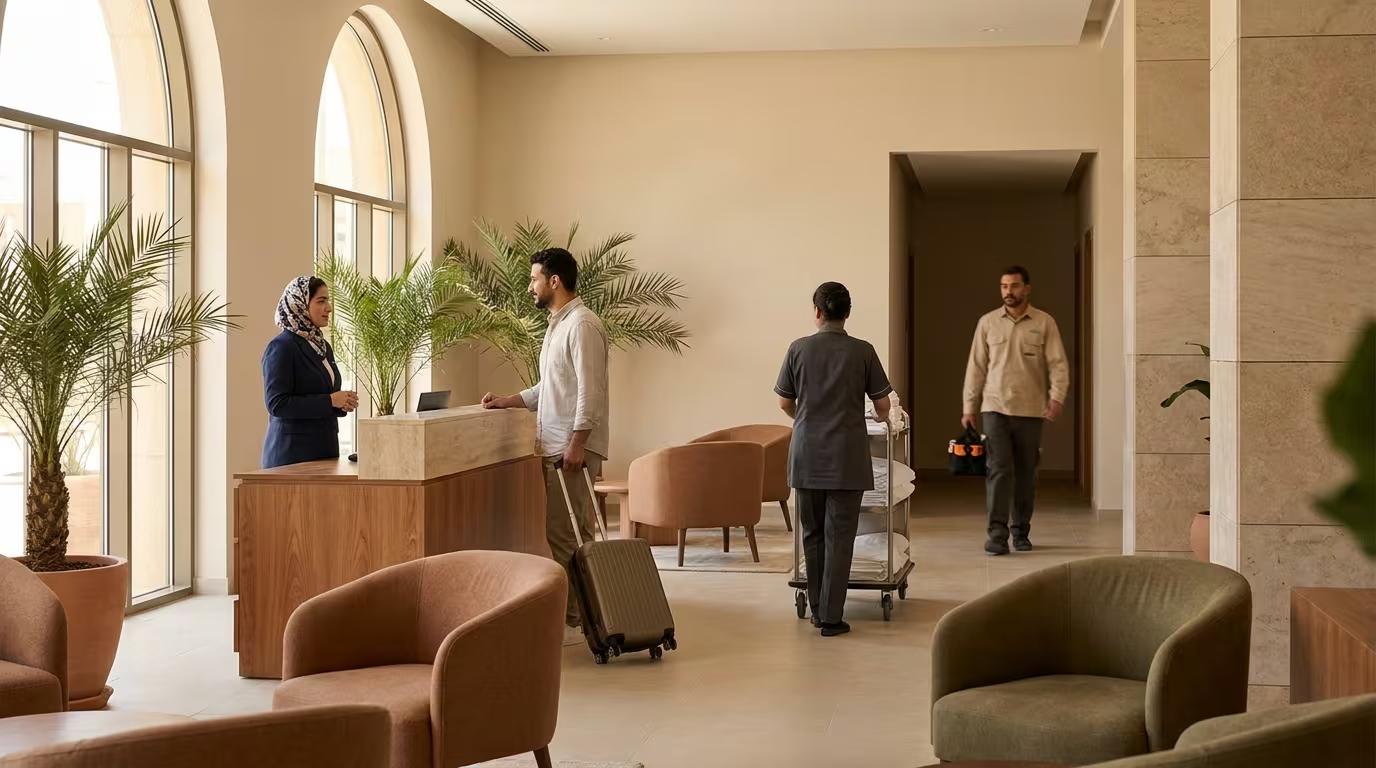
Serviced apartments occupy the space between a hotel and a home. Residents settle in, learn the team by name, and expect service without ceremony. A small staff covers reception, housekeeping, and maintenance between them. The uniform has to hold that balance: professional enough to signal duty, relaxed enough to belong in a residential corridor, and clear about who does what.
Between Hotel and Home
A serviced apartment sits in an unusual place between hospitality and housing. Guests are not passing through for a night; they unpack, cook, receive laundry, and learn the names of the people who look after their unit. That familiarity changes what a uniform has to do. In a conventional hotel, the garment carries almost all of the identification work because the encounter is brief and anonymous. In a long-stay property, the relationship does the identifying, and the uniform shifts toward reassurance: a visible signal that the person at the door belongs to the building, is on duty, and has a defined role. Procurement teams who simply copy a downtown hotel specification usually end up with something that reads as too ceremonial for a residential corridor, or so casual that a resident cannot tell staff from another tenant. The useful brief sits between those poles: unmistakably professional, quietly worn, and consistent enough that residents stop noticing it and start trusting it.
Fewer People, More Roles
Long-stay properties usually run leaner than full-service hotels. One person may greet arrivals in the morning, handle a package at noon, and walk a resident through a faulty air conditioner in the evening. That multi-tasking is efficient, but it erodes the visual language guests rely on, because a single garment ends up representing several jobs. The practical answer is a family of pieces built on one shell rather than several unrelated outfits. Keep the base colour, the badge position, and the collar treatment constant, then let a layer do the switching: a tailored overshirt or waistcoat for reception duty, an apron or tunic for apartment servicing, a work shirt for technical calls. Staff change one item instead of a whole uniform, and residents still read the role at a glance. It also simplifies the stock room, since the shared base garment carries most of the wear and the role layers can be ordered in smaller, faster-moving quantities without stranding sizes across four separate programmes.
Reception: Formality, Softened
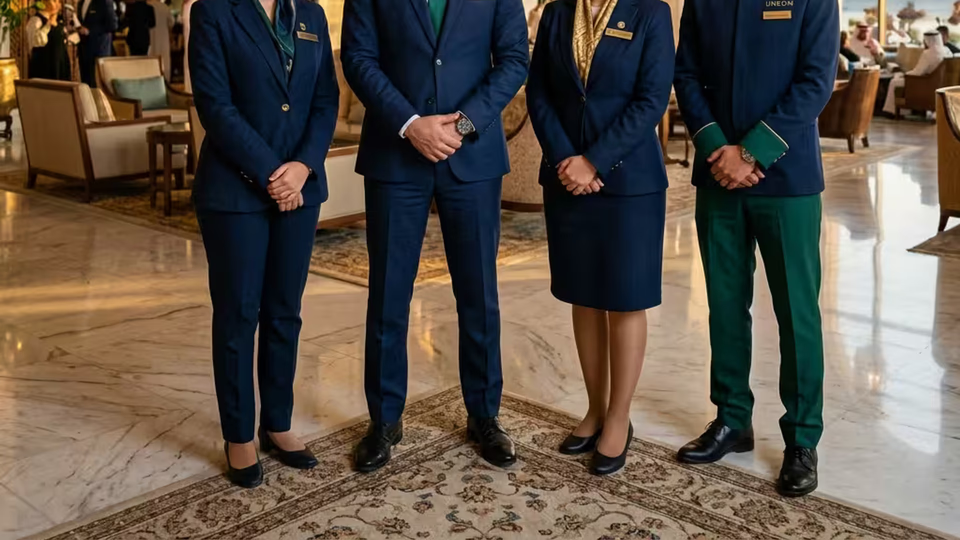
Reception in an aparthotel greets the same faces every day, which makes rigid formal tailoring feel out of place while a polo shirt gives up too much authority. A softened business register works better: a structured jacket or waistcoat over a breathable shirt, matte finishes rather than sheen, and a colour drawn from the building's interior palette so the desk reads as part of the residence. Fabric choice matters more than cut here, because the garment is worn through long shifts in mixed conditions — cooled lobbies, hot loading bays, and the walk to a parking level in Riyadh or Jeddah in summer. Polyester-rich blends hold their press and colour through frequent laundering and dry quickly, while higher cotton content improves next-to-skin comfort and moisture absorption; the sensible specification balances the two rather than chasing one property. For women, a longer-line jacket, extended sleeve, and a coordinated hijab in the same dye lot keep the look deliberate rather than improvised, and give staff options that suit their own preference.
Housekeeping Inside a Home
Housekeeping in extended stay is a different job from turning a hotel room. Servicing happens on a cycle the property sets rather than every morning, apartments contain personal belongings, and the work includes kitchens, appliances, and resident laundry alongside bathrooms and beds. Entering a home rather than a room raises the bar for how staff present: a clean, well-fitted tunic or apron dress, closed non-slip footwear, a legible badge, and no loose trims that can catch on furniture. Because the work is heavier and involves grease, limescale, and cleaning chemistry, the garment needs abrasion resistance, colourfastness through repeated hot washes, and a shade that stays presentable rather than showing every splash. Articulated sleeves, a gusseted underarm, and a small amount of elastane make reaching and kneeling less punishing across a shift. Provide enough sets per person that nobody is forced into a damp or stained garment, and specify a pocket layout that carries a phone, a key card, and a cloth without sagging or rattling against door frames.
Maintenance in Front of Residents
Technical staff in a serviced apartment work in front of an audience. A chiller repair, a leaking mixer, or a tripped breaker is handled with the resident and often their family in the room, so the technician's clothing has to satisfy two requirements at once: the protection the task and the property's risk assessment demand, and an appearance that does not feel like a construction site has arrived in the living room. A neat work shirt and trousers in a durable blend, with reinforced knees and a tool-friendly pocket layout, generally reads better indoors than heavy coveralls, with task-specific protective equipment added when the job calls for it. Keep hi-visibility elements on the plant-room and rooftop layer rather than the corridor layer, and let the badge and shirt colour do the identifying inside the building. Shoe covers, a clean drop cloth, and a spare shirt for the second half of a hot day cost little and do more for perceived professionalism than any amount of logo placement.
Running the Programme Over Seasons
A long-stay uniform programme is judged over seasons, not at handover. Small teams turn over, new hires arrive mid-quarter, and one missing size can put a person in front of residents in the wrong garment for weeks. Build the programme around a documented size set with garments physically tried on rather than measured from a chart, a held buffer of the fastest-moving sizes, and a named owner for reorders so replenishment does not depend on someone remembering. Include modest options as standard rather than exceptions: longer tunics, full-length sleeves, higher necklines, trousers cut for coverage, and matched headscarves, so Saudi women joining guest-facing roles under national employment plans choose from the same catalogue as everyone else. Bilingual name badges in Arabic and English suit a resident mix that spans both. UNEOM manufactures inside the Kingdom and has done since 2013, works to ISO 9001:2015, and holds OEKO-TEX Standard 100 certification for tested articles, which shortens the distance between a sizing problem on site and a corrected delivery.
Frequently asked
- How is a serviced apartment staff uniform different from a hotel uniform?
- The difference is relationship rather than standard. Residents know the team by name, so the uniform works less as identification and more as a signal of duty and role. In practice that means a softer formality than a city-centre hotel, a colour palette that suits a residential building, and clearer separation between reception, housekeeping, and maintenance layers within a smaller team.
- Should reception, housekeeping, and maintenance look different in a small aparthotel team?
- Yes, but through layers rather than separate outfits. Keep one base garment, one badge position, and one colour across the team, then mark duty with an overshirt or waistcoat at reception, an apron or tunic for apartment servicing, and a work shirt for technical calls. Residents read the role instantly and stockholding stays simple.
- Which fabrics suit extended stay housekeeping in Saudi summer conditions?
- Blends usually win. Polyester content brings abrasion resistance, colour retention through hot institutional washing, and fast drying; cotton content brings absorbency and comfort against the skin in heat. A little elastane helps with reaching and kneeling. Choose a shade that hides light soiling without showing dust, and test the fabric against your own laundry chemistry before committing.
- How many uniform sets should a long-stay property issue per employee?
- Work from the laundry cycle rather than a fixed figure. Count the shifts a person covers between wash returns, add cover for a garment pulled out of service by a stain or tear, and hold a buffer in the fastest-moving sizes. Confirm the quantity with a short trial on the real rota before scaling it across the property.
- How should a long stay hotel uniform accommodate modest dress?
- Treat modest options as part of the standard range, not a special order. Offer longer tunics, full-length sleeves, higher necklines, coverage-cut trousers, and headscarves matched to the uniform dye lot, then let staff choose what they prefer. Keeping every option in one catalogue means women joining guest-facing roles are dressed to the same standard as their colleagues.