Security Guard Uniform Standards in Saudi Arabia: A Procurement Guide
How Saudi security companies specify guard uniforms that read as professional, stay distinct from official uniforms, endure summer heat and long shifts, and survive a client audit.
Private security uniforms in Saudi Arabia carry an unusual burden: they must project authority, stay clearly distinct from official state uniforms, survive long outdoor shifts in extreme summer heat, and hold up to client audits. This guide sets out how procurement and operations teams can specify guard attire that satisfies all four demands.
The uniform as an operational control
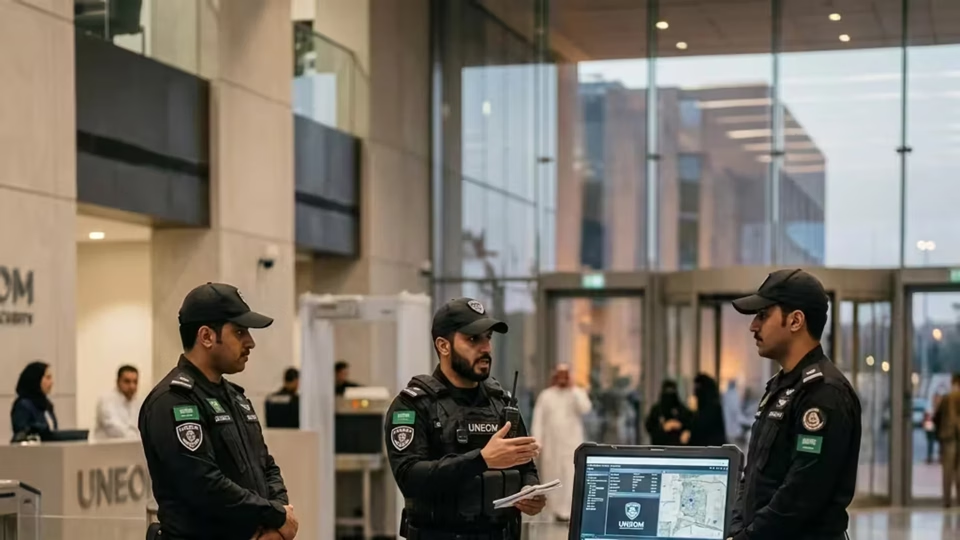
A private security uniform does the work of a first impression and a control at the same time. Before a guard speaks, the garment tells a visitor whether this person is authorised to be at the gate, who employs them, and what they may reasonably be asked to do. That is why procurement teams should treat security attire as an operational specification rather than a styling choice. The specification has to answer several questions at once: is the wearer identifiable at a distance and on camera, is the company clearly named, is the uniform visually distinct from the clothing of official state bodies, and does it survive long standing shifts in Saudi conditions without looking neglected by mid-rotation. Those goals sometimes pull against each other. A darker, heavier fabric photographs as authoritative but behaves poorly at an unshaded gate in July. A lighter, softer garment stays comfortable but loses its crisp line quickly. Good programmes name the priority order in writing before samples are requested, so trade-offs are decided deliberately rather than discovered after deployment.
Distinction from official uniforms
The single most consequential design question in Saudi private security attire is also the one a supplier cannot answer for you: how far the uniform must stand apart from the clothing worn by state security and military bodies. Private security in the Kingdom operates under a licensing and supervision framework, and clients running industrial or energy facilities may additionally face security requirements set by their own regulator or by bodies such as the High Commission for Industrial Security. What those frameworks say about colour, cut, insignia and titles changes over time and is interpreted by the competent authority, not by a garment factory. Treat any confident claim about specific banned shades or mandatory patterns with suspicion unless it is quoted from a current official document. The practical route is to draft the concept, put it in front of your legal or compliance function, and obtain the authority's or client's written view before tooling and bulk cutting begin. Manufacturers should support that review with clear technical drawings, colour references and insignia layouts, then build only what has been cleared.
Insignia, rank and identification
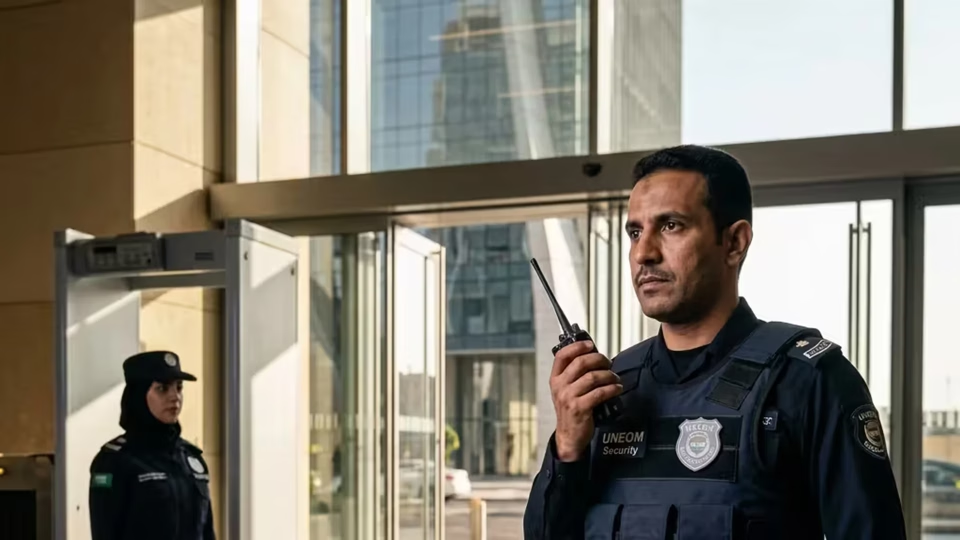
Identification is the part of the uniform most likely to be examined closely, and the part most likely to fail first. A typical specification carries the company name or mark, a rank or role indicator, a name or number for accountability, and sometimes a site-specific patch required by the client's contract. Each of these can be applied by embroidery, woven patch, hook-and-loop panel, or heat transfer, and the choice is a maintenance decision as much as an aesthetic one. Direct embroidery holds up well through repeated industrial laundering but locks the garment to one rank and one site. Removable panels keep the same shell usable when a guard is promoted or redeployed, at the cost of a visible fastening and periodic replacement of the panel itself. Heat-applied marks look clean initially but are the most vulnerable to lifting under high wash temperatures and abrasion. Whatever the method, keep placement, size and wording under document control, because inconsistent insignia across a shift undermines exactly the authority the uniform is meant to project.
Heat at the static post
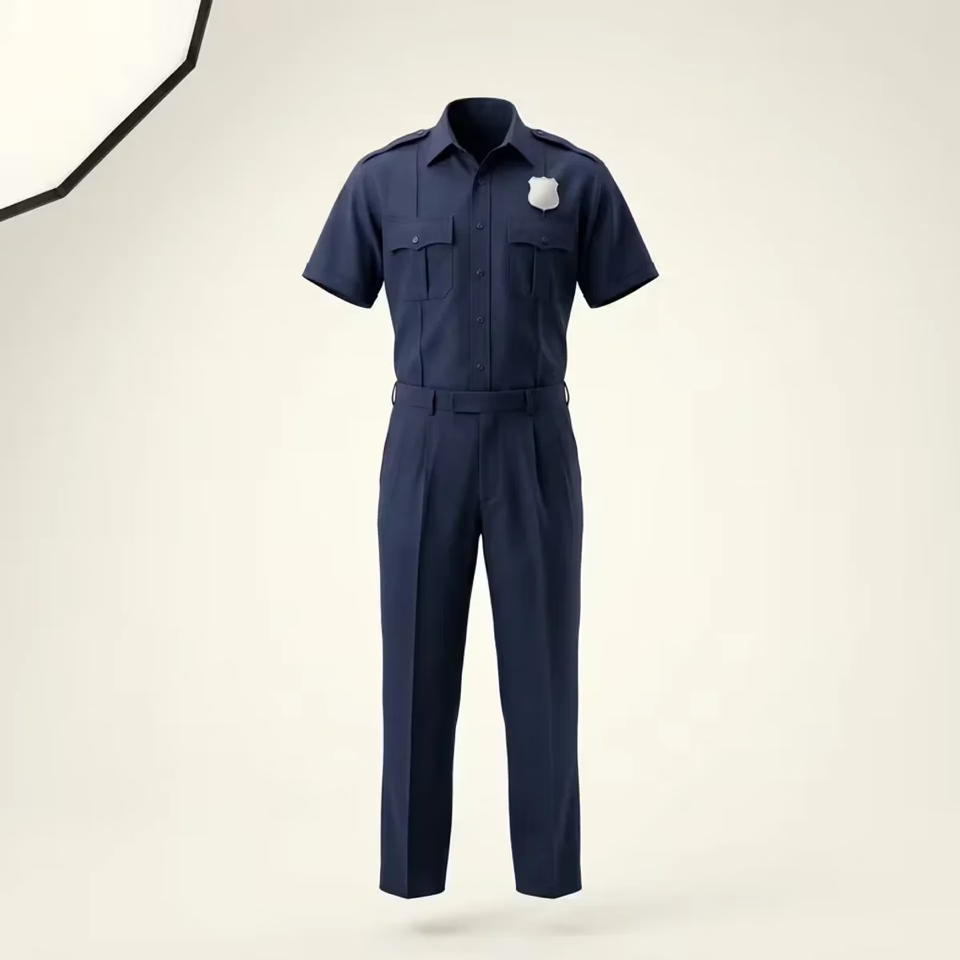
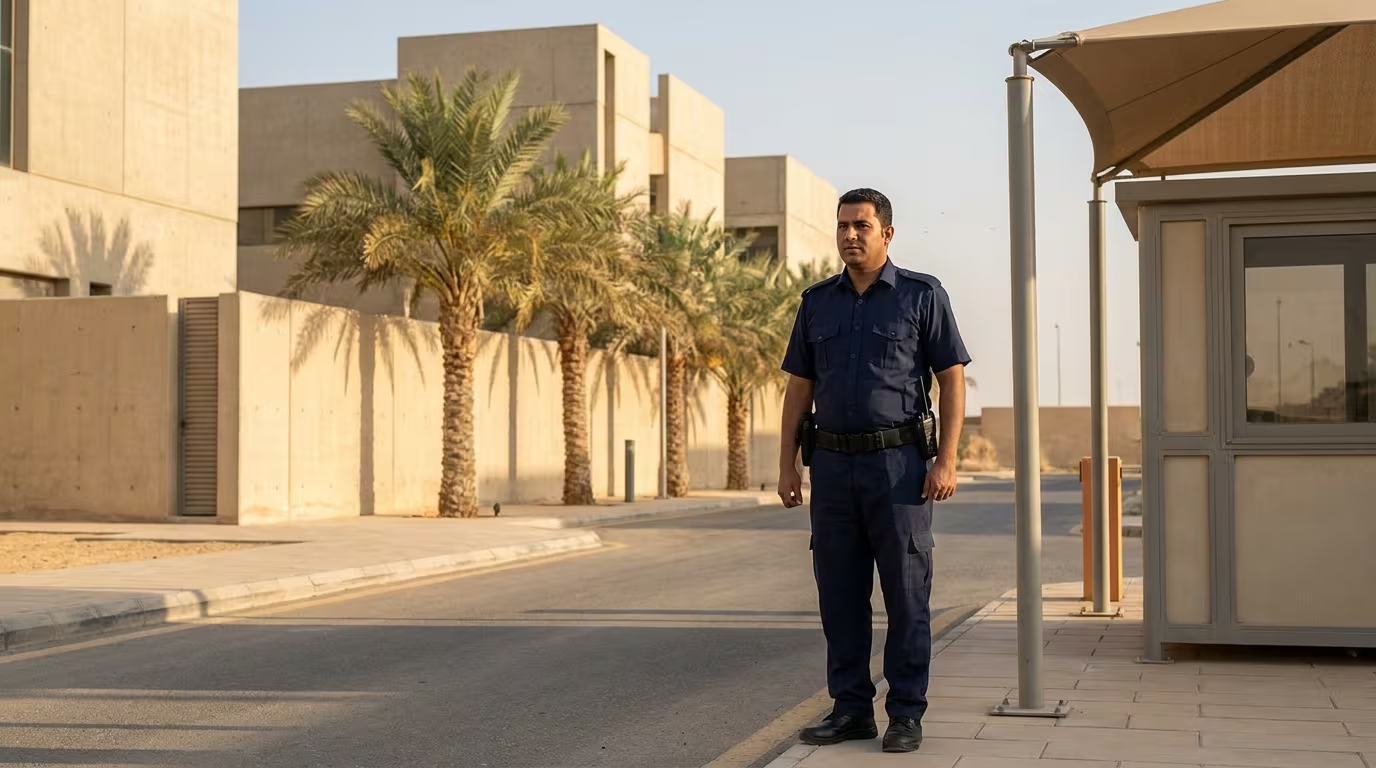
Guarding is largely static work performed where the shade is not. A guard at a vehicle gate in Riyadh or Jubail during the summer stands in direct sun with little air movement, wearing a garment that must still look formal at the end of the shift. Fabric choices here are about heat transfer rather than marketing language. Lighter constructions and more open weaves move air and water vapour more readily than dense, heavy ones. Polyester-rich blends dry quickly and hold a pressed appearance, while higher cotton content generally feels cooler against damp skin but creases and dries more slowly; most duty shirts land somewhere between the two for that reason. Lighter surface colours reflect more solar radiation than dark ones, which matters at an exposed post even when the contract calls for a dark identity. Fabric alone, however, does not manage heat stress. Shade structures, rotation off exposed posts, drinking water availability and the summer midday work rules applied at your site belong in the risk assessment, not in a textile specification.
Durability, fit and the wardrobe
Security wardrobes fail in predictable places, and a specification that names them survives longer than one that does not. Duty belts abrade the waistband and lower back; radios and torches wear the shoulder and chest area; repeated sitting in a guardhouse chair polishes the seat of the trouser. Reinforced seams, bar-tacked stress points, fabric with adequate abrasion and tear resistance, and colourfast dyeing that holds through many industrial wash cycles are worth more over a contract than a lower unit price. Fit is the other quiet driver of both appearance and retention. A guard who cannot reach comfortably or whose collar tightens after laundering will look untidy no matter what the drawing said. Size sets should be trialled on real shift patterns before bulk release, and the range should include garments cut for women in the service, with longer tops, modest coverage and headscarf-compatible collars offered as standard options rather than exceptions. Finally, agree replacement triggers up front, so worn kit is retired on a rule rather than on a complaint.
Documentation at audit
When a facility client audits a security contractor, the uniform becomes a paperwork question. Expect requests for the approved technical specification with fabric composition and construction details, colour and insignia references matching what was cleared, supplier quality documentation, issue records showing who received which items and when, and the wear and replacement policy the guards are actually held to. Certificates carry weight when they are the right ones and are read accurately: a quality management certification such as ISO 9001:2015 speaks to how the manufacturer controls its processes, while OEKO-TEX Standard 100 concerns tested limits on harmful substances in the textile itself. Neither is a performance guarantee for a particular garment, and presenting them as such invites a difficult conversation with an auditor. UNEOM manufactures inside the Kingdom and has done since 2013, holds ISO 9001:2015 and OEKO-TEX Standard 100, and supplies the specification and traceability documents that support this kind of review. Local production also shortens the loop when a client-driven design change has to be re-approved and re-issued mid-contract.
Frequently asked
- Does a private security uniform have to look different from official uniforms in Saudi Arabia?
- Yes, visual distinction from state security and military dress is a core design constraint, but the specific limits are set and interpreted by the competent authority, not by a supplier. Draft your concept with drawings, colour references and insignia layouts, then obtain a written view from the authority or your client before production begins.
- What fabric works best for outdoor guard posts in the Saudi summer?
- There is no single answer, but the direction is consistent: lighter weight, a construction that lets air and vapour move, and a blend that balances quick drying with comfort against damp skin. Test candidate fabrics on real posts through a summer rotation, and pair the choice with shade, water and rotation controls.
- Should rank insignia be embroidered or removable?
- It depends on how often guards change rank or site. Direct embroidery is the most durable through industrial laundering but ties a garment to one role. Removable panels preserve flexibility for promotions and redeployment while adding a fastening and a replaceable part. Many contractors embroider the company mark and keep rank and site markings removable.
- What documents will a client ask for when auditing our guard uniforms?
- Typically the approved technical specification with fabric composition and construction, the cleared colour and insignia references, supplier quality documentation such as ISO 9001:2015, textile certification such as OEKO-TEX Standard 100, issue records per guard, and the written wear and replacement policy. Keep these in one file, updated whenever the specification changes.
- How do we accommodate female security staff in the uniform range?
- Treat women's options as part of the standard range rather than a special request. That usually means garments cut for women, longer top lengths, coverage that suits the workplace, and collars that work with a headscarf. Confirm preferences with the team itself and with the client site, and include the options in the approved specification.