Hotel Cleaning Staff Uniform: Designing for Visibility and Respect
How to specify a hotel cleaning staff uniform that reads as professional rather than lesser: distinction without demotion, chemical durability, freedom of movement, heat, and pockets that work.
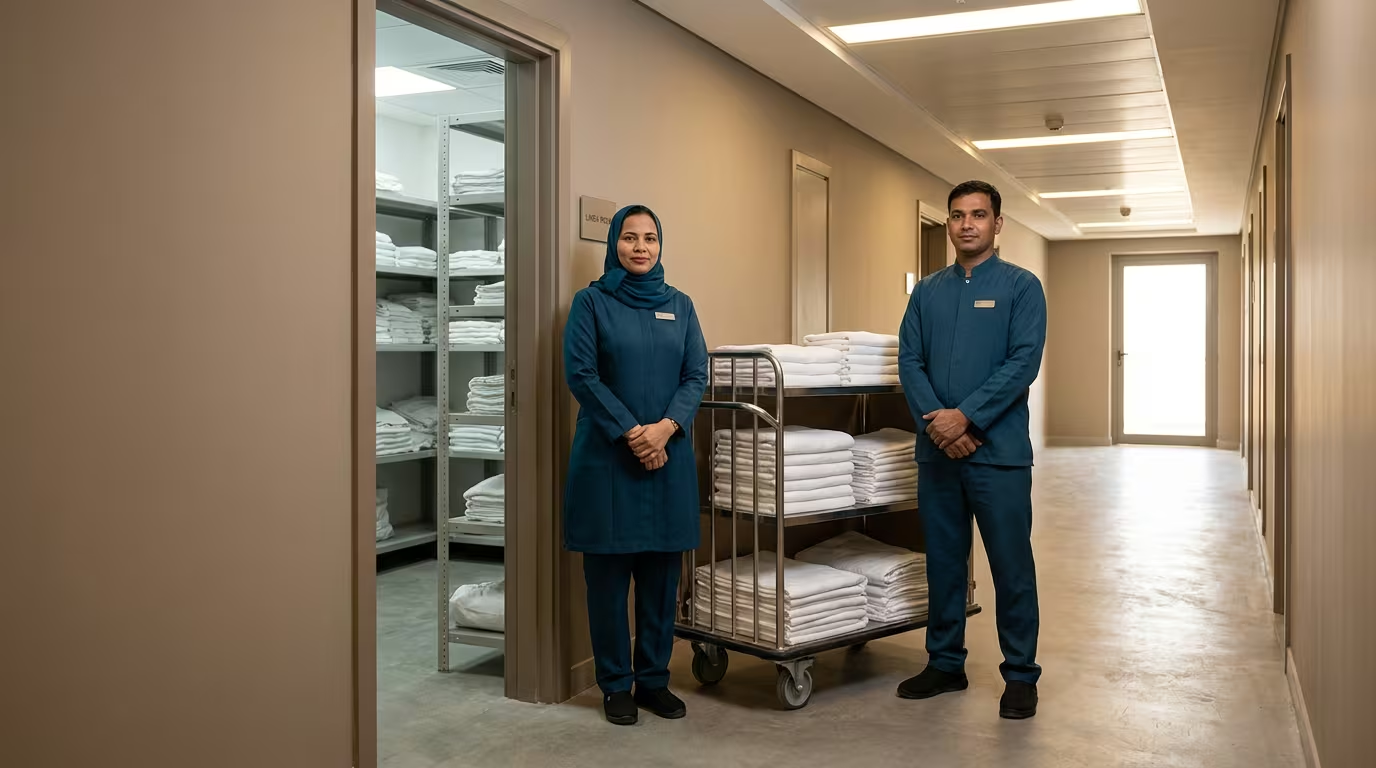
A hotel cleaning staff uniform is one of the clearest statements a property makes about how it values the people who keep it running. This guide covers the specification decisions that carry that message: distinction without demotion, durability against cleaning chemicals, freedom to bend and reach, heat in unconditioned service corridors, and pockets that actually work.
The Uniform as a Message
Housekeeping and cleaning teams spend their shift in the parts of a hotel most guests never study, yet their uniform is read constantly — by guests in corridors, by supervisors on rounds, and most of all by the people wearing it. A garment that is thinner, plainer, or visibly cheaper than what the front desk wears communicates a hierarchy no mission statement can undo. The opposite is also true. When the cleaning team's uniform is cut from the same quality of cloth, fitted with the same care, and finished with the same attention to collar, hem, and badge placement as guest-facing roles, the message is that support work is part of the property's standard rather than beneath it. For procurement and HR, this is not sentiment; it is a specification decision made at the tender stage. Fabric weight, colour palette, tailoring standard, and replacement frequency all encode how the organisation values the role, and staff notice each of these long before they mention them.
Distinct, Not Diminished
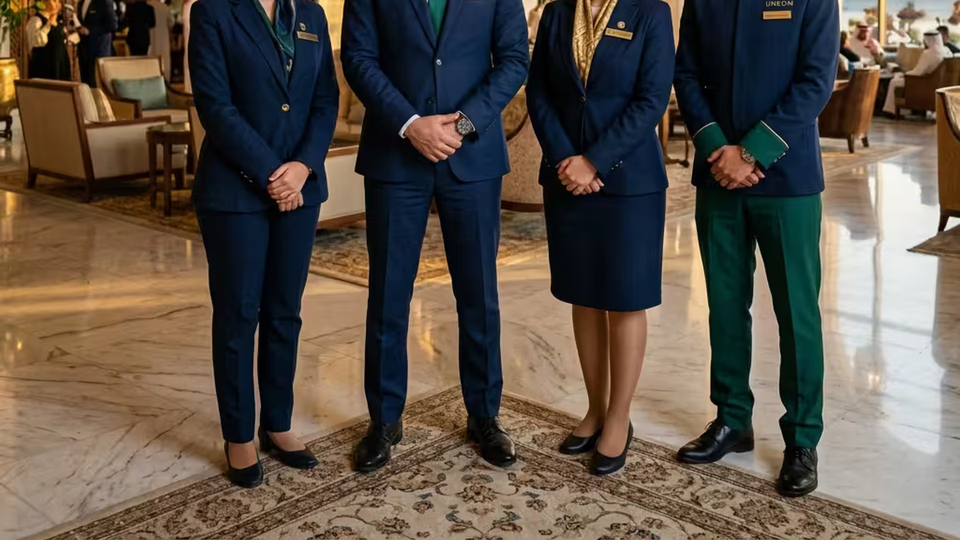
Operationally, a hotel needs to tell roles apart at a glance: a guest looking for help, a duty manager scanning a floor, and a security officer reviewing footage all benefit from clear role coding. The mistake is achieving that distinction by downgrade — a shapeless smock, a washed-out colour, or a fabric that reads as disposable. Distinction is better carried by deliberate design signals that carry no status penalty: a different but equally considered colour from the brand palette, a contrast yoke or piping, a distinct collar treatment, or an embroidered role title rather than a stamped label. Keep the silhouette tailored, keep the trim quality identical across departments, and let the colour do the identification work. It also helps to name the department in language the property is proud to use, since the wording embroidered on a chest is worn every day. Where a hotel operates several brands or standards, apply the same rule inside each: differentiate horizontally between teams, never vertically in perceived quality.
Visibility in Two Senses
Visibility has two meanings in this brief, and both matter. Socially, a cleaning uniform should make the wearer identifiable as a member of the hotel team rather than an anonymous contractor, which supports guest interaction, access control, and simple courtesy. Physically, parts of the job happen where lighting is poor and vehicles move: loading bays, basement car parks, service ramps, and night rounds through unlit back corridors. Where your risk assessment identifies traffic exposure, high-visibility elements belong in the specification — a reflective trim on the sleeve or back yoke, or a separate hi-vis vest kept at the dock — chosen against the relevant conspicuity standard rather than by appearance alone. Do not scatter reflective tape across every garment; it reads as industrial and undermines the hospitality register indoors. The practical answer is usually a base uniform designed for corridors and rooms, plus a defined outer layer issued for the specific zones and hours where visibility is a safety requirement, documented in the property's own PPE matrix.
Chemicals, Colour, and Wear
Cleaning uniforms meet what front-of-house fabrics never do: chlorine bathroom products, alkaline degreasers, acidic descalers, splashes from mop buckets, and an industrial wash that runs hotter and harsher than any domestic cycle. Two failure modes dominate, and they are separate problems. The first is colour loss, because bleach and strong oxidisers attack dye rather than fibre — a garment can be structurally sound and still look ruined, which is why deep saturated shades and dark navies usually show damage first. The second is structural wear at knees, cuffs, and the points that rub against a trolley. Polyester-rich blends generally hold shape, resist abrasion, and dry quickly, though they hold oily marks stubbornly; cotton-rich cloth breathes well and feels cooler against skin, but repeated chlorine bleaching degrades cellulose over time. Rather than trusting adjectives in a catalogue, run a wash trial with your own chemicals and laundry partner, comparing a cycled garment against a new one. UNEOM has manufactured inside the Kingdom since 2013 under ISO 9001:2015, with OEKO-TEX Standard 100 fabrics.
Cut for Bending and Reaching
A housekeeping shift is a sequence of postures rather than a standing pose: bending to strip a bed, kneeling at a bath edge, reaching over a mattress, pushing a loaded trolley down a long corridor. Garments cut for a static desk role fail all four. The details that matter are unglamorous — a longer back rise and a tunic length that stays put when the wearer bends forward, an action back or underarm gusset so the sleeve does not ride up when arms lift, a knee that has room to fold without straining a seam, and a waistband that does not dig when the body folds at the hip. Coverage should hold through movement, not only when standing still, and that single requirement solves both a modesty concern and a dignity concern at once. Offer trouser and long-tunic options, a properly graded women's block rather than a scaled-down men's pattern, and a hijab-compatible neckline and headwear option for staff who prefer it, with size runs wide enough that nobody is issued the closest available fit.
Heat, Layers, and Pockets
Guest floors are conditioned; service corridors, linen rooms, loading docks, and rooftop plant routes often are not, and a Saudi summer turns those spaces into the hardest part of the shift. Specify for the back of house, not the lobby. Lighter constructions, open weaves, moisture-moving finishes, and a cut that allows air to move under the garment do more for comfort than any single fibre claim, and a light long sleeve can be cooler than bare skin under direct sun on a rooftop or dock. Build the wardrobe in layers so staff can adapt between a cold laundry and a hot ramp instead of enduring both in one garment. Pockets deserve the same seriousness: a place for a phone that will not fall out during bending, a secure pocket for a master key or access card, a loop or clip for a cloth, and a badge position that stays readable. Add enough issued sets that nobody has to wear yesterday's uniform, and set a replacement trigger on appearance, not only on calendar age.
Frequently asked
- Should hotel cleaning staff wear a different colour from front-of-house teams?
- Yes, colour is the cleanest way to code roles at a glance for guests, duty managers, and security review. The condition is that the colour comes from the same brand palette and the garment carries the same tailoring and trim quality. Differentiate horizontally between departments; never let the distinction read as a downgrade in fabric or finish.
- What fabric handles cleaning chemicals best?
- There is no universally best cloth. Polyester-rich blends generally hold shape, resist abrasion, and dry fast but retain oily marks; cotton-rich fabrics breathe better yet weaken under repeated chlorine bleaching. Colour loss usually appears before structural failure, so test shade stability with your own chemicals and laundry cycle before you standardise on any construction.
- Do cleaning teams need high-visibility clothing inside a hotel?
- Not as a default. Base uniforms should suit rooms and corridors. Where a risk assessment identifies vehicle movement — loading bays, basement parking, service ramps, night deliveries — issue a defined high-visibility layer for those zones and hours, selected against the relevant conspicuity standard and recorded in the property's PPE matrix rather than applied to every garment.
- How do we make housekeeping attire comfortable in summer?
- Specify for unconditioned back-of-house areas, not the lobby. Favour lighter constructions, open weaves, and moisture-moving finishes, and cut the garment so air can move underneath. Build the wardrobe as layers so staff can adapt between cold linen rooms and hot loading ramps, and issue enough sets that a fresh uniform is always available.
- What should we include for women on the housekeeping team?
- Use a properly graded women's block rather than a scaled-down men's pattern, and offer coverage choices instead of a single mandated look: trousers, longer tunics, sleeve-length options, and a hijab-compatible neckline and headwear for staff who prefer it. Coverage should hold while bending and reaching, and the size run should fit everyone genuinely.