Bank Staff Uniform in Saudi Arabia: Tellers, Relationship Managers and Branch Identity
How tellers, relationship managers, greeters and branch leadership should look different — and consistent — across a Saudi bank network, from seated comfort to modest design and colour control.
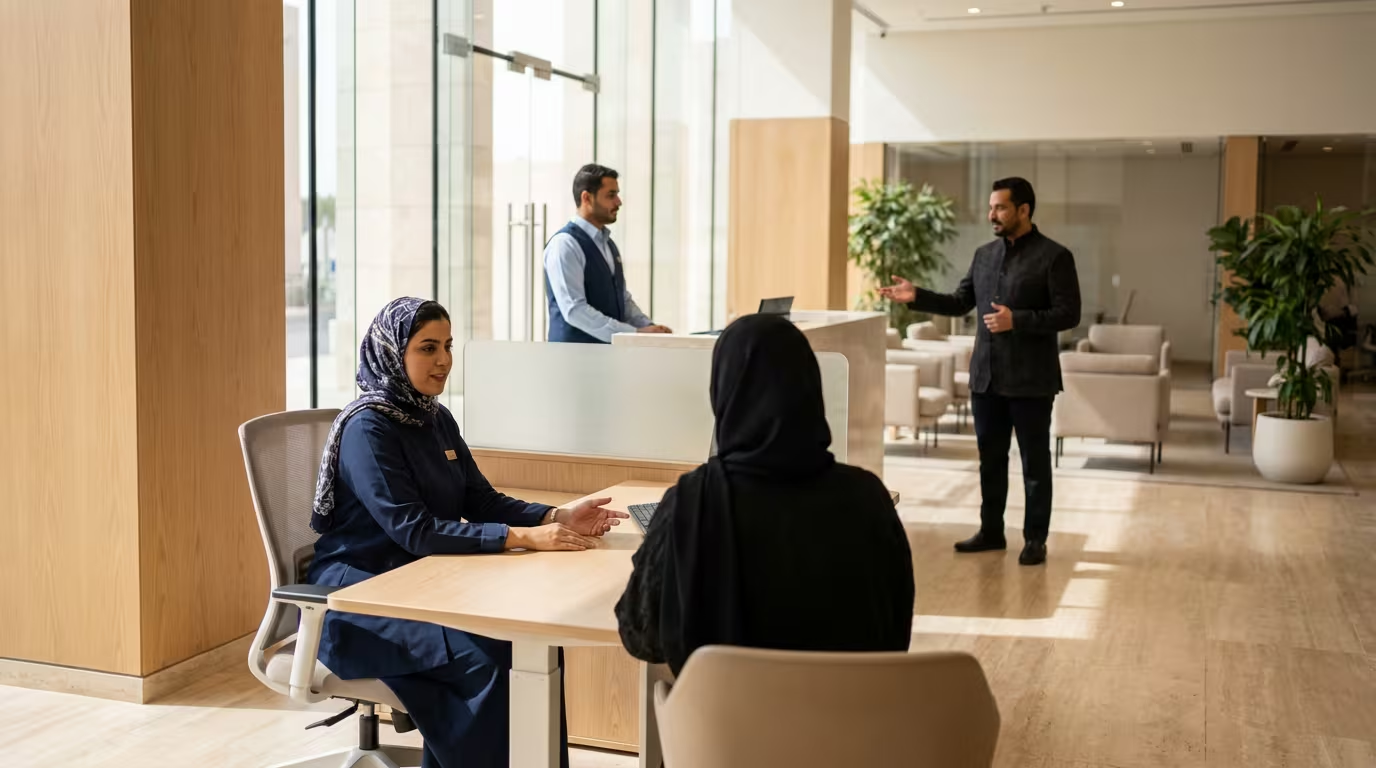
Walk into any branch and the first decision a customer makes is whom to approach. A bank staff uniform in Saudi Arabia has to answer that question before anyone speaks, while keeping tellers comfortable through long seated shifts, respecting modest dress, and holding the same colour across every branch in the network.
Reading the Branch at a Glance
A bank branch is one of the few remaining places where a customer walks in with a question and has to decide, within seconds, whom to approach. Signage helps, but people read other people first. A well-designed bank staff uniform in Saudi Arabia works as a wayfinding system: the person at the door looks approachable and mobile, the person behind the counter looks transactional and fixed, and the person seated at an open desk looks like someone you sit down with. That legibility is a service outcome, not a styling preference. When every role wears the same shirt in the same colour, customers queue at the wrong point, ask the greeter for something only a relationship manager can authorise, and leave with the impression that the branch is disorganised. The design question is therefore not what staff should wear, but what each role should signal and from how far that signal must be readable. Answer that first and the garment specification becomes a much simpler conversation.
The Teller Behind the Glass
The teller is framed like a portrait. From the customer's side of the counter, only the upper body is visible — collar, shoulders, chest, and whatever the glass or screen does not cut off. Everything below the counter line is invisible to the customer but is exactly where the wearer spends the day: seated, leaning forward, reaching for a drawer, turning to a printer. A bank teller uniform therefore needs two different design logics in one garment. Above the counter it should be crisp, colour-stable and clean at the collar and placket, because that band of fabric is under continuous inspection at close range. Below it, the priority is seated comfort and durability — a rise and back length cut for sitting rather than standing, sleeves that do not drag across a counter edge, and a fabric that tolerates chair-back abrasion without pilling into a shine. Polyester-rich blends hold pressed lines and colour through frequent laundering; a small amount of stretch helps the shoulder move without the shirt riding up.
Relationship Managers and Branch Leadership
Move away from the counter and the visual grammar changes. A relationship manager sits across a desk from a customer discussing financing, salary transfer or a portfolio, and the conversation is longer, quieter and more consultative. Relationship manager attire should read as advisory rather than operational: a tailored jacket or a structured overshirt, a defined shoulder, and a colour palette that is closer to the corporate identity than to the service line. The jacket does most of the signalling, which is why many programmes issue it as the differentiator while keeping the shirt beneath common across roles — simpler to stock, and instantly reversible when someone is promoted. Comfort here is a seated problem again, but a different one: jackets worn all day in an air-conditioned branch need armhole height and back width that allow leaning forward over a screen without the collar lifting off the neck. Branch managers usually sit one step further, distinguished by a deeper shade or a finer cloth rather than by a different silhouette.
The Host at the Door
The host or floor guide at the entrance has the hardest brief in the branch. They are the first person a customer sees, often from several metres away and against the glare of a glass façade, and they spend most of the day on their feet or walking between the queue system, the self-service machines and the waiting area. Branch staff dress standards for this role should prioritise readability at distance and freedom of movement: a strong, unambiguous colour block on the torso, a clean silhouette that stays tidy while moving, and a name or role badge positioned where it is visible to someone standing rather than seated. Because this person moves between the cooled interior and the doorway, where a 45-plus-degree afternoon pushes heat inside every time it opens, breathable fabric and a layer that can be added or removed matters more here than anywhere else in the branch. A jacket that must stay closed for appearance reasons is the wrong garment for a role that is constantly in motion.
Modest Design, Seated All Day
Saudi branches now employ Saudi women across customer-facing roles in growing numbers, and a uniform programme that treats modest options as an afterthought will be visibly inconsistent within a month. The practical answer is to design the modest version first and derive the rest from it: longer tunic lengths that keep coverage when seated, sleeves that stay at the wrist when the arm is raised to a counter, opaque fabric that does not become sheer under branch lighting, and a neckline and closure that work with a scarf without bunching. Where an abaya is worn over the uniform, the visible layer becomes the scarf, the cuff and whatever shows at the front opening, so those elements must carry the colour code and the finish quality. Coordinating an approved scarf palette is usually more effective than issuing a single mandated style, because it respects personal preference while keeping the branch visually coherent. Fit should be reviewed on seated wearers, since a garment that looks correct standing can pull across the lap after ten minutes at a desk.
One Bank Across Every Branch
The hardest part of a branch uniform programme is not the design; it is keeping a network of branches from Jeddah to Dammam looking like one bank three years after launch. Colour drift is the usual culprit — a replenishment order cut from a different dye lot, a shade that shifts after repeated washing, a replacement jacket in a slightly warmer navy sitting next to the original. Controlling that requires a written specification held by the manufacturer rather than a purchase order repeated from memory: named fabric, locked shade references, retained approved samples, and the same construction on every reorder. A national sizing set with sealed fit samples per role prevents the slow slide into whatever happens to be left in the branch cupboard. UNEOM manufactures inside the Kingdom and has done since 2013, works to ISO 9001:2015 quality management, and certifies its fabrics to OEKO-TEX Standard 100 — which matters most for the parts of the garment worn against the skin all day. Local production also shortens the loop when a branch opens or headcount moves.
Frequently asked
- How should a bank teller uniform differ from what relationship managers wear?
- The teller is seen from the chest up across a counter, so the collar, shoulder line and colour stability carry the whole impression. A relationship manager is seen seated at an open desk in a longer conversation, so a tailored jacket or structured layer does the signalling. Keeping the shirt common beneath both simplifies stock and promotions.
- Should every role in the branch wear a different colour?
- Rarely. Too many colours read as noise and make replenishment harder. Most branches need three legible tiers: the person who greets, the person who transacts, and the person who advises. Differentiate with one clear variable — a jacket, a distinct shirt shade, or a contrast trim — and keep everything else identical across the network.
- What fabric suits staff who sit for most of the shift?
- Look for a blend that resists creasing at the lap and elbow, tolerates chair-back abrasion without going shiny, and holds its shade through frequent laundering. Polyester-rich constructions generally do this well; a little elastane helps the garment move and recover. Ask for a wear trial on real seated staff before committing to a network rollout.
- How do we handle modest requirements without splitting the programme in two?
- Design the modest version as the base garment and derive the shorter or lighter options from it. Keep one fabric, one colour reference and one construction, and vary length, sleeve and closure. Publish an approved scarf palette rather than a single mandated style, so coverage choices stay personal while the branch stays visually consistent.
- How do we keep colour consistent across many branches over several years?
- Lock the specification with the manufacturer, not the purchase order: named fabric, fixed shade references, retained approved samples and sealed fit samples per role. Reorder against those references rather than against last year's invoice, and check new deliveries against the retained sample under the same light before they reach a branch.