Saudi National Day Corporate Uniforms: Branding, Heritage, and the Green Deployment
The 72-hour procurement window, the green-shade specification problem, and how to avoid the post-September wardrobe crisis.
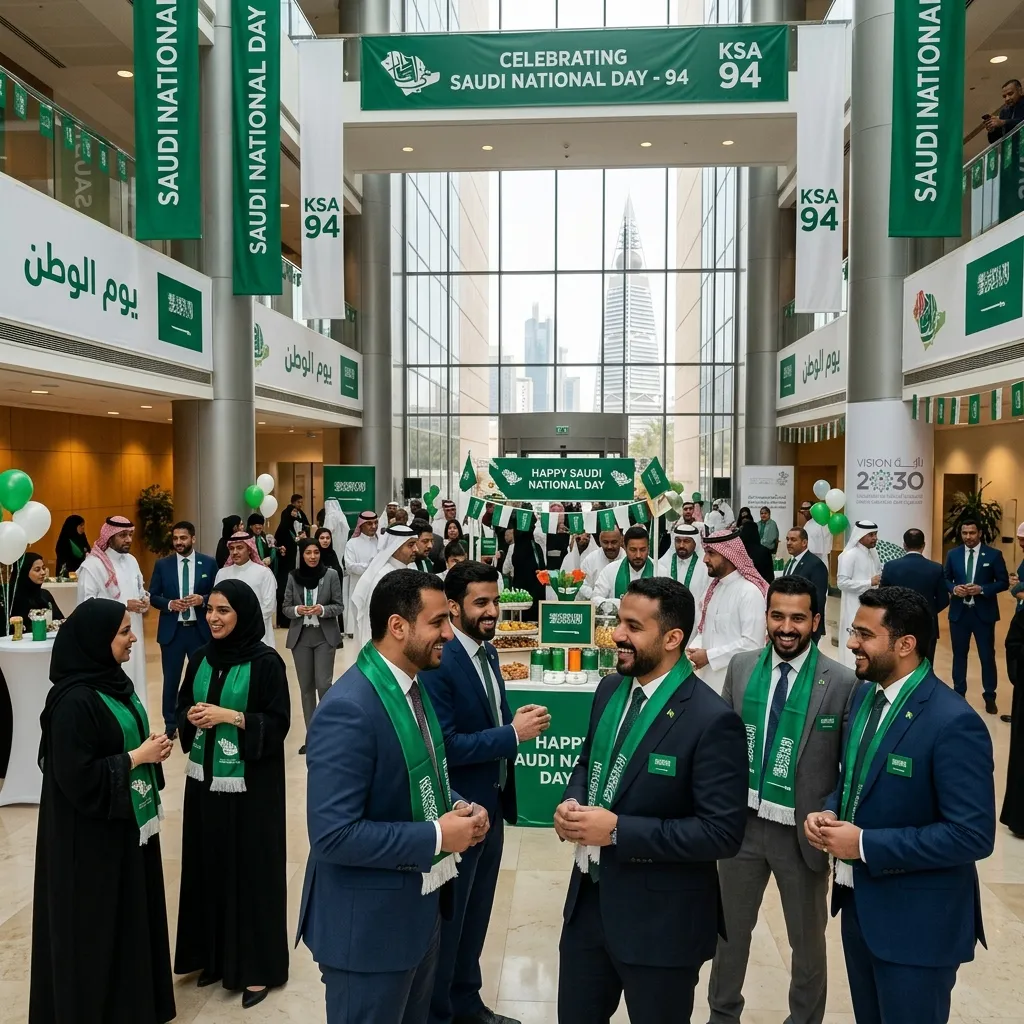
Saudi National Day — September 23rd — has evolved from a public holiday into the Kingdom's largest corporate branding event. Every Saudi-based organisation, from banks to hospitals to retail chains, deploys green-themed uniform elements for the week surrounding the celebration. The result is an annual procurement spike that overwhelms unprepared suppliers and leaves late-ordering organisations scrambling for green accessories that do not match their brand palette, do not fit their staff, and will not survive the event's laundry demands. UNEOM's National Day programme converts this annual crisis into a managed brand activation by treating it as what it is: a seasonal uniform deployment requiring the same programme discipline as any other.
The green-shade specification problem
Saudi National Day green is not a single colour — it is a spectrum. The Saudi flag uses a specific green that is darker and more saturated than the institutional green used by many government entities, which is itself different from the bright green used in National Day decorations and marketing materials. When a corporate client requests green uniforms for National Day without specifying a Pantone reference, the delivered shade is unpredictable — and when multiple suppliers provide different elements of the same National Day kit, the result is a patchwork of greens that looks uncoordinated rather than celebratory. UNEOM has catalogued 14 distinct green shades used across Saudi National Day corporate deployments, ranging from Saudi flag green at Pantone 349 C through institutional green at Pantone 356 C to celebration green at Pantone 361 C. Each shade carries different cultural associations: flag green is authoritative and formal, institutional green is government-aligned, and celebration green is festive and accessible. The choice of shade should align with the organisation's National Day messaging: a bank marking the occasion with formal patriotic messaging would use flag green, while a retail chain creating a festive customer experience would use celebration green. UNEOM's National Day programme begins with a shade-selection consultation where the client's marketing team selects the target green from our 14-shade reference library, views physical fabric swatches in the selected shade, and approves a dye-lot sample before production begins. This process eliminates the shade-mismatch problem entirely — every element of the National Day kit, from ties and pocket squares to hijab accents and lapel pins, is produced from the same dye lot, ensuring perfect colour consistency. The shade-selection consultation happens in June — three months before National Day — because dye-lot production and approval requires four weeks, and garment production requires an additional four weeks. Organisations that begin procurement in September are too late for matched production and will receive whatever shade their supplier has in stock.
The accessory programme: maximum impact, minimum waste
Most organisations do not need — and should not purchase — complete National Day uniforms. The base uniform programme remains the standard corporate attire; the National Day deployment adds green accent accessories that transform the existing uniform into a patriotic statement without the cost and waste of single-use green garments. UNEOM's National Day accessory programme includes seven elements, any combination of which can be deployed: silk ties in the client-specified green shade at SAR 45 per unit, silk pocket squares at SAR 35, silk hijab accent panels that attach to the existing programme hijab at SAR 40, lapel pins in custom design featuring the client logo with National Day theming at SAR 15, wrist bands in woven green fabric at SAR 8, lanyards with green ribbon and National Day graphics at SAR 12, and face-mask covers in green fabric for healthcare and hospitality staff at SAR 10. The accessory approach provides three advantages over full green uniforms. First, cost: a full green shirt-trouser set costs SAR 350 to 500 per employee and will be worn for one week before returning to the standard uniform — a per-wear cost of SAR 50 to 70 that is difficult to justify for non-customer-facing staff. The accessory programme costs SAR 60 to 100 per employee and can be reused across multiple National Day celebrations if stored properly. Second, waste reduction: a full green uniform that is worn for one week and then stored for 11 months occupies wardrobe space, ages visually, and frequently does not fit the following year due to staff body changes. Accessories have no fit dependency and occupy minimal storage space. Third, brand consistency: the base uniform remains the organisational standard, preserving the brand identity investment, while the green accessories add the patriotic layer without replacing the brand layer. UNEOM manages the National Day accessory programme as a standing seasonal order: clients confirm their deployment quantities by June 30th, and UNEOM produces and delivers by September 15th — one week before National Day. Late orders received after July 31st are fulfilled from standard green stock without shade-matching guarantee.
Heritage integration beyond green
The most sophisticated National Day uniform deployments go beyond green colour to incorporate Saudi heritage design elements that communicate cultural pride through craft rather than colour alone. UNEOM offers three heritage-integration options for clients seeking a premium National Day presentation. Option 1 is Sadu-weave accent panels: hand-woven Sadu fabric — the traditional Bedouin geometric weaving technique — integrated as pocket squares, tie accent panels, or hijab borders. The Sadu patterns are sourced from Saudi artisan cooperatives in the Al-Jouf and Northern Borders regions, supporting traditional craft preservation while providing an authentically Saudi design element that cannot be replicated by generic suppliers. Each Sadu panel is individually unique due to the hand-weaving process, creating a conversation piece that reinforces the organisation's cultural commitment. Option 2 is Arabic calligraphy embroidery: the organisation's name or a National Day phrase rendered in traditional Thuluth or Naskh calligraphy, machine-embroidered in green thread on the standard uniform shirt or blazer. The calligraphy is designed by a professional Arabic calligrapher who creates a custom lettering specific to the client — not a computer-generated Arabic font, but a genuine calligraphic composition. The embroidery is positioned at the left chest or right sleeve, depending on the client's preference and the base uniform's existing embroidery layout. Option 3 is heritage colour palette: instead of a single green, the National Day deployment uses a palette derived from Saudi geographical heritage — desert gold, Red Sea coral, Hejazi terracotta, and Najdi green — applied across the accessory range to create a richer visual statement than monochrome green. This palette approach is particularly effective for hospitality and retail clients whose customer-facing staff serve as the physical embodiment of the organisation's National Day celebration.
Programme timeline and logistics
The National Day uniform programme operates on a fixed annual timeline that clients must understand to avoid the procurement crisis that affects 40% of Saudi organisations each September. The timeline is as follows: April is the design phase — UNEOM's design team presents the coming year's heritage collection and clients select their deployment concept. This is also when new clients are onboarded and existing client measurements are verified. May is the shade selection and approval phase — clients confirm their green shade from the 14-shade library, approve dye-lot samples, and finalise accessory selection. June is the ordering deadline — final quantities confirmed by June 30th. This deadline allows for production scheduling and fabric procurement. July is the production phase — all National Day accessories and custom elements are manufactured, quality-inspected, and packaged. August is the quality assurance and staging phase — finished goods undergo final inspection, are sorted by client and distribution point, and are staged for September delivery. September 1st to 15th is the delivery window — all National Day programme elements are delivered to client distribution points, which may be corporate offices, hotel properties, hospital departments, or retail locations. September 16th to 30th is the deployment period — staff receive their National Day accessories, receive wearing guidelines, and deploy for the celebration period. For organisations with multiple locations across Saudi Arabia, UNEOM manages the logistics centrally, shipping to each location based on the location-specific staff count and size profile. The largest single National Day programme UNEOM manages covers 12,000 employees across 340 locations in 24 Saudi cities — a logistics operation that requires the same programme discipline as any permanent uniform deployment. After National Day, UNEOM offers a recovery service: collection, laundering, quality inspection, and climate-controlled storage of reusable accessories until the following September. Clients using this service reduce their annual National Day programme cost by approximately 45% because the stored accessories replace new procurement for the following year.
Frequently asked
- When should National Day uniform procurement start?
- April for design, May for shade selection, June 30th ordering deadline. Starting in September means no shade matching and limited stock availability.
- Do we need full green uniforms?
- No — UNEOM recommends green accent accessories (SAR 60-100 per employee) over full uniforms (SAR 350-500) for cost efficiency, waste reduction, and brand consistency.
- Which green shade should we use?
- Depends on messaging: flag green (Pantone 349C) for formal patriotic, institutional green (356C) for government alignment, celebration green (361C) for festive customer-facing.
- Can National Day accessories be reused next year?
- Yes — UNEOM offers a recovery service (collection, laundering, storage) that reduces following-year programme cost by approximately 45%.
- What heritage options are available beyond green?
- Sadu-weave accent panels from Saudi artisans, professional Arabic calligraphy embroidery, and a heritage colour palette (desert gold, Red Sea coral, Hejazi terracotta, Najdi green).