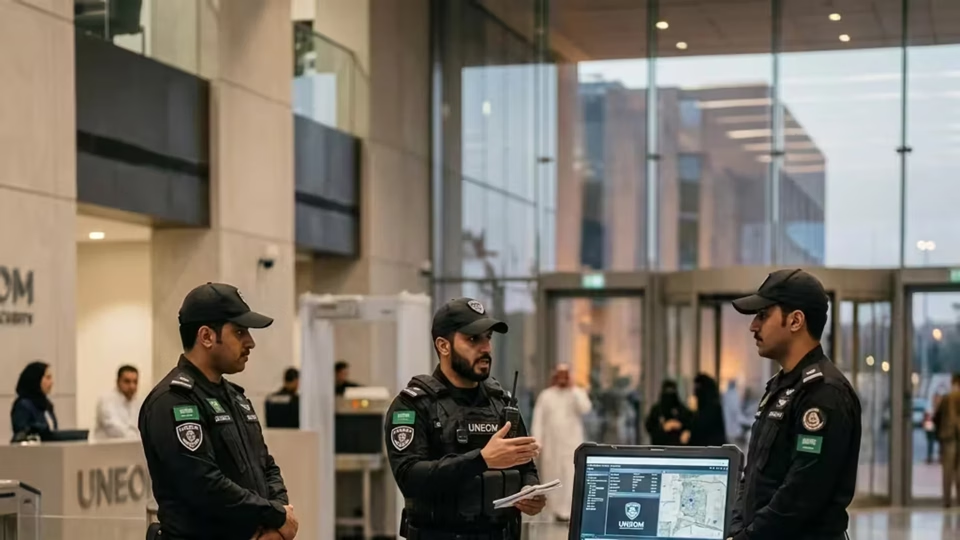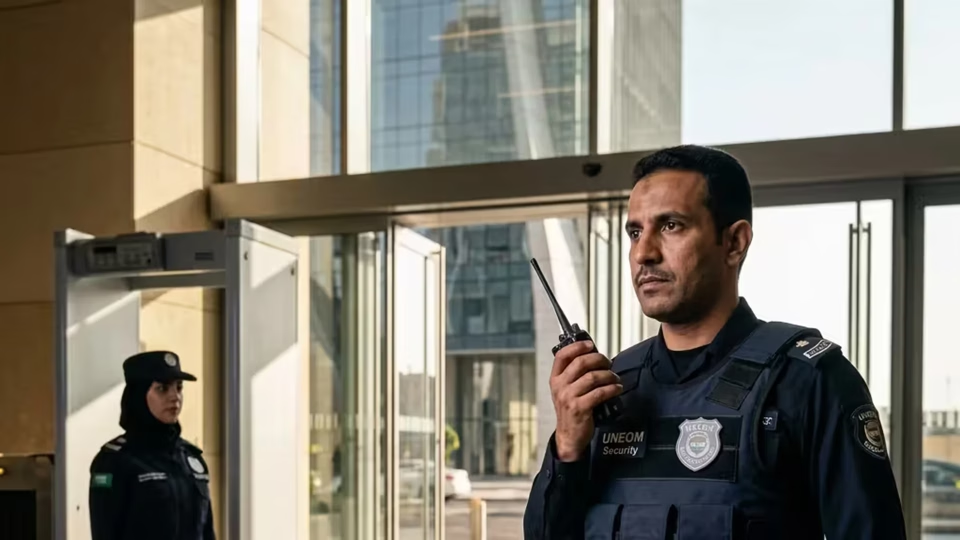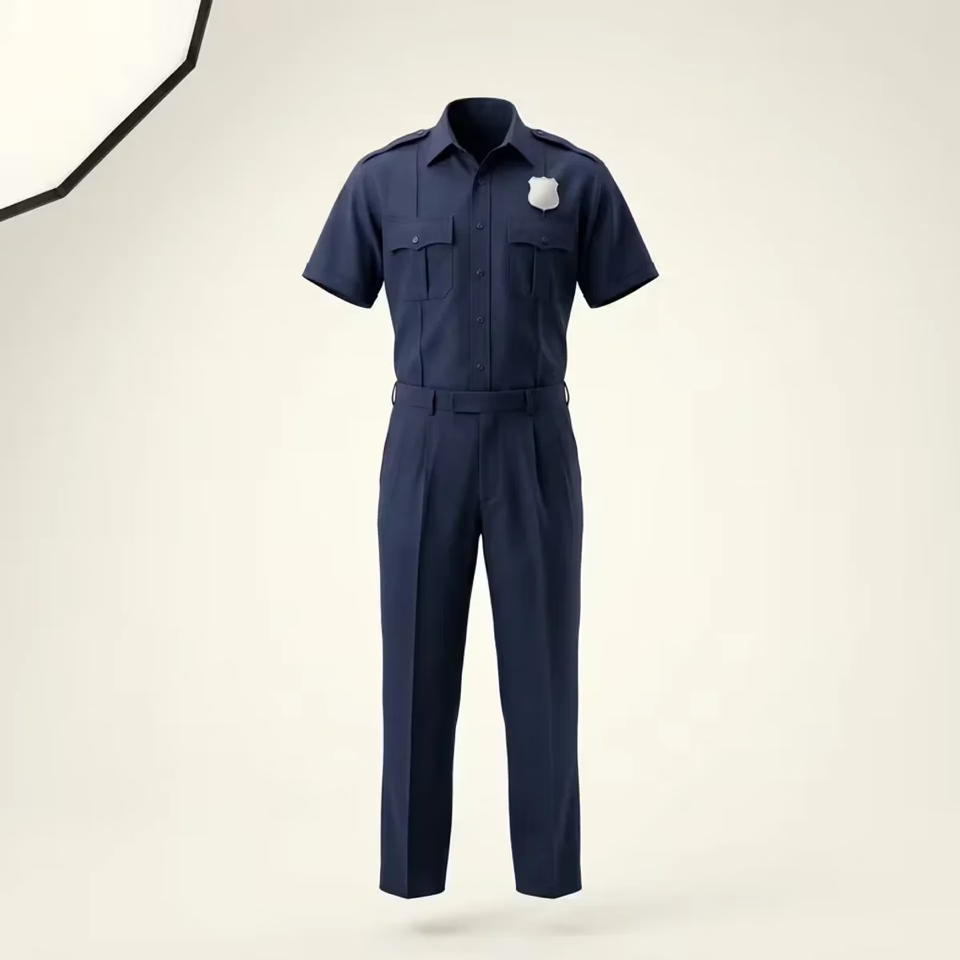
Female Security Guard Uniform in Saudi Arabia: Designing for Women Officers
How to specify a female security guard uniform in Saudi Arabia: women's pattern blocks, modest coverage that survives movement, secure hijab integration, duty-belt fit and visual authority.
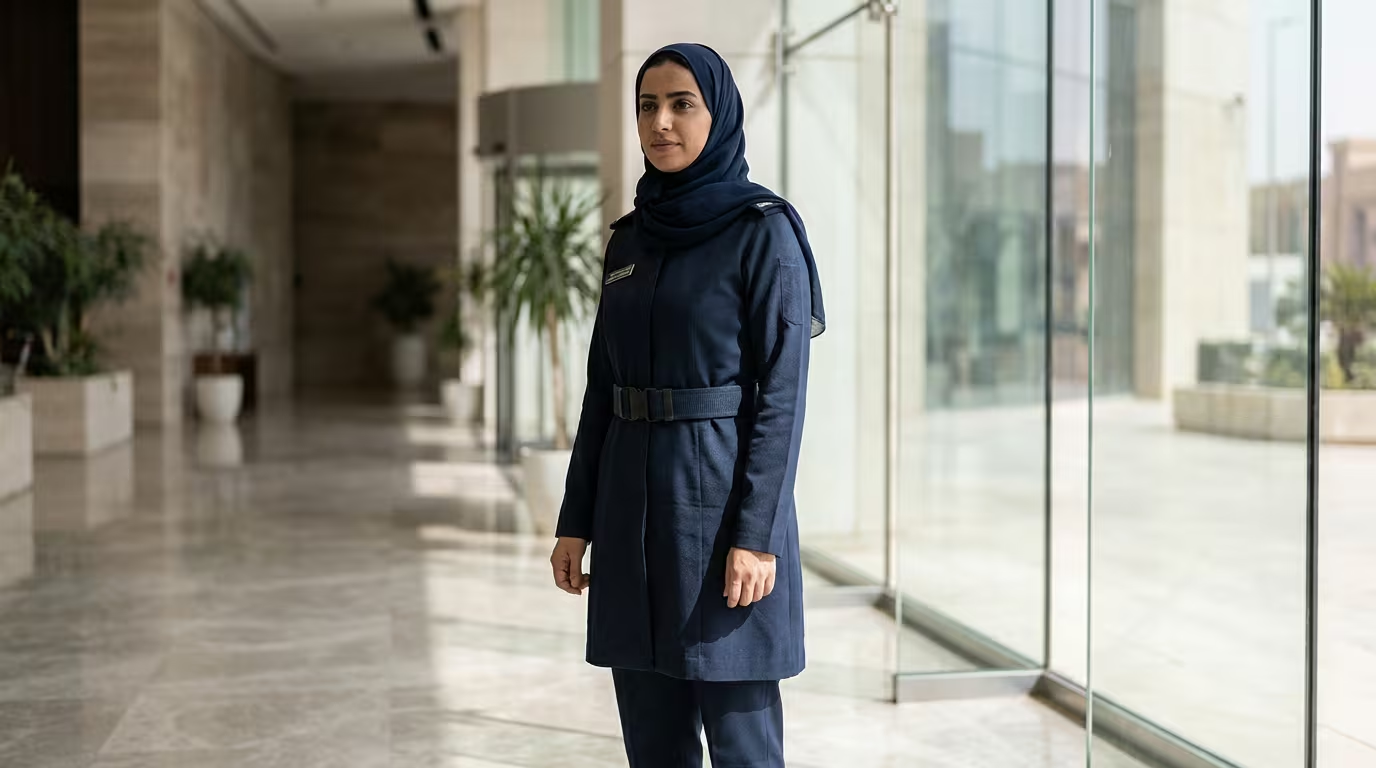
Saudi women are now working posts across malls, hospitals, campuses, events and corporate facilities, and the uniform has to catch up. A credible female security guard uniform is not a smaller men's shirt; it is a purpose-drafted garment that holds coverage in motion, carries equipment on a different frame and projects the same authority.
Start from a women's block
The quickest way to fail a women's security programme is to issue the men's garment in a smaller size. A men's block is drafted around a different shoulder slope, a different torso length and a waist-to-hip relationship that does not match most women's proportions, so shrinking it shortens the sleeve without moving the shoulder seam, narrows the chest without correcting where the front closure sits, and tightens the thigh while leaving the waist gaping. The officer then spends the shift adjusting the garment instead of watching the floor, and the uniform reads as borrowed rather than issued. A proper women's pattern begins from its own block: armhole and shoulder drafted for a narrower frame, front closure engineered to stay flat and closed across the bust, waist suppression graded independently of chest, and sleeves pitched for reaching, restraining and carrying. Grading deserves the same attention, because a size run that expands every dimension at one uniform rate simply relocates the fit failure to the smallest and largest ends of the range.
Coverage that holds in motion
Modesty in a duty uniform is not achieved by adding length; it is achieved by controlling what the garment does when the body moves. A tunic that covers well while the officer stands still can ride up during a stair climb, pull open between buttons when she raises an arm to direct traffic, or twist around the hip once a belt is loaded. Coverage that holds requires design decisions: a longer, shaped tunic or overshirt with side vents so it hangs cleanly instead of tenting over the belt; a closure system that stays shut under movement, whether that means a concealed placket, a higher button stance or a front zip beneath a button strip; sleeves cut long enough that the cuff stays put when the arm extends; and trousers with enough seat and thigh room to kneel without strain, held by a waistband that does not migrate. Layering choices matter too, since an under-layer that clings or shows through in sunlight undoes the coverage the outer garment was meant to provide.
A coordinated, secure hijab
Where officers wear hijab, the uniform programme should treat it as an issued component rather than an accessory left to the individual, because a personal scarf in a mismatched shade quietly breaks the visual discipline the rest of the uniform is built on. Coordination comes first: the issued headscarf should match or deliberately complement the uniform shade, in the same fabric family so it ages and launders at a similar rate rather than drifting to a different tone after a season of washing. Security comes next. A loose rectangular wrap with trailing ends can catch, slip or be grasped during a physical encounter, so many programmes prefer a fitted one-piece style, a wrap secured without exposed pins, or ends tucked and fastened at the back. Some specifications add a lightweight breakaway fastening so the garment releases under pull. Comfort is not an afterthought either, since a headcover worn through a Gulf summer shift needs a light, breathable, colourfast fabric and a smooth edge where it meets the collar.
The duty belt on a different frame
Equipment carriage is where a women's uniform most often fails in service, because a duty belt designed to sit on a straighter waist tends to rotate, dig or ride high on a frame with a shorter distance between waist and hip. The belt then sits at an angle, the radio digs into the ribs when the officer sits in a vehicle, and the load shifts every time she stands. Fixes are practical rather than exotic: a contoured or tapered belt that follows the waist-to-hip curve, an inner belt with more keeper positions so the outer belt can be anchored where it actually needs support, thoughtful placement of the heaviest items away from the point where the belt wants to tip, and a trouser waistband tall enough to carry pressure without folding. Where a vest or load-bearing rig is issued, women's cuts with independent torso length and girth adjustment prevent the ride-up and gapping a unisex panel produces. Fit checks should be done seated, kneeling and after a walk, not standing still in a fitting room.
Authority that reads the same
Authority in a security uniform is carried by structure, colour and insignia, and the moment a women's version softens any of the three, the wearer is read as support staff rather than as an officer. Parity is the design principle: the same shade, the same shoulder line intent, the same badge, rank marking, name tape and reflective identification in the same positions, so the public sees one team rather than two tiers. Structure does the rest of the work. A defined shoulder, a clean collar stand, a closure that holds a straight vertical line and a garment that stays flat over the belt project composure; a limp, unstructured cut reads as informal no matter what the badge says. Tailoring for a woman's frame should sharpen that line rather than decorate it, which usually means avoiding fashion details, contrast trims and slimmer silhouettes that restrict movement. Finish carries weight too, because a crisp, colourfast, non-shiny fabric that resists creasing keeps the officer looking on duty at hour nine.
Heat, fabric and programme control
Saudi conditions decide much of the specification. An outdoor gate post in midsummer and an air-conditioned mall lobby place opposite demands on the same programme, so most buyers end up with a layered range: a light, breathable, opaque base garment, an outer piece that can be removed indoors, and a fabric that keeps colour and shape through frequent industrial laundering. Blends are a balance rather than a winner: more cotton generally reads cooler and softer against the skin, while a higher synthetic content usually holds press, resists abrasion and dries faster, so the right ratio depends on the post, the wash cycle and how the garment is worn under a belt or vest. Opacity deserves an explicit line in the specification, checked on the actual colour under bright light. Governance closes the loop: a genuine women's size set, a wear trial before full rollout, a documented replacement cycle and a friction-free route for officers to report fit problems. UNEOM has manufactured in the Kingdom since 2013, works to ISO 9001:2015 and offers OEKO-TEX Standard 100 certified fabric options.
Frequently asked
- How is a female security guard uniform different from the men's version?
- It is drafted from a women's block rather than graded down from the men's. Shoulder slope, armhole, front closure position, waist suppression and sleeve pitch all change. Trousers need seat and thigh room for kneeling without a gaping waistband. Sizing to women's proportions instead of smaller men's sizes is the single biggest improvement.
- Can a modest security uniform still look authoritative?
- Yes, provided modesty comes from cut rather than added bulk. Longer, shaped tunics with side vents, closures that stay flat, a structured shoulder and a clean collar keep the silhouette disciplined. Authority then comes from identical colour, insignia and finish across the team, so a woman officer is read as an officer, not as support staff.
- How should hijab be integrated into a security uniform?
- Treat it as an issued item, matched to the uniform shade and fabric family so it does not fade differently over time. For duty wear, fitted one-piece styles or wraps with no trailing ends and no exposed pins reduce snag and grab risk, and some specifications add a breakaway fastening. Personal style preference stays respected within the agreed palette.
- How do you fit a duty belt for women officers?
- Fit it seated and kneeling, not only standing. A contoured belt following the waist-to-hip curve, an inner belt with generous keeper positions and heavier items placed away from the tipping point stop rotation and rib pressure. A taller trouser waistband spreads load. Where vests are issued, use women's cuts with separate length and girth adjustment.
- What should procurement specify when ordering female guard uniforms?
- A genuine women's size set with a fitting session, opacity checked on the final colour, colourfastness and laundering expectations matched to the actual wash process, coordinated headwear where worn, insignia parity with the men's range, a wear trial before full rollout, and a documented replacement cycle with a simple route to report fit problems.