Real Estate Agent Uniform in Saudi Arabia: Dressing Sales, Property, and Site Teams
How to specify uniforms for real estate sales, property management, and maintenance teams in Saudi Arabia — clothing that survives the car, the dust, and the showroom.
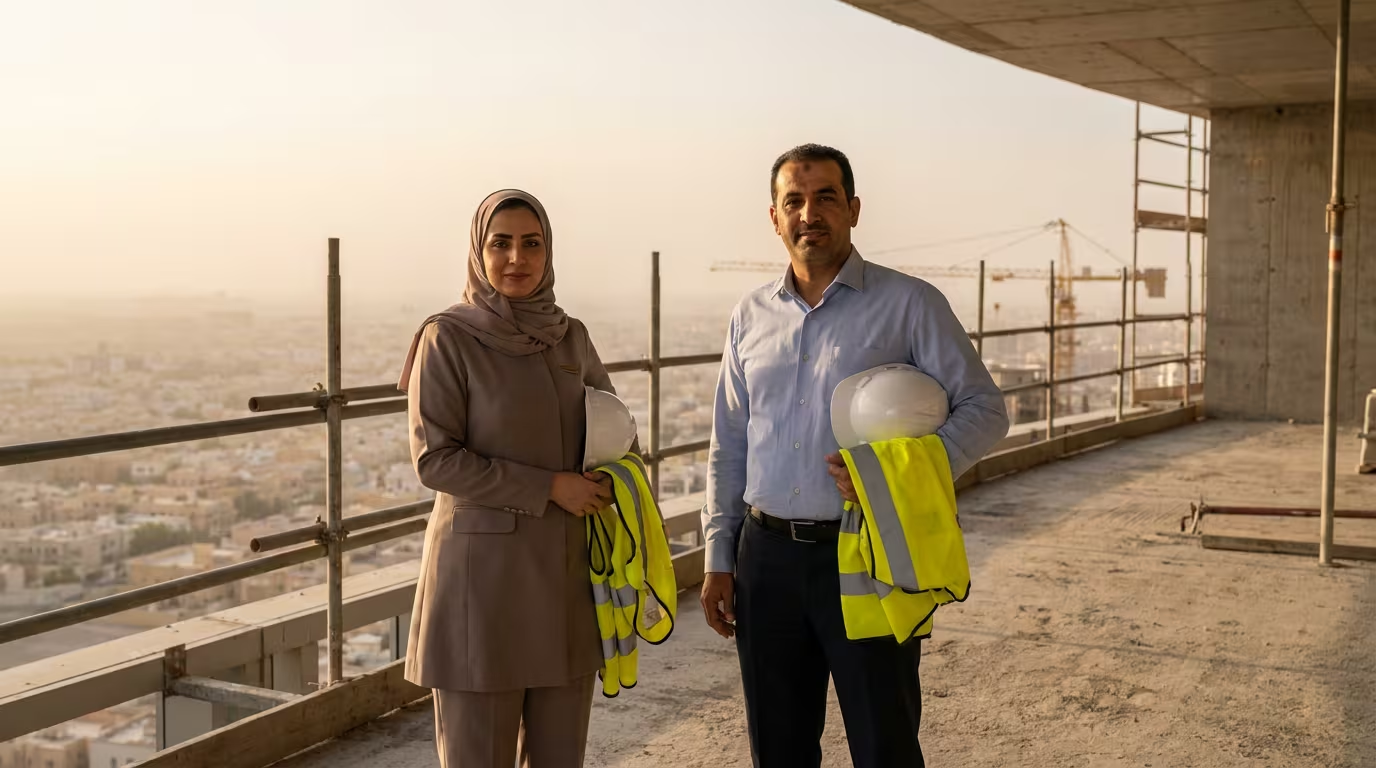
Real estate teams change environments faster than almost any other office-based workforce: a cooled meeting room, an hour in traffic, a dusty half-built floor, then a showroom conversation about a life-changing purchase. A uniform programme that ignores any one of those settings will look tired by mid-afternoon. Here is how to specify one that does not.
Three Environments, One Outfit
A property professional's day rarely stays in one place. The morning may begin in a cooled office, move to a car for a cross-city drive, continue across a half-finished floor plate with dust underfoot, and end in a polished showroom in front of a family deciding on the largest purchase of their lives. Each of those environments asks something different from clothing. The office rewards a crisp, structured look. The car punishes it, pressing creases into the back of a jacket and the seat of a pair of trousers within a single journey. The site adds dust, uneven ground, and heat that lingers in the fabric long after the visitor returns to air conditioning. The showroom then expects everything to look untouched. A uniform programme for real estate teams is therefore not a styling exercise; it is a specification problem. The question is not which shirt looks best on a hanger, but which garment still reads as professional at the third stop of the day.
Sales, Management, and Maintenance
Most property organisations in the Kingdom carry at least three distinct populations, and dressing them identically serves none of them. Sales and leasing agents work face to face with clients and need the most formal register: tailored trousers, a structured shirt or blouse, and an optional jacket that can be left in the car when the temperature climbs. Property and facility management staff move between tenant meetings, service corridors, and plant rooms, so they benefit from a slightly more relaxed and more durable version of the same look, often a polo or an overshirt in the corporate palette. Maintenance and technical crews need workwear proper, with reinforced seams, tool-friendly pockets, and whatever protective specification the site risk assessment calls for. The design task is to make these tiers legible at a glance while keeping them visibly related, usually through a shared colour family, a consistent logo placement, and a common trim detail. Tenants should be able to tell who is knocking on the door before anyone speaks, and no tier should read as an afterthought.
How the Fabric Behaves
Fabric choice is where a real estate programme is won or lost, because the enemy here is creasing rather than abrasion. Pure cotton is comfortable and breathable and, unusually among common fibres, is stronger wet than dry, which makes it forgiving in the wash; it also creases readily and shows every minute spent seated. Polyester resists creasing, holds its shape, and dries quickly, but on its own it can feel close and warm in still air and tends to hold oily soils and odour. Most credible office-and-site programmes therefore land on a blend, tuned toward polyester for shape retention and toward cotton for hand feel, sometimes with a small proportion of elastane so that trousers and sleeves move with the wearer and recover afterwards. Fibre family is not destiny, though: viscose drapes beautifully and feels cool but loses strength when wet, so it behaves nothing like cotton despite both being cellulosic. Ask the supplier for a wear trial in your own climate and your own cars before committing the whole team.
Colour, Dust, and Sunlight
Colour is a functional decision in Saudi conditions, not only a brand one. Fine airborne dust settles on everything during a site visit, and it is most visible against deep navy, charcoal, and black, which is precisely the palette most corporate identities default to. Mid-tone greys, sand, stone, and muted olive absorb that dust visually and buy an agent another appointment before the garment looks tired. Pale colours behave the opposite way, staying clean-looking against dust but showing perspiration and hem soiling quickly. Darker shades also absorb more solar radiation and can feel hotter in direct sun, although a loose cut and a fabric that lets air move mitigate much of that. A practical compromise is to keep the strong brand colour in the smaller elements, such as a jacket, a scarf, a placket, or embroidery, and to build the large surfaces from mid-tones that forgive both dust and sweat. Textured or subtly patterned weaves disguise marks better than flat, solid finishes, which is a cheap advantage worth taking.
Modesty and Movement
Client-facing property work in the Kingdom now involves mixed teams meeting families, and clothing has to respect that setting without slowing anyone down. In practice this means opaque fabric that does not become sheer in bright light or under a showroom spotlight, generous sleeve and hem coverage, and a cut that skims rather than clings, particularly when a person is climbing site stairs or stepping over cabling. For women, a well-judged programme usually offers a longer tunic or overdress, wide-leg or straight trousers, and options that sit comfortably under or alongside an abaya, with headscarves supplied in fabrics and shades that coordinate with the corporate palette rather than fighting it. For men, some organisations dress agents in a business shirt and trousers, others in a tailored thobe carrying discreet embroidery, and many allow both according to the setting. These are matters of organisational policy and personal preference, and the sound approach is to consult the team, offer choices within a defined palette, and let people select what allows them to work with confidence.
Site Kit and Programme Rhythm
The last mile of a property uniform is the kit that lives in the boot of the car. A visit to an active construction site is governed by the contractor's rules and the project risk assessment, which typically require a high-visibility vest, a hard hat, and closed protective footwear regardless of how smart the underlying outfit is; the office layer therefore has to accept a vest over it without bunching, and shoes should be chosen so that an agent is never tempted to walk a slab in something unsuitable. Around that sits ordinary programme discipline: measure everyone rather than guessing sizes, hold a stock of the common sizes so a new hire is dressed in days rather than weeks, issue enough sets that nobody is washing a shirt overnight, define a replacement trigger based on visible wear rather than the calendar alone, and write down who pays for what. UNEOM manufactures inside the Kingdom and has done since 2013, works to ISO 9001:2015, and offers OEKO-TEX Standard 100 certified fabric options for teams that ask for them.
Frequently asked
- What should real estate agents in Saudi Arabia wear for construction site visits?
- Whatever the site requires, worn over the office layer. Active sites are governed by the contractor's rules and the project risk assessment, which usually mean a high-visibility vest, a hard hat, and closed protective footwear. Choose an office garment that accepts a vest without bunching, and keep proper shoes in the car rather than improvising at the gate.
- How should a uniform distinguish sales agents from property management and maintenance staff?
- Keep the tiers related but legible. Sales wears the most formal register, property management a more practical version of the same look, and maintenance proper workwear with reinforced construction. Tie them together with one colour family, a consistent logo placement, and a shared trim detail, so a tenant can identify the role before anyone speaks.
- Which fabric stays presentable after an hour in the car?
- Blends tuned toward polyester recover from creasing far better than pure cotton, which is comfortable and breathable but shows every seated minute. A small amount of elastane helps trousers and sleeves return to shape. Rather than trusting a specification sheet alone, run a wear trial through your own commutes and summer conditions before committing.
- What uniform options work for women in client-facing property roles?
- Opaque fabric that stays opaque under showroom lighting, generous sleeve and hem coverage, a skimming rather than clinging cut, and longer tunics or overdresses with straight or wide-leg trousers. Options that sit comfortably under or alongside an abaya matter, as do headscarves supplied in coordinated shades. Offer choices and let colleagues select.
- How many uniform sets should each agent receive?
- Enough that nobody is washing a shirt overnight, which depends on wear rate, laundry access, and how many site days a role carries. Agents in daily client contact usually need more rotation than back-office colleagues. Set the number from an observed wear trial, and trigger replacement on visible wear rather than the calendar alone.