Medical Hijab Standards: Infection Control, Safety, and Dignity in Saudi Healthcare
Why personal hijabs in clinical environments create infection control risk, and what the compliant alternative looks like.

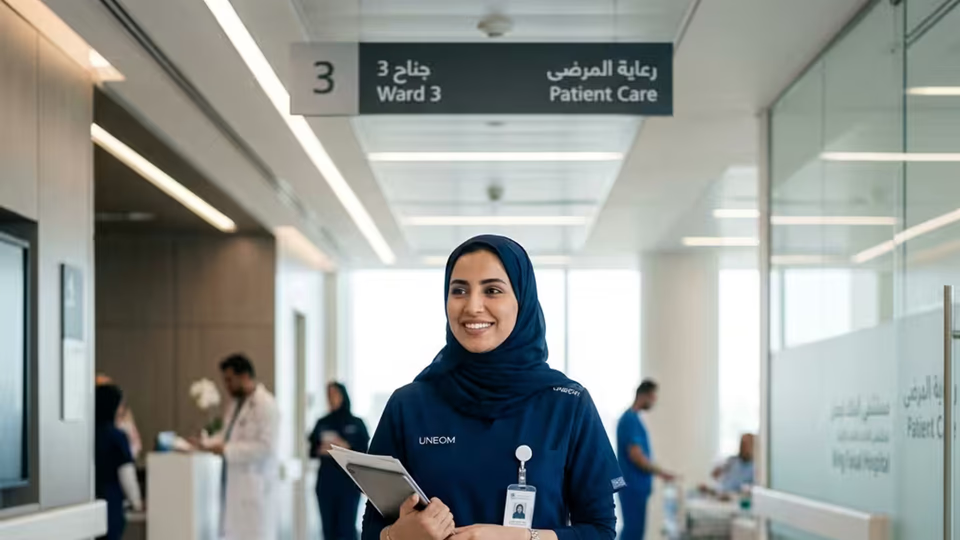
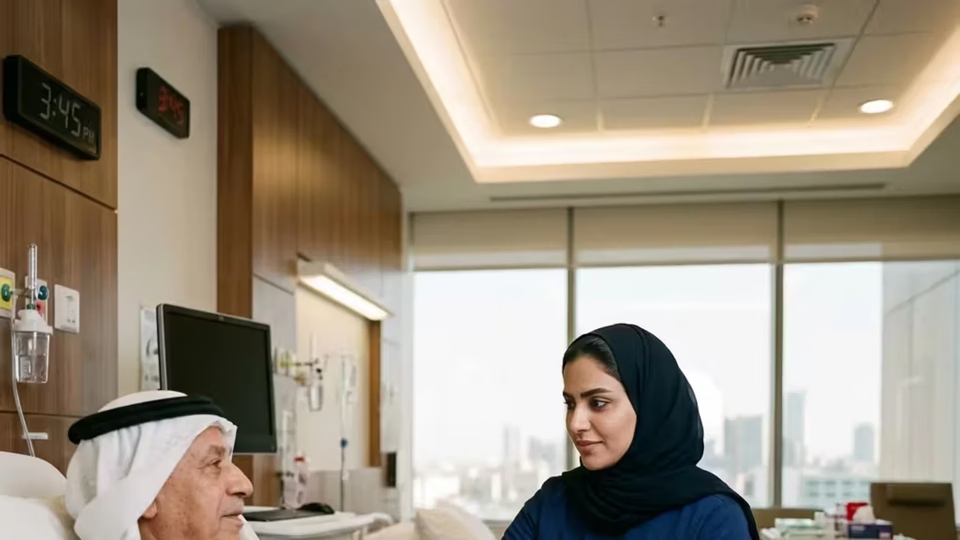
The medical hijab occupies a unique position in Saudi healthcare infrastructure: it must satisfy religious modesty requirements that are non-negotiable, infection control standards that are clinically mandatory, occupational safety regulations that protect the wearer, and professional appearance standards that maintain institutional identity. Most Saudi hospitals have not yet standardised medical hijab procurement, leaving individual nurses to source their own hijabs — creating a gap in the infection control chain that facility managers may not recognise because the hijab is perceived as a personal rather than clinical garment.
The infection control gap
Personal hijabs enter the clinical environment from the community every shift and return to the community at the end of every shift — the same garment cycling between environments with fundamentally different pathogen profiles. A personal hijab is laundered at home, with household detergent at whatever temperature the wearer's machine runs — not under the validated thermal and chemical conditions a facility's own laundering programme is designed and audited to meet. Personal clothing that cycles between home and the clinical environment sits outside the facility's controlled laundering programme altogether, which is why infection-control policy treats it as a separate control point rather than assuming home laundering is equivalent. The infection control implications are twofold. First, the hijab is in direct contact with the neck and hair — areas that come into close proximity with patients during clinical care activities such as bed-making, patient positioning, and vital signs measurement. Contaminated hijab fabric can transfer pathogens to patients during these activities. Second, the hijab travels between the hospital and the community, creating a potential pathway for hospital pathogens to enter the community environment — particularly concerning for healthcare workers who live with immunocompromised family members, elderly relatives, or young children. The standardised medical hijab addresses this gap by bringing the hijab into the facility's industrial laundering programme. Every medical hijab is laundered at 71 degrees Celsius with chlorine-based disinfectant — the same thermal and chemical decontamination process applied to scrubs, lab coats, and other clinical garments. The hijab is issued at the start of each shift and collected at the end for laundering, exactly like other clinical garments. This shift-based cycling eliminates the community-hospital-community contamination pathway entirely. UNEOM supplies medical hijabs in sufficient quantities for this shift-based cycling model: minimum 5 hijabs per nurse, allowing for a 3-day laundry turnaround while ensuring 2 clean hijabs are always available. For facilities transitioning from personal hijabs, UNEOM recommends a 3-month pilot programme in one department — typically the ICU or surgical ward where infection control sensitivity is highest — with pre-and-post environmental sampling to demonstrate contamination reduction.
Safety breakaway engineering
A hijab in a clinical environment presents a specific occupational safety risk: entanglement. Clinical environments contain numerous catch points — IV poles, bed rails, wheelchair handles, door handles, curtain tracks, and medical equipment with protruding components. A conventional hijab secured with pins or wrapped and tucked in the traditional manner can catch on these points and, if the wearer is moving, create a sudden pulling force on the neck and head. While serious injury from hijab entanglement is rare, near-miss incidents are documented in Saudi hospital safety reports at a rate that justifies engineering intervention. UNEOM's medical hijab uses a breakaway closure system that addresses this risk without compromising coverage or modesty. The closure mechanism is a magnetic snap system concealed within the chin-wrap panel of the hijab. The magnets provide sufficient holding force for normal clinical activities — holding the hijab securely during walking, bending, patient transfer, and equipment operation. But the magnets release under a pull force of 2 kilograms — approximately the force that would be applied if the hijab caught on equipment while the wearer was walking past. This force threshold was determined through testing with Saudi nursing staff across a range of clinical activities: the highest holding force required during normal activities was measured at 1.2kg, so the 2kg release threshold provides a comfortable safety margin without risk of accidental opening during routine work. The breakaway release is not a catastrophic failure — the hijab does not fall off entirely. The chin-wrap panel opens, but the back panel remains in position, secured by the under-cap that sits beneath the hijab. The nurse can re-close the magnetic snap in 2 seconds without a mirror — restoring full coverage instantly. For comparison, a pin-secured hijab that catches on equipment creates a direct force transfer to the scalp through the pin, which cannot release without conscious manual intervention — requiring the wearer to stop, identify the catch point, and carefully disengage while managing the pulling force on their head. The breakaway system eliminates this entire scenario.
Fabric specification for clinical hijabs
The fabric requirements for a medical hijab differ from clinical uniform fabric in two important ways: the hijab is in continuous contact with facial skin and hair — requiring a softer hand and lower irritation potential than standard clinical fabric — and the hijab must drape smoothly around the contours of the face and head without the stiffness that standard clinical fabrics exhibit. UNEOM's medical hijab fabric uses a jersey-knit construction in the same antimicrobial-treated fibre as the uniform body — typically a 60/40 polyester-cotton blend with copper-oxide antimicrobial integration. The jersey knit provides the soft drape and stretch that the hijab requires, while the antimicrobial treatment and polyester-cotton blend provide the infection control performance and laundering durability that clinical use demands. The weight is specified at 140gsm — lighter than the 180 to 200gsm uniform body fabric, providing comfort without overheating around the head and neck where thermal sensitivity is highest. Colour fastness is critical because the hijab is visible to patients at close range during every interaction — colour fading or inconsistency is immediately apparent. UNEOM specifies ISO 105-C06 colour fastness to washing at Grade 4 minimum (on a 5-point scale) and ISO 105-B02 colour fastness to light at Grade 5 minimum (on an 8-point scale), ensuring the hijab maintains its colour match to the uniform body throughout its 4-month lifecycle. The under-cap — a fitted cap that sits beneath the hijab providing additional coverage and creating the anchor point for the breakaway magnetic closure — uses a moisture-wicking mesh construction at 90gsm. This mesh prevents perspiration accumulation at the scalp, which is the primary comfort complaint from nurses wearing hijab during 12-hour shifts. The mesh channels perspiration away from the scalp surface to the hijab fabric layer above, where it can evaporate. The under-cap is sized by head circumference and replaced monthly — more frequently than the hijab itself — because the continuous skin contact and perspiration exposure degrades the mesh fabric more rapidly than the outer hijab.
Implementation pathway for Saudi hospitals
Transitioning from personal hijabs to standardised medical hijabs requires a structured implementation approach that addresses clinical governance, staff engagement, and operational logistics simultaneously. UNEOM's implementation pathway has been refined through deployment at 14 Saudi hospitals and follows a four-phase process. Phase 1 is Clinical Governance Alignment lasting 4 weeks: UNEOM presents the infection control evidence and safety engineering rationale to the hospital's Infection Prevention and Control Committee, the Occupational Health and Safety Committee, and the Nursing Leadership Council. The presentation includes the facility-specific contamination data if available, the breakaway safety engineering documentation, and the programme specification. The goal is formal endorsement from all three governance bodies, creating institutional authority for the transition. Phase 2 is Staff Engagement lasting 6 weeks: individual department sessions where nursing staff can examine, handle, and try on the medical hijab. These sessions are conducted by UNEOM's female programme specialists and address the concerns that nurses consistently raise — will it stay on during CPR, can I adjust it without a mirror, will it match my skin tone, and does it accommodate different wrapping preferences. UNEOM provides three wearing-style options within the same hijab design: a standard wrap, a high-coverage wrap for nurses who prefer minimal face-frame, and a sport-style pull-on for high-activity roles in emergency and trauma departments. Phase 3 is Pilot Department lasting 3 months: full deployment in one high-sensitivity department with environmental sampling before and after to quantify contamination reduction. The pilot generates facility-specific evidence that supports full-facility rollout and identifies any operational issues — locker space for clean hijabs, collection bins for used hijabs, and laundry processing capacity — that need to be resolved before scaling. Phase 4 is Full Facility Rollout lasting 8 to 12 weeks depending on facility size: department-by-department deployment with the pilot department's nursing champions serving as peer advocates. Each department receives its own deployment session, inventory allocation, and 30-day adjustment period during which nurses can request alternative sizes or wearing styles.
Frequently asked
- Do personal hijabs pose infection control risks?
- A personal hijab is laundered at home, outside the facility's controlled laundering programme, so infection-control policy generally treats it as a separate control point from garments the facility launders itself. Your facility's infection-control team sets that policy — confirm it with them rather than with a supplier.
- How does the breakaway closure work?
- Concealed magnetic snaps hold during normal activity but release at 2kg pull force — if the hijab catches on equipment. The back panel stays secured by the under-cap; re-closure takes 2 seconds.
- How many medical hijabs does each nurse need?
- Minimum 5 per nurse for shift-based cycling with 3-day laundry turnaround, ensuring 2 clean hijabs are always available.
- Is the medical hijab available in multiple styles?
- Yes — three wearing styles within the same design: standard wrap, high-coverage wrap, and sport-style pull-on for emergency department staff.
- How long does hospital-wide implementation take?
- Approximately 6 months total: 4 weeks governance, 6 weeks engagement, 3 months pilot, 8-12 weeks full rollout.