
How Many Scrubs Per Nurse? A Hospital Allocation Method, Not a Guess
There is no universal scrub allocation. Learn how Saudi hospitals calculate sets per nurse from laundry turnaround, shift patterns, mid-shift changes, buffer stock, and issue model.
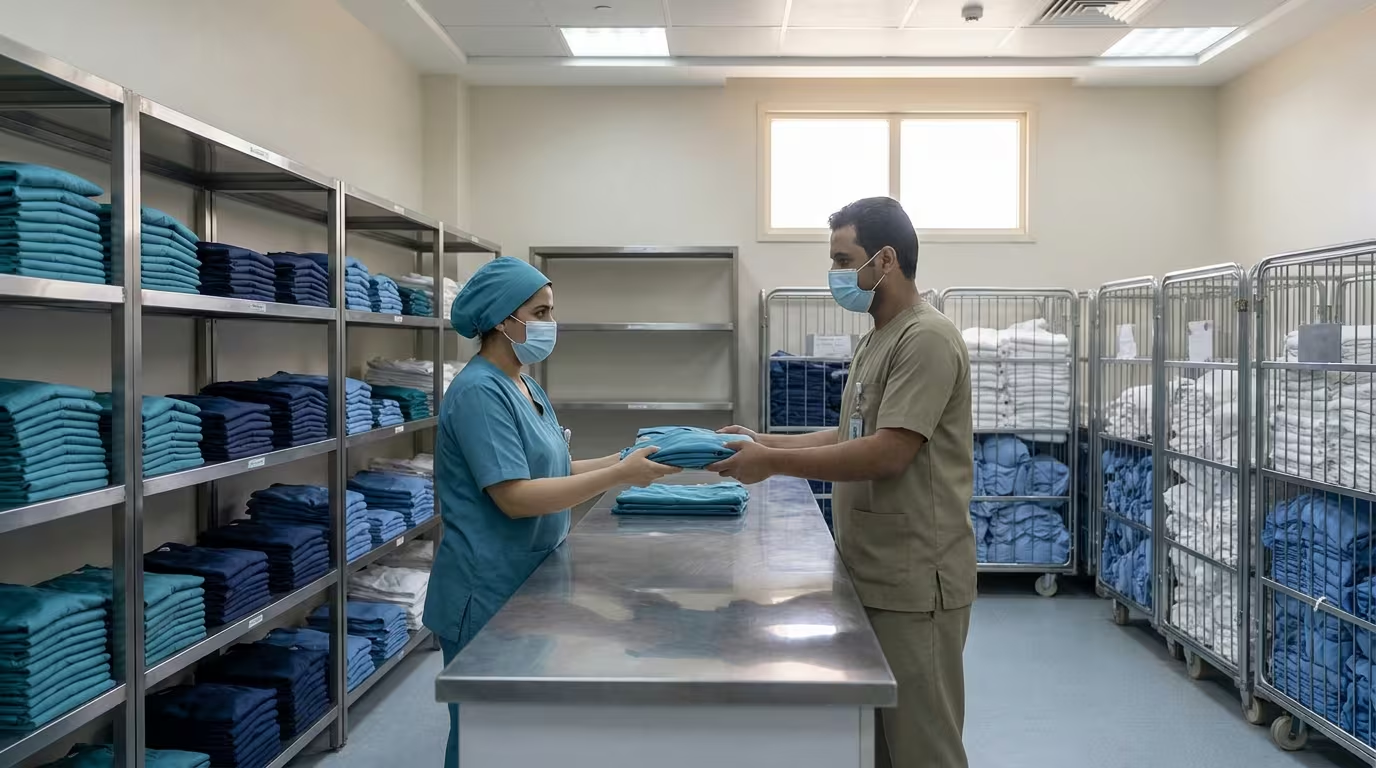
Every hospital eventually asks how many scrub sets each nurse should receive, and no supplier can answer it honestly without knowing the facility. The number is calculated, not quoted. This guide sets out the variables that decide it: laundry turnaround, rota density, mid-shift changes, contamination buffer, and the choice between personal issue and central exchange.
The Number Is an Output
Procurement teams usually open this conversation by asking for a number, and the honest answer is that no defensible number exists until the facility describes itself. Scrub allocation is arithmetic performed on local variables: how often garments leave the building for laundering, how long they stay away, how many duties each nurse works between collections, how many changes a duty demands, and how much stock must sit idle so that a contaminated set never leaves a nurse without a clean replacement. Two hospitals of identical bed count can land on very different allocations because one runs an in-house laundry with same-day turnaround and the other ships linen to an external contractor on a fixed collection schedule. Copying a number from another organisation imports its laundry contract, its rota, and its case mix along with it. The disciplined approach is to build the count from your own variables, document the assumptions behind it, and revisit the figure whenever the rota, the laundry contract, or the service mix changes.
Laundry Turnaround Sets the Floor
The single largest driver of how many sets must exist per nurse is the time a garment spends out of her hands. A set worn today does not become available again the moment it is dropped in a soiled linen bag; it waits for collection, travels, queues for washing and thermal or chemical disinfection, dries, is inspected, pressed, sorted back to size and unit, and returns on a delivery run. Every hop in that chain is dead time during which the nurse still has to report for duty in something clean. If the cycle from drop-off to reissue spans several duty days, allocation must cover every duty falling inside that window plus the sets already dirty and waiting. Facilities that collect only on certain weekdays effectively lengthen the window for anyone whose duties fall just after a collection. Ask the laundry provider for the realistic worst-case turnaround rather than the contracted average, because allocation must survive the worst week of the year, not the median one.
Rota Density and Shift Pattern
Once the laundry window is known, the rota tells you how many wearing occasions fall inside it. A nurse working back-to-back long shifts burns through sets faster than one on a spread pattern with rest days between duties, even though both may hold the same contracted hours. Night duty adds a wrinkle, because a nurse finishing at dawn may not be able to return a set to the collection point before it closes, pushing her garment into the next cycle. Float staff and agency cover complicate matters further: they may work across units with different colour codes, and each colour is effectively a separate stock line rather than an interchangeable garment. Build the count from the densest realistic block a nurse can be rostered, not from the average week, and check what happens during Ramadan schedule changes, Hajj season staffing, and annual leave cover when remaining staff absorb extra duties. The allocation that fails is always the one designed around a comfortable month and tested during a busy one.
Units That Change Mid-Shift
Allocation collapses when planners assume one set per duty. Operating theatres, delivery suites, emergency departments, dialysis units, and paediatric wards all generate events that force a change before the shift ends: a splash, a spill, a soaked hem, a procedure that leaves visible soiling a patient should not have to look at. Theatre and isolation environments may also require garments to stay inside a defined zone, so a nurse crossing that boundary changes by protocol rather than by need. Count these units separately and give them a per-duty change assumption drawn from the unit's own incident experience and infection prevention policy, not from a hospital-wide average that quietly under-serves the highest-risk areas. Summer compounds the problem in Saudi facilities, where staff who move between buildings, ambulance bays, or outdoor triage areas arrive back indoors carrying perspiration into a garment that then feels unwearable for the rest of a long duty. The right question for each unit is how many times a garment realistically leaves service during a single shift.
Buffer, Layers, and Attrition
Two further quantities sit outside the wear-and-wash arithmetic. The first is buffer: garments held so that an unplanned contamination, a lost set, a sizing change after a uniform is issued, or a sudden new hire does not become an operational problem. Buffer belongs to the store, not to the individual, and it is the line most often cut first and regretted first. The second is layering. Many nurses in Saudi facilities wear a long-sleeve under-scrub top and a headcover with the scrub set, and where these are part of the issued uniform they are a separate stock line with their own soiling and laundering behaviour, often needing a different replacement rhythm than the tunic and trouser. Attrition also has to be planned rather than discovered: repeated industrial laundering with high temperatures and disinfectants gradually dulls colour, weakens seams, and loosens elastic, so a proportion of the fleet leaves service every year purely from wear. Decide in advance what condition triggers retirement, and fund replacement as a routine cycle instead of an emergency purchase.
Individual Issue or Central Exchange
The last variable is the model itself. Under individual issue, each nurse holds a personal allocation in her own sizes and is responsible for returning it; the count per person is higher, fit is better, and staff generally treat the garments with more care, but total inventory rises and sizing errors are expensive to correct. Under central exchange, garments are pooled and drawn from a counter or dispensing unit against a clean-for-soiled return; the fleet can be smaller because idle stock is shared rather than sitting in lockers, and control over what leaves the building is far tighter, but the model only works if size distribution is right and returns are enforced. A hybrid is often the practical answer: pooling theatre and high-risk unit garments while issuing ward scrubs personally. Whichever model applies, quantities should be agreed with the supplier before the first bulk order, because the model dictates size curve, colour coding, and reorder rhythm. UNEOM manufactures inside the Kingdom since 2013 under ISO 9001:2015 with OEKO-TEX Standard 100 certified fabrics.
Frequently asked
- Is there a standard number of scrub sets per nurse?
- No credible universal figure exists, because allocation depends on facility variables rather than on a published rule. The count is derived from laundry turnaround time, the density of the rota, how often a unit forces a mid-shift change, the buffer held for contamination, and whether garments are issued personally or exchanged centrally.
- How does laundry turnaround change the number?
- Turnaround defines how long a worn set is unavailable. Allocation must cover every duty that falls between handing a set in and receiving it back, plus the sets still in the system. Longer or less frequent collection cycles push the required count up, while same-day in-house laundering pulls it down.
- Which units need more sets than a general ward?
- Any unit where a garment can leave service before the shift ends. Operating theatres, delivery suites, emergency departments, dialysis, and paediatrics commonly see splashes, spills, or protocol-driven changes at a zone boundary. Set the per-duty change assumption from each unit's own incident experience and infection prevention policy rather than a hospital-wide average.
- Does central exchange need fewer garments than individual issue?
- Usually yes, because idle stock is shared instead of sitting unused in personal lockers, and control over what leaves the building is tighter. The trade-off is fit and accountability: pooled models depend on an accurate size curve, disciplined returns, and enough sorting capacity to keep the right sizes on the counter.
- Do hijabs and under-scrub layers count in the allocation?
- If the facility issues them, yes, as their own stock line. A long-sleeve under-scrub top and a headcover soil, launder, and wear out on a different rhythm from the tunic and trouser, so counting them inside the scrub set quantity leaves staff short. Plan and reorder them separately.