Government Employee Uniform Requirements in Saudi Arabia: A Ministry Staff Program Guide
How Saudi ministries and public entities build uniform programs that stay consistent across sites, satisfy procurement documentation, size thousands of staff, and renew on a planned cycle.
Uniform programs in Saudi government entities answer to a different set of pressures than corporate ones: many sites under one identity, staff who represent the institution to the public, procurement rules that demand documented evidence, and headcounts large enough that sizing and replacement become logistics problems. This guide covers what those pressures change in practice.
Why Government Programs Differ
A ministry uniform program is not a scaled-up corporate dress code. It serves an institution that citizens interact with directly, across headquarters, regional branches, service centers and field sites that may sit hundreds of kilometers apart. The same shirt must look identical in Riyadh and in a small governorate office, be reordered years after the first issue, and survive a laundering routine no central team controls. That pushes the design work toward stability rather than fashion: a restricted color family, a specification written tightly enough to be repeatable, and construction details a supplier can reproduce in later batches without drift. Public-facing roles also carry a representational weight; staff are read as the institution itself, so appearance decisions become policy decisions rather than preferences. Add procurement rules that require documentation, competitive comparison and auditable records, and the program becomes an administrative system with a garment attached. Treating it that way from the first meeting saves years of correction later, because the program will outlive the people who set it up.
Dignity and Role Distinction
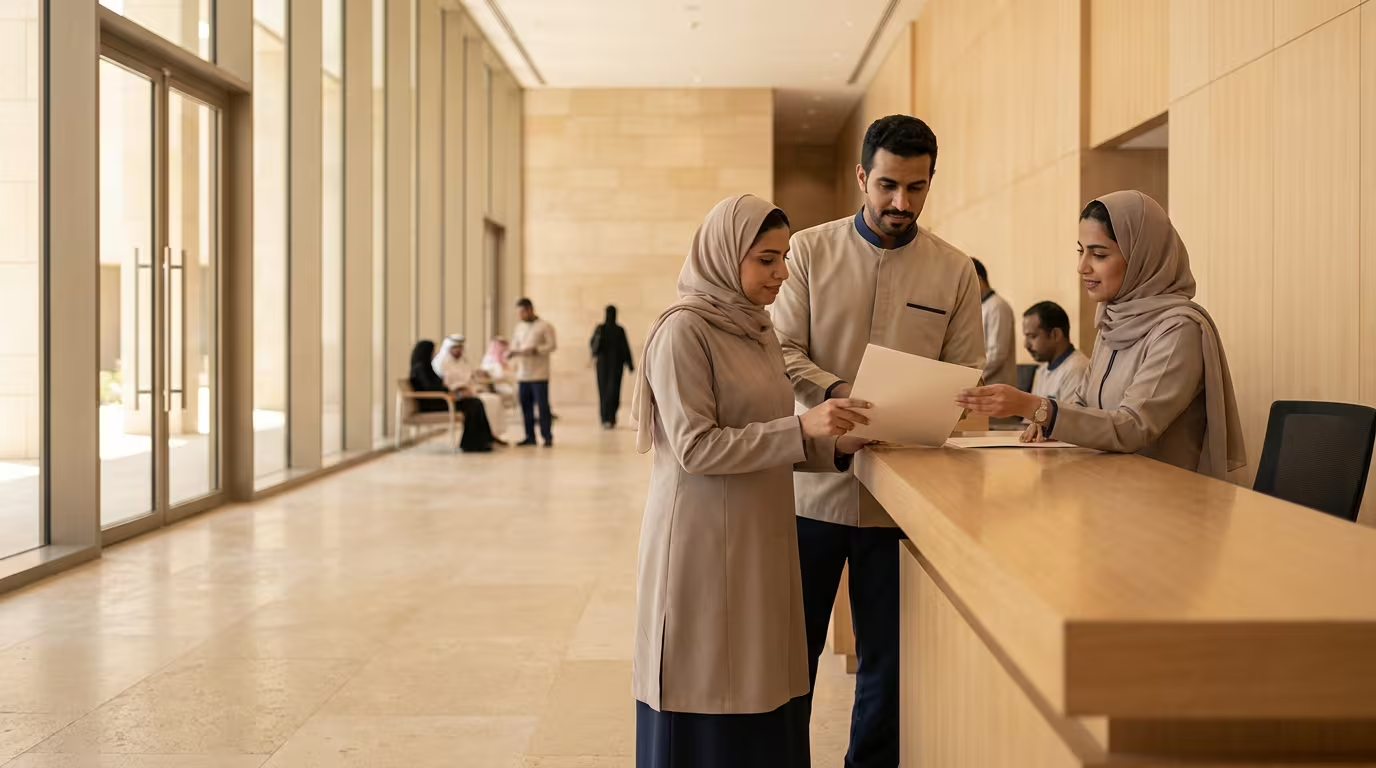
Government staff span a wide range of functions under one identity: reception and service counters, administrative and technical offices, inspection and field teams, drivers and facilities crews, security posts, and senior management. A well-built program lets a visitor tell these apart within a second or two without turning the workforce into a costume parade. The usual tools are quiet ones: a consistent base color for the institution, a secondary color or trim that shifts by function, different garment types for desk and field work, and discreet name or role identification placed the same way on every garment. Formality is the other axis. Public-facing dress in Saudi institutions tends toward the composed and unshowy, with covered arms, relaxed rather than close fits, opaque fabrics that hold their shape through a full day, and neat necklines for both men and women. Female staff commonly need longer tunics, wider sleeves, and garments that work with a scarf and abaya. Building those options into the standard set makes the identity feel deliberate.
Fabric Choices for Saudi Conditions
Most ministry staff work in conditioned air, but almost none of them stay inside all day. Between the parking lot, the entrance, site visits and inspection rounds, a summer garment handles a swing from a cooled office to genuine desert heat several times a day. That argues for lighter weights in the warm months, weaves that let air move, and fibers that manage moisture instead of holding it against the skin. The trade-off is familiar: cotton-rich cloth feels better in heat but creases and softens over time, while polyester-rich cloth keeps its press, dries fast and survives institutional laundering but breathes less. Mid-range blends exist precisely because most offices sit in between. Color matters more than buyers expect, since deeper shades read as formal and hide soiling while lighter sand and grey tones stay cooler outdoors but show dust and perspiration. Colorfastness under strong sun and repeated washing, opacity, pilling resistance at seat and elbow, and skin-safe finishing certified to OEKO-TEX Standard 100 belong in the written specification rather than in assumptions.
Specification and Procurement Records
Public buyers document what private buyers settle by phone. In practice the written specification carries the program: fiber composition and cloth construction, finished measurements per size rather than vague size labels, stitch and seam types, thread, fastenings, labeling and care instructions, packing and marking, delivery milestones, and how defects are handled after delivery. Two habits protect the buyer more than any clause. The first is a sealed reference sample, approved by the committee and kept by both sides, so later batches are judged against an object and not a memory. The second is requiring test reports from accredited laboratories against named international test methods for the properties that actually matter to the entity: shrinkage, colorfastness, tensile and seam strength, and any performance claim made by the bidder. What each entity requires, which thresholds apply, how local content and Saudization are weighted, and which certificates must accompany the offer are set by the tender documents for that specific competition, which remain the only reliable source.
Sizing Across Thousands of Staff
Sizing is where large public programs usually lose time. Self-declared sizes collected by email produce a predictable pattern: too many exchanges, a shortage of the middle sizes, and a tail of staff wearing something that fits badly enough to be noticed by the public. The dependable method is physical. A set of graded try-on samples travels to each site or region, staff wear the actual garment rather than reading a chart, and the confirmed size is recorded against the employee number in a file the entity keeps. That record becomes the backbone for reorders, new joiners and the next cycle. Plan for practical realities as well: separate grading for men and women rather than a shortened men's block, longer lengths and generous sleeves for staff who prefer more coverage, tall and short options where the population justifies them, and a small allowance for alterations at the sites. Agreeing an exchange window after first issue, with a clear cut-off, keeps goodwill without leaving the order open indefinitely.
Replacement Cycles and Continuity
A uniform program is a standing service, not a purchase. Entities that run theirs well decide in advance how many sets each role receives, how often they are renewed, who authorizes an early replacement, and what evidence is needed for one, normally an inspection of the worn garment rather than a request by message. Issues are recorded against the employee, returns are collected when someone leaves or changes role, and garments carrying the institutional emblem are withdrawn and destroyed rather than released into the market. Two continuity risks deserve attention at contract stage. Shade drift between production lots is real, so reorders should reference the sealed sample and be dyed in planned batches where possible. And the specification itself must survive staff turnover, kept as a controlled document so the next tender reproduces the same uniform rather than reinventing it. Local manufacturing helps here: UNEOM has produced inside the Kingdom since 2013 under an ISO 9001:2015 quality system, which shortens reorder cycles and keeps records close to the buyer.
Frequently asked
- What should a government employee uniform specification include in Saudi Arabia?
- At minimum: fiber composition and cloth construction, finished measurements for every size, seam and stitch types, thread and fastenings, labeling and care instructions, packing and marking, delivery milestones, and the process for handling defects. Add a sealed reference sample and test reports from accredited laboratories. The binding detail for any particular competition sits in the tender documents themselves.
- How do ministries keep uniforms consistent across multiple branches?
- Consistency comes from a controlled specification, a sealed approved sample retained by both buyer and supplier, planned dye batches to limit shade drift, and a single central point that authorizes reorders. Site-level purchasing is the usual cause of divergence: once branches buy independently, colors, fabrics and trims separate within one or two cycles.
- What fabrics suit public sector office uniforms in Saudi summer?
- Most offices are cooled, but staff cross open ground and some roles work outdoors, so summer sets favor lighter weights and breathable weaves. Cotton-rich cloth is more comfortable in heat; polyester-rich cloth holds its press and endures institutional laundering. Blends sit between. Prioritize colorfastness, opacity and pilling resistance in the written specification.
- How often should government uniforms be replaced?
- There is no single answer; the cycle follows role, wear rate and the entity's own policy. Desk roles usually run longer than field or facilities roles. What matters more than the interval is the rule: renewal driven by inspection of the worn garment against agreed condition criteria, recorded per employee, and budgeted in advance.
- How should female staff uniforms be handled in government offices?
- Treat them as a designed part of the standard set, not an adaptation. That usually means separate grading rather than a shortened men's block, longer tunics or over-layers, sleeve and neckline options that give fuller coverage, and garments that sit comfortably with a scarf or abaya. Offer choices within one visual identity and let staff select.