Corporate Suit Programme Saudi Arabia: Executive Dress Standards for Leadership Teams
How to build an executive uniform programme in Saudi Arabia: cloth and tailoring decisions, thobe and suit together, and coordination with other tiers without flattening hierarchy.
Uniform programmes usually stop at the supervisor. Extending them to the executive tier raises different questions: how much individuality to allow, what cloth survives a Saudi summer, how the thobe and the suit sit together in one standard, and how leadership dress stays connected to the rest of the workforce without erasing rank. This guide orders those decisions.
Why the Executive Tier Is Different
An executive uniform programme is not the frontline catalogue in a better colour. The population is small, the visibility is disproportionate, and the failure modes change entirely. A housekeeping tunic fails through abrasion, shrinkage or colour loss; an executive jacket fails through a collar that lifts, a shoulder that ripples, or a trouser break that photographs badly at a signing ceremony. That shifts the procurement question from durability testing to fit governance, and from bulk economics to individual measurement records. It also changes who owns the programme: frontline uniforms usually sit with operations or HR, while executive dress standards touch brand, communications and the office of the chief executive. Volumes are too small to negotiate on scale alone, so value comes from getting the block right once and reordering against it for years. Treat the executive tier as a separate workstream with its own specification, its own measurement cycle and its own approval path, then connect it deliberately to the rest of the programme rather than assuming it inherits the same rules.
Standard Without Sameness
The instinct to standardise collides with the fact that senior people expect some authorship over how they appear. The workable answer is to fix a small number of variables and release the rest in writing. Fix the shell: cloth family, colour range, silhouette, lapel and pocket treatment, button stance, and any brand element such as a lining, a discreet embroidered mark or a consistent shirt collar. Release the interchangeable layer: shirt within a stated palette, tie or open collar, pocket square, and shoes within a stated level of formality. Written this way, a dress standard describes outcomes and boundaries rather than a parts list, which survives fashion drift and personal preference far better than a locked product code. It also gives HR a defensible position when someone deviates, because the document explains what the organisation wants a visitor to perceive rather than dictating taste. Publish it with photographs of acceptable and unacceptable combinations, and review it on a fixed cadence with the executives themselves in the room.
Cloth for the Climate
Executive dress in the Kingdom lives an air-conditioned life punctuated by brutal minutes: the walk to the car, the site visit, the airport kerb. Cloth should be chosen for that duty cycle rather than for how it feels in a showroom. Wool remains the reference fibre because it manages moisture vapour and recovers its shape after a long day of sitting, but the variable that matters most is construction rather than fibre alone. High-twist, open weaves in the tropical or fresco family move air and resist creasing far better than dense, smooth cloth of the same weight, which is why lighter is not automatically cooler. Reducing the lining, specifying a breathable body lining and leaving the back unlined does more for comfort than chasing grams. Blends with synthetics buy wrinkle recovery and cost stability at the expense of hand and breathability, which may be the right trade for constant travellers. Resist buying by mill numbering: those figures describe fibre fineness, not durability, and very fine cloth is often the least suited to daily programme wear.
Where Tailoring Shows
Two decisions carry most of the perceived quality: how the front of the jacket is built, and how disciplined the fitting process is. A fully fused front is cheap, stable and prone to looking flat over time, while a half-canvas or full-canvas front lets the chest mould to the wearer and hold its line through repeated wear and cleaning. Shoulder construction sets the silhouette, and it should be chosen once for the programme rather than negotiated person by person. On sourcing, altered off-the-rack works when the leadership population fits a consistent block and the alteration standard is written down; made-to-measure earns its place when postures vary, when the same people are photographed constantly, or when a distinctive house cut carries brand meaning. Either way, run a proper fitting session with a tailor present, keep individual measurement records, and schedule remeasurement, because bodies change. Build alterations and a spare pair of trousers into the contract from the start; trousers wear out long before jackets, and an orphaned jacket is a failure nobody planned for.
Thobe and Suit Together
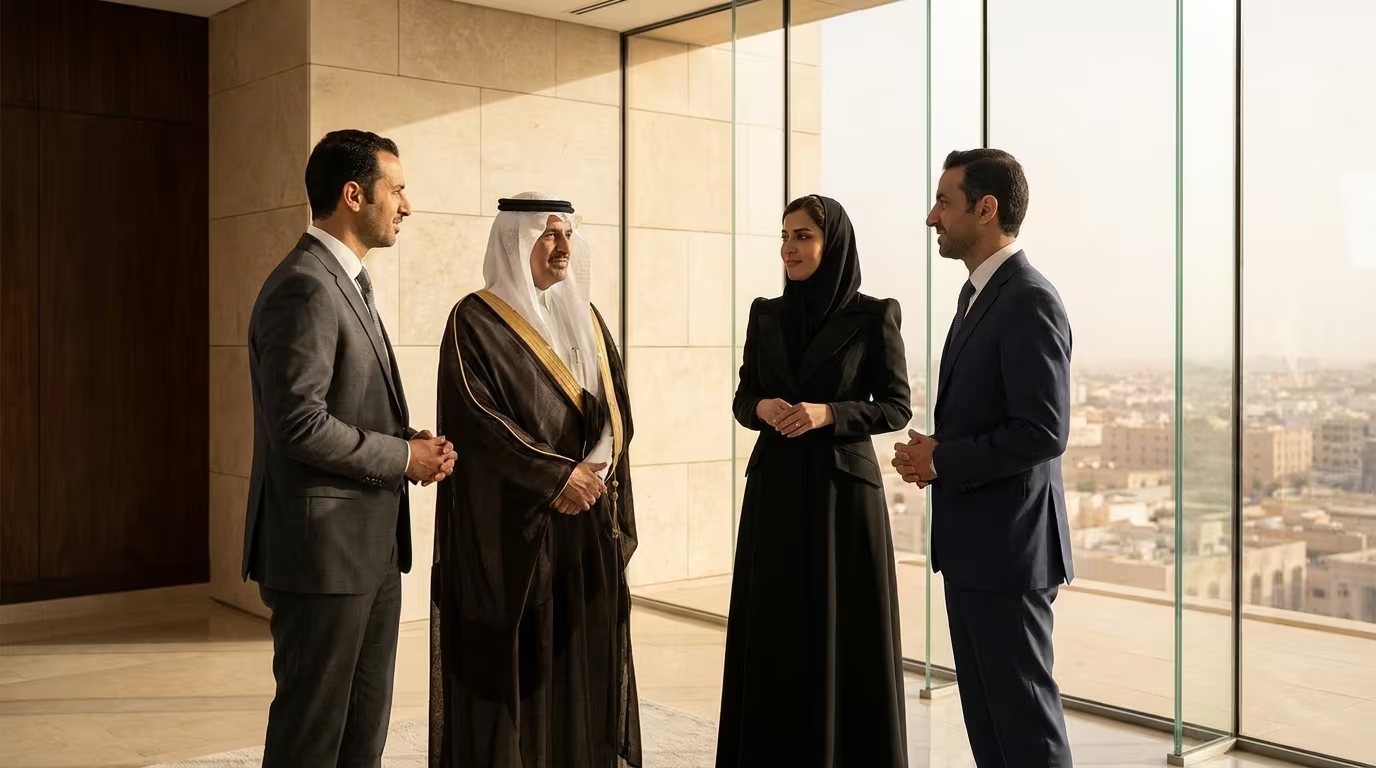
In Saudi executive life the thobe is not a cultural exception to a suit-based standard; it is a parallel formal register with its own ladder, and a credible programme specifies both. That means writing the thobe standard with the same care as the jacket: cloth for summer and winter, collar style, cuff and sleeve treatment, length and finish, and the occasions on which a bisht is worn. It also means declaring equivalence, so a general manager in a well-cut thobe and a colleague in a two-piece suit read as the same seniority in the same room. International meetings, plant visits and ceremonial hosting pull differently, and the standard should map occasions rather than personalities. For women in senior roles, extend the same logic: tailored modest workwear, abaya or coat-dress options drawn from the corporate colour architecture, cut for movement and long days, specified rather than improvised. Describe the practice respectfully, allow the choice, and keep the quality bar identical across both registers.
Tiers, Signals and Governance
The executive tier should be recognisably part of the same organisation without dissolving into it. The reliable device is a shared colour architecture with escalating material: a common accent that appears as a tie, a scarf, a lining or a trim at every level, while cloth, construction and finish become quieter and richer as seniority rises. Visitors read hierarchy from contrast and cleanliness of line long before they read a name badge, so keep that signal deliberate rather than accidental. Governance carries the rest: who approves the standard, what triggers replacement, how allowances are administered, what happens to garments when someone leaves, and how new appointments are measured within their first weeks. Pilot with a small group through a full summer before committing the whole leadership team. Working with an in-Kingdom manufacturer shortens the loop that matters most here — fitting, adjusting the block, reordering against it — which is why UNEOM has manufactured in Saudi Arabia since 2013 under ISO 9001:2015 quality management, with OEKO-TEX Standard 100 certified materials.
Frequently asked
- What should a corporate suit programme in Saudi Arabia actually specify?
- At minimum: cloth family and weight for summer and winter, colour range, silhouette and lapel treatment, lining approach, shirt palette, level of shoe formality, and any brand element. Add the governance layer — measurement records, fitting cadence, replacement triggers, allowance rules and offboarding. Specify outcomes and boundaries rather than fixed product codes, so the standard survives supplier and fashion changes.
- Made-to-measure or altered off-the-rack for executives?
- Altered off-the-rack is efficient when the leadership population fits a consistent block and the alteration standard is documented. Made-to-measure earns its cost when postures vary widely, when the same people are photographed constantly, or when a distinctive house cut carries brand meaning. Many programmes mix both: altered off-the-rack for new appointments, made-to-measure at renewal.
- Which cloth handles Saudi summer without looking informal?
- Look at construction before weight. High-twist, open weaves in the tropical or fresco family move air and resist creasing while keeping a formal surface. Reduce or remove lining in the back and body, and choose a breathable lining where structure is needed. Synthetic blends add wrinkle recovery for frequent travellers but cost some breathability and hand.
- How should thobes fit into an executive dress standard?
- Treat the thobe as a parallel formal register, not an exception. Specify cloth for summer and winter, collar and cuff style, length, finish quality, and the occasions on which a bisht is worn, with the same rigour applied to suits. State explicitly that both registers carry equal formality, so nobody is disadvantaged by their choice.
- How do we coordinate executive dress with frontline uniforms?
- Use one colour architecture across all tiers, then let material and finish escalate with seniority. A shared accent — a tie, scarf, lining or trim — signals one organisation, while quieter cloth and cleaner tailoring signal rank. Avoid an entirely separate palette for leadership; visitors read disconnection as inconsistency rather than as hierarchy.