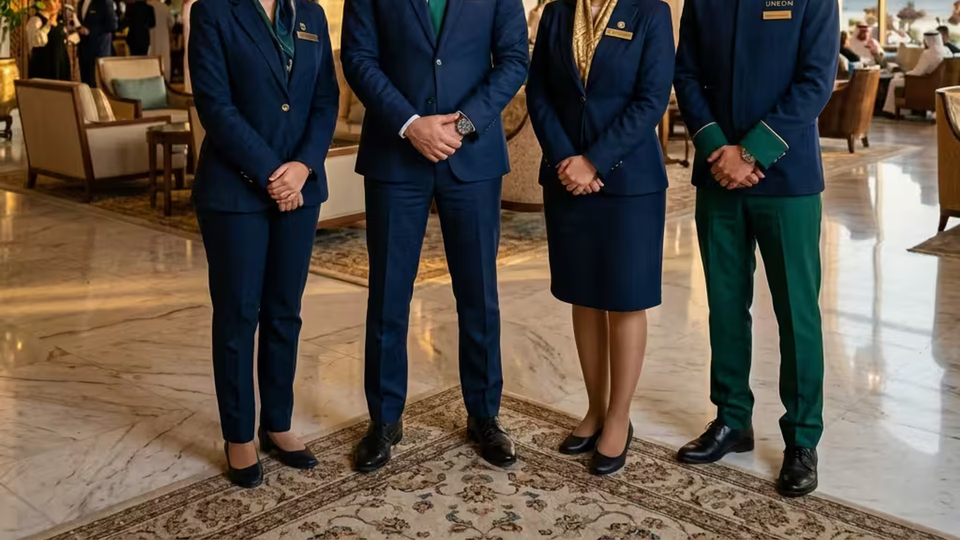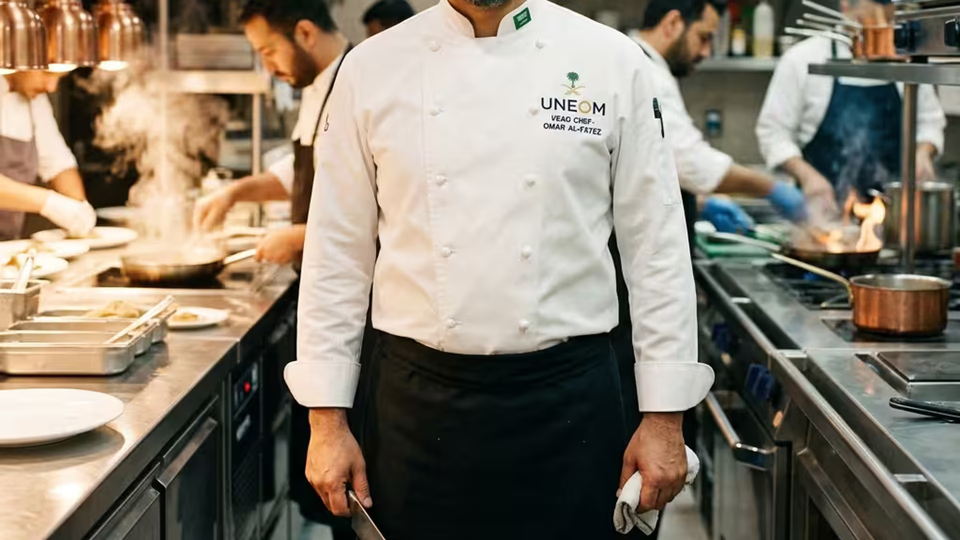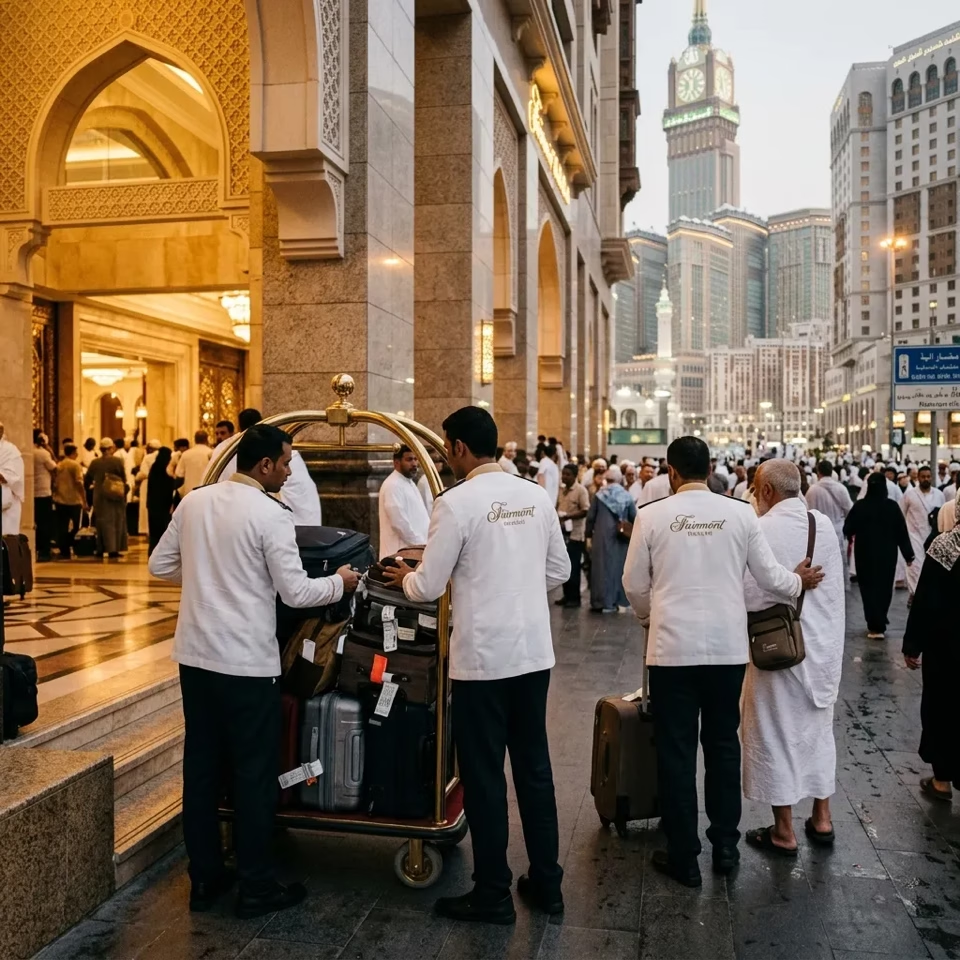
Concierge Uniform Hotel Design: Fit, Fabric, First Impression
The concierge uniform is the only one in a hotel a guest examines at conversational distance, for minutes at a time. This guide covers fit tolerance, the door-versus-desk climate split, fabric that survives a Riyadh summer under a portico, rank insignia, and how to stay formal without being forbidding.
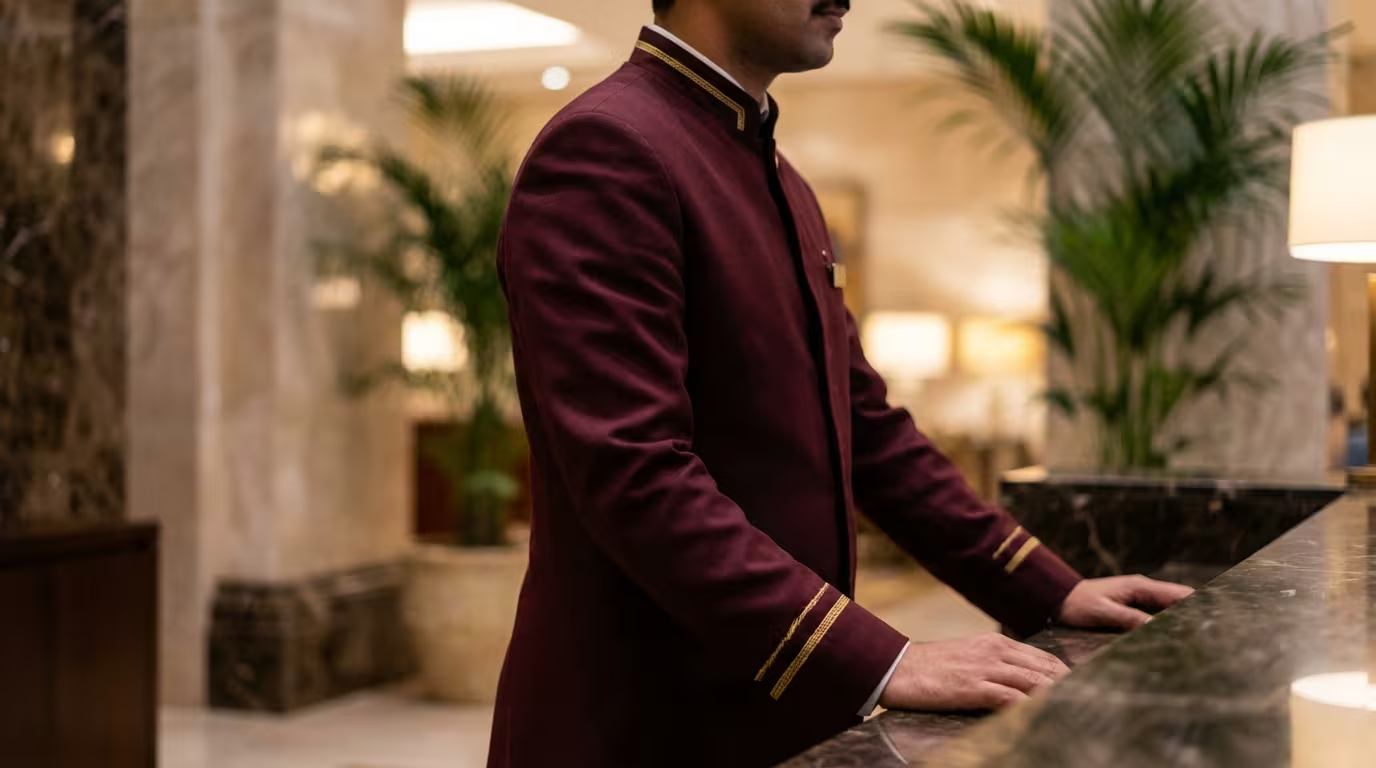
A guest at the concierge desk is not walking past. They stand at conversational distance, ask for something they actually care about, and then wait — with nothing to look at but the person serving them: the collar, the cuff, the badge, the state of a shoulder seam. Every other uniform in the hotel is judged in motion. This one is judged at rest, close up, by someone who has time to look — and that alone changes what belongs in the specification.
The Only Uniform a Guest Studies Up Close
Most hotel uniforms are judged in motion. Housekeeping passes in a corridor. Banquet staff are read across a room. The concierge is different: a guest stands at conversational distance, asks for something they care about, and then waits — with nothing to look at but the person in front of them. That distance changes what belongs in the specification. Close up, the eye finds things that vanish across a lobby. A collar that lost its roll after laundering. A lapel edge that ripples instead of lying flat. Pilling on the forearm where the sleeve rubs the desk edge. A name badge pinned at a slightly different angle every shift. A white shirt that has drifted grey next to a fresh cuff. None of these is a dramatic failure. Together they read as a property that does not check its own details, which is the opposite of the message the desk exists to send. Match your inspection to the viewing distance. Do not approve a sample on a hanger. Put it on someone from the actual team, seat them behind the actual desk, stand where a guest stands, and look under the lobby's own light — warm interior lighting and daylight spilling from the entrance will show sheen and shade differently from a showroom. Then have them stand, lean in, and reach across the desk. Most of the faults you will live with for the whole contract are visible in that short exercise, and almost none are visible on the hanger.
Fit Tolerance: Write It Into the Spec, Not the Complaint Log
Fit is where concierge programmes quietly fail. The garment fits on delivery day; then bodies change, a new hire arrives mid-season, or someone moves from the door to the desk and inherits a jacket cut for a different frame. Decide early whether you are buying graded sizes with alterations, or made-to-measure for the front line. Graded sizing plus a real alteration allowance covers most teams: ask for generous seam allowance at side seams, centre back and sleeve, and a hem that can be let down. Made-to-measure earns its cost on hard-to-fit bodies and on anyone who spends a whole shift facing a guest across a desk. Then specify what a tailor cannot fix later. Sleeve pitch matters for people who gesture and point all day; a sleeve set for a static arm twists the moment the arm lifts. Armhole height and back width decide whether a buttoned jacket stays closed when someone leans forward to write. Rise decides whether the shirt stays tucked through a shift. For women's garments use a women's block, not a downsized men's pattern — a regraded men's jacket never sits correctly at the shoulder or bust. Then build the loop: order a sizing set before bulk, run a fitting with the actual team, agree who pays for alterations and how fast they turn around, and tie re-measurement to your own review calendar rather than to a rule of thumb someone invented.
The Door and the Desk Are Two Different Climates
One design, two builds — the most useful decision in a front-of-house programme, and usually made too late. The desk is air-conditioned and largely sedentary; the concierge sits, writes, turns to a screen, and rarely moves into the sun. The door is another job entirely. Under a portico in a Riyadh summer, the air is hot, the driveway radiates heat back up, car doors open onto a wall of it, and the same person is lifting luggage. Then they step into a chilled lobby, and back out again, all shift. A single garment specified for the lobby will be punishing outside; a garment specified for outside will look under-dressed at the desk. Keep the visual identity identical and change the construction. For the door role: a lighter cloth in the same colour and finish, half-lining or an unlined back, a breathable lining rather than a sealed one, a higher armhole so the jacket moves with the arm, and a back vent that actually opens. Treat the shirt as the variable and the outer garment as the constant, so a mid-shift change is possible without breaking the look. One reservation, stated plainly: managing heat exposure for outdoor staff is an occupational safety matter owned by your HR and HSE function under the rules that apply to your site and season. Uniform construction is one input among several — rotation, shade and rest are the others — and it is not a substitute for any of them.
Fabric That Survives a Riyadh Summer Under a Portico
Start with fibre facts, because much of what circulates in uniform sales is simply wrong. Cotton does not weaken when wet — it is stronger wet than dry, which is why it tolerates hard laundering. What it does instead is crease, hold moisture and show perspiration. Lyocell keeps its strength well when wet, one reason it works in shirtings and in blends that are washed often. Viscose is the fibre that loses a large share of its strength when wet, so treat it carefully in anything heading into a heavy laundry cycle. Do not lump these together as "cellulosics" — they behave differently, and the difference decides whether a shirt lasts. For outer garments in this climate, construction beats fibre marketing. High-twist yarns in an open, air-permeable structure with a matte finish wear cooler and look better than a dense, low-twist cloth with a sheen — sheen is what makes a dark jacket read as cheap under lobby light. Wool in tropical weights breathes and recovers from creasing; engineered polyester-rich cloths hold colour and press through repeated laundering. Most programmes blend both priorities. Two practical points. Sun exposure fades outdoor garments faster than indoor ones, so plan replacement for the door role separately. And agree upfront how shade variation between dye lots is handled on reorder, and whether your base cloth is reserved for your programme. UNEOM manufactures inside the Kingdom and has done since 2013, works to a quality system certified to ISO 9001:2015, and can specify materials certified to OEKO-TEX Standard 100.
Insignia, Rank, and What Isn't Yours to Design
A concierge desk carries hierarchy, and guests read it whether or not you meant to signal it. Decide what you are signalling before anyone starts drawing. Build a rank map first: chief concierge, concierge, door and luggage staff, and any duty role that stands in for management. Then decide which markers sit on the garment and which travel with the person. Garment-borne markers — a different lapel treatment, a contrast collar, a shoulder detail on the door coat — are stable but expensive to change when someone is promoted. Person-borne markers — a lapel bar, a tie or scarf in a different colourway, an extra badge line — move with the individual. Most properties are better served by keeping the garment constant and letting the small pieces carry rank. Name badges deserve their own decision: bilingual Arabic and English, the role written in words a guest understands rather than an internal job code, one agreed position enforced daily, and a replacement route that is not measured in weeks. The part that is not yours: emblems belonging to professional associations. Where a concierge is a member of an association with its own insignia, the rules on who may wear it, and how, belong to that association — confirm eligibility and placement with them, never assume. Likewise, if anyone tells you a classification tier obliges you to buy a specific garment, ask to see the clause in the criteria that apply to your own licence. Appearance requirements in such criteria are written in general terms; they do not come with a cut sheet.
Formal Without Being Forbidding
The brief usually arrives as one word: elegant, formal, approachable. None of those is a specification. Formality is a set of dials, and each one can be set deliberately. The dials that raise formality: more jacket structure, darker and lower-contrast colour, a closed collar and tie, matte metal, gloves and headwear on the door. The dials that lower it: softer shoulders, an open collar, a waistcoat instead of a jacket at the desk, a lighter mid-tone, visible texture. A property that wants warmth without losing authority usually keeps structure in the outer garment and softens at the neck, because the neck is what a guest sees while talking. Two tests are worth running before bulk. First, the movement test: have the team do the actual tasks in the sample — reach across the desk, walk a guest to the lift, load a bag, hold a door in wind. Anything that pulls, rides up or exposes a shirt tail will do it every day. Second, the two-distance test: check the read across the lobby, where silhouette and colour do the work, and again at the desk, where finish and detail do. If you want a local reference in the design — a woven trim, a colour drawn from regional textiles — use it sparingly and check it with people who know the reference. Restraint reads as confidence; applied heavily it reads as costume, and a concierge in costume is harder to approach.
Frequently asked
- Should the doorman and the concierge wear the same uniform?
- Same design, different build. Keep colour, cloth family and detailing identical so the team reads as one, then construct the door version for outdoor work: lighter cloth, half or no lining, a higher armhole, a working vent. Guests see continuity; the person outside gets a garment they can actually work in. Specify both builds at the start — retrofitting a lobby jacket for the driveway rarely works.
- Which fabric holds up outdoors in a Riyadh summer without looking cheap?
- Look at construction before fibre names. High-twist yarns in an open, air-permeable weave with a matte finish wear cooler and photograph better than a dense, shiny cloth. Wool in tropical weights breathes and sheds creases; engineered polyester-rich cloths hold colour and press through frequent laundering. Sheen, not fibre content, is what makes a dark jacket look inexpensive under lobby lighting. Plan faster replacement for outdoor garments, since sun fades them sooner.
- Do we need made-to-measure, or will graded sizes work?
- Graded sizes plus a genuine alteration allowance cover most teams, provided you order a sizing set, run a real fitting, and keep a tailoring loop with agreed turnaround. Reserve made-to-measure for hard-to-fit bodies and for people who spend an entire shift facing guests across a desk. The failure mode is never the size chart — it is having no alteration budget and nobody owning it.
- Can we add a crossed-keys or association emblem to the concierge jacket?
- Not on your own authority. Emblems belonging to a professional concierge association are governed by that association: who may wear one, and where it sits, is their decision, not your uniform programme's. Confirm eligibility and placement directly with them before any sample is made. Your own rank markers — lapel bars, tie or scarf colourways, badge lines — are yours to design and far easier to change later.
- How do we handle women's uniforms and hijab coordination at the desk?
- Start from a women's block rather than a resized men's pattern; shoulder and bust never grade correctly otherwise. Offer coverage options within one design language: a longer jacket, sleeve length choices, a higher neckline, and a scarf supplied in the programme's own fabric and colourway so shades match. Let each person choose from the approved set. Supplying the scarf rather than leaving it to individuals is what keeps the desk looking coordinated.