How to Make School Uniforms Last Longer Through the Year
Most school uniforms are retired for how they look or how they fit, not because the cloth wore through. This guide separates what a school can fix in the specification from what only weekly care at home can control.
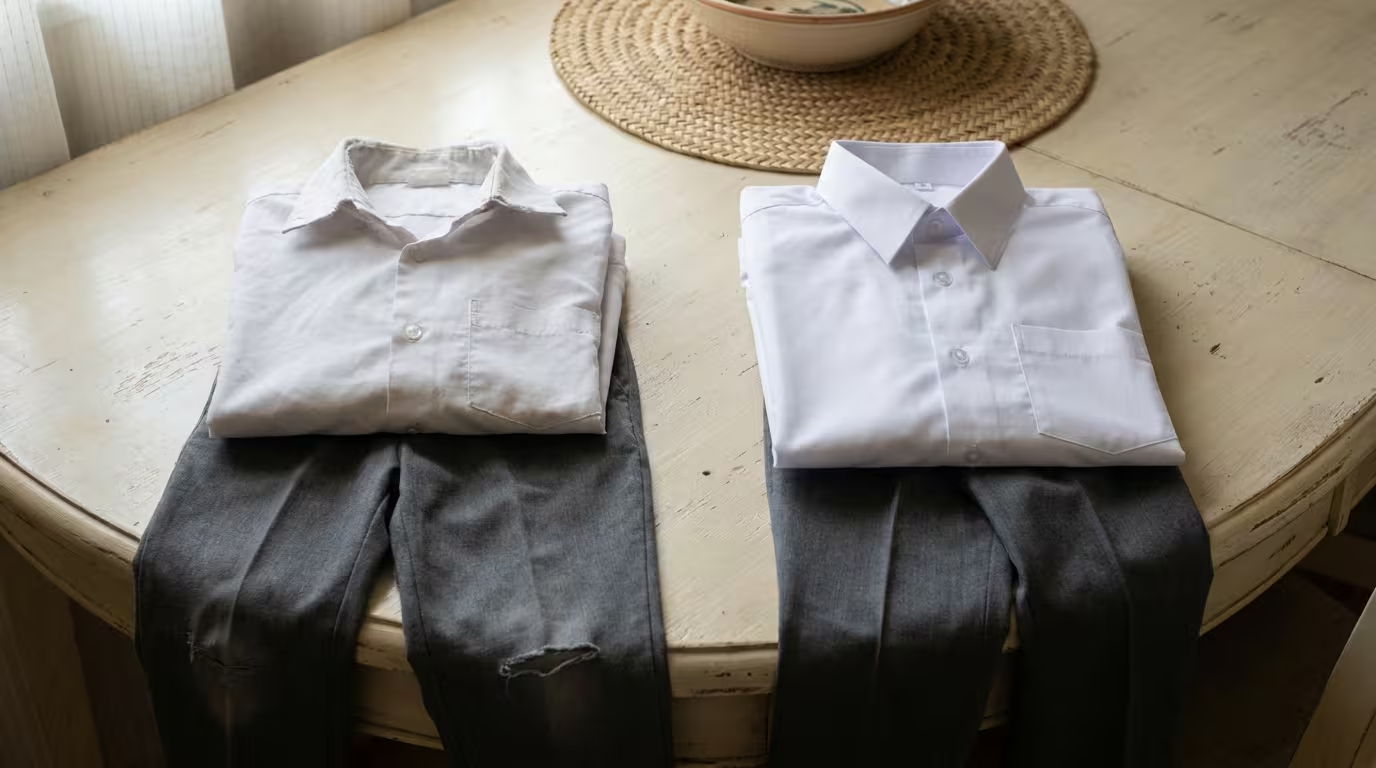
By the second term the pattern is predictable: knees gone shiny or split, seats thinned from chair fabric, white collars carrying a grey band that no longer washes out, and trousers that fit fine except the hem now sits above the shoe. Very little of this is random. Each failure has a mechanism, and each mechanism is owned by someone — either the person who wrote the specification in July, or the person doing the laundry on Thursday night.
The Four Ways a Uniform Actually Fails
Uniform failure is not one problem; it is four, and they run on different clocks. Abrasion comes first. Knees, seat, elbows, cuff edges and pocket mouths lose fibre wherever cloth rubs a surface repeatedly — floor, chair, desk edge, bag strap. Abrasion shows as shine or thinning long before it shows as a hole, which is why a knee looks polished weeks before it splits. Soiling and greying is second, and it is what families actually notice. Collars and cuffs collect skin oils that ordinary washing lifts slowly; grey on a white collar is usually oil-bound soil plus soil that was released in the wash and settled back onto the garment. Seam and closure failure is third. Pocket corners, fly ends, crotch junctions, button plackets and zip tapes carry concentrated load. A garment with strong cloth and unreinforced stress points opens at the stitch line long before the fabric is worn. Fit loss is fourth, and across a school population it is often the largest. The child grows; the garment is retired in good condition. This matters because it assigns ownership. Abrasion and seam failure are decided mostly in the specification — weave, construction, reinforcement. Greying and heat damage are decided mostly at home. Fit loss is decided at ordering, through hem allowance, adjustability and how sizes were measured. Treating all four as a supplier quality problem wastes the two you could have solved yourself.
What the Specification Decides Before the Year Starts
A specification written for price alone produces a uniform that fails on schedule. A few construction decisions change the outcome more than the fabric name does. Weave before blend. A twill construction generally resists abrasion better than a plain weave in comparable cloth, and its diagonal surface hides light soil. For trousers and skirts meeting chairs and floors every day, weave choice is doing more work than the fibre label suggests. Blend behaviour, honestly. Cotton is comfortable and absorbent, and contrary to a common assumption cotton fibre is stronger wet than dry. Polyester brings abrasion resistance and colour retention but holds oily soil more stubbornly and can pill. A blend is a trade, not an upgrade; write down what you are trading for. Reinforcement where load concentrates. Bar tacks at pocket corners and fly ends, double-needle stitching on seat and inseam, and a knee reinforcement option for the youngest years cost little at order stage and cannot be added afterwards. Continuity. Ask the manufacturer to retain a reference sample and to commit to shade continuity on mid-year reorders, so a replacement shirt does not sit visibly off-tone beside the original. Documentation. Ask what a supplier can actually evidence. UNEOM has manufactured inside Saudi Arabia since 2013, works to ISO 9001:2015, and holds OEKO-TEX Standard 100 certification on the materials it covers. Ask any supplier to show what applies to your specific fabric rather than to the company in general.
Grey Collars, Direct Sun, and the Two Habits That Cost Most
Two ordinary habits shorten uniform life more than anything the child does. The first is overloading the machine. Washing works by moving water and detergent through cloth; when the drum is packed, soil that lifts off one garment settles onto another instead of leaving with the water. That is the mechanism behind grey whites. Collars grey faster because skin oil binds soil there and holds it in place. The fix is unglamorous: fewer items per load, enough detergent for the water and the soil level, and a little detergent worked into collar and cuffs before the wash rather than after the mark has set. The second is drying uniforms in direct sun. Strong sunlight fades dyes and, over time, weakens the fibre surface that faces it. In Saudi drying conditions this is not a marginal effect. Drying in shade or indoors, or simply hanging the garment inside out, protects colour and surface without adding a step to anyone's day. Heat tells the same story at the dryer and the iron. Over-drying shrinks and embrittles, and the lint you empty out is fibre that left the garment. Hot ironing on twill can glaze the surface into a permanent shine, and high heat degrades the elastane in stretch waistbands. A caution rather than a recipe: chlorine bleach is not a maintenance product for children's uniforms. It can yellow some finished cottons and it damages elastane. Whatever product you use, follow the sewn-in care label and the product's own instructions, and test on a hidden seam allowance first.
The Weekly Routine That Does the Real Work
Beyond those two habits, a short routine handles the rest. Rotate properly. A garment worn every school day with only a couple of sets in circulation never rests and never gets a full laundry cycle; elastane recovers its shape when a garment rests, and soil that sits for days is harder to lift. Enough sets in rotation costs less than the replacements it prevents. Treat marks before they set. Food, ink and playground marks lift far more easily on the same day. Blot rather than rub — rubbing drives soil deeper into the weave and abrades the surface exactly where the mark is. Prepare the garment for the machine. Close zips and fasten buttons so hardware does not catch other items, turn shirts and trousers inside out so the visible face is not the surface being scoured, and empty the pockets — one forgotten pen costs a whole shirt. Skip fabric softener on performance fabrics. Softener leaves a film on the fibre; on a polyester or blended cloth chosen for moisture movement, that film works directly against the property you paid for. Repair on the day it starts. A seam that has just begun to open closes in minutes; the same seam left for weeks becomes a tear with frayed edges that no longer meet. Ask at order stage whether spare buttons and matching thread are issued with each set — most manufacturers will, if asked. Store between terms clean and dry. Soil left in fabric across a long break sets hard and stops washing out.
Growth and Hems: the Failure That Isn't About Fabric
In the primary years especially, fit is typically the reason a uniform leaves service before the cloth is worn out — and this is the one failure a supplier cannot be blamed for and a wash cannot undo. Buy to measurement, not to age. Age-based size labels are a rough average across a population, not a statement about your child. A sizing session before the order — actual chest, waist and inside-leg measurements against the manufacturer's own size chart — removes most of the mid-year exchange traffic. Specify hem allowance. Trousers and skirts with a deep turn-up can be let down as the child grows, so the garment retires when it is worn rather than when it is short. This must be in the order; fabric cannot be added later. Specify adjustability. Internal elastic with button tabs at the waist, and a generous back rise on trousers, widen the fit window in the direction children actually grow. Resist the one size up reflex. Oversized trousers drag the hem along the ground, which puts the most abrasive contact the garment will ever meet on its most exposed edge, and long sleeves collect soil at the cuff. Correct fit with a deep hem beats a large size every time. Agree the exchange route before term starts. A mid-year size exchange window, written into the order with a clear cut-off and a stated condition standard, is far cheaper for families than buying replacements, and it hands the school real data on which sizes were under-ordered.
Turning This Into a Specification and a Care Card
Two documents carry most of the value: what you send the supplier, and what you send the parents. For the supplier, put construction in writing instead of adjectives. Weave and fabric identification, reinforcement at stress points, stitch type on seat and inseam, hem allowance, waist adjustability, closure specification, a retained reference sample with shade continuity across reorders, spare buttons and matching thread issued with each set, and the terms of the mid-year exchange window. Ask for evidence tied to your fabric, not to a company brochure. For parents, one care card in Arabic and English beats a paragraph in the handbook. Keep it to what matters: wash inside out, do not overload the machine, dry in shade, avoid high heat and bleach, treat marks the same day, and follow the sewn-in care label whenever it differs from anything else — the label on the garment always takes precedence. Settle name labelling before the first wash. Marker ink can bleed on some finishes and is permanent when it does, heat-seal labels can lift with repeated hot washing, and sewn labels are slower but survive. Choose one method and tell everyone. Keep a failure log: garment, point of failure, year group. After one year you know whether your problem is specification, care or fit, and the next tender writes itself. One reservation: this is operational guidance, not regulatory advice; dress-code rules, product-safety obligations and procurement requirements should be confirmed with your own authority and adviser. And any fabric finish protects the fabric — it is not a health measure for the child.
Frequently asked
- Is a higher polyester content always more durable for school uniforms?
- Not automatically. Polyester resists abrasion and holds colour well, but it grips oily soil and can pill, while cotton is comfortable, absorbent, and — contrary to a common assumption — stronger when wet than dry. Durability comes more from weave and construction than from the blend ratio: a twill with bar-tacked stress points and double-needle seams will usually outlast a plain-weave garment of the same fibre content.
- Can grey collars be recovered once the greying has appeared?
- Partly, and honestly not always. Grey on a collar is oily soil bound into the fibre, plus soil redeposited during washing. Working detergent into the collar before the wash, washing smaller loads and using enough detergent will lift a good part of it. What has been set by hot washing or hot drying often will not come back. Chlorine bleach is not the answer on children's uniforms.
- Should we buy a size up so the uniform lasts the whole year?
- No. Oversized trousers drag the hem on the ground, which puts the heaviest abrasion the garment will ever meet on its most exposed edge, and long sleeves collect soil at the cuff. Buy to measurement and specify a deep hem turn-up and an adjustable waistband instead. That way the garment grows with the child without spending the year being worn out at the bottom.
- How many uniform sets should we plan per student?
- Set it by the household laundry cycle rather than by a fixed figure. Count the school days that pass between one wash run and the next, provide a set for each of those days, then add one spare for accidents and slow drying. The principle that matters is that no garment is worn on consecutive days without a full wash and a proper dry.
- Is drying in direct sun really a problem, or is it just a care myth?
- It is real, not a myth. Sustained direct sunlight fades dyes and gradually weakens the exposed fibre surface, and local drying conditions make that exposure intense. Drying in shade or indoors, or hanging garments inside out, protects the outer face without slowing anything down. The same logic applies to heat: over-drying and hot ironing cost more life than most families realise.