The Complete Guide to Maid & Domestic Staff Uniforms in Saudi Arabia
Fabric specs, seasonal weight selection, bulk-programme pricing, and the operational realities of uniforming domestic staff across Saudi residential compounds and corporate facilities.

The search term "يونيفورم عاملات" generates more monthly queries in Saudi Arabia than any other uniform-related keyword — yet the content available online is dominated by low-quality product listings with no technical specifications, no fabric data, and no guidance on programme-level procurement. This guide addresses the gap with the same engineering rigour UNEOM applies to hospital scrubs and hotel staff programmes: fabric weight by season, fibre composition by work environment, sizing architecture for inclusive coverage, and the economics of buying 50 vs 500 units.
Fabric types: cotton vs poly-cotton vs jersey knit
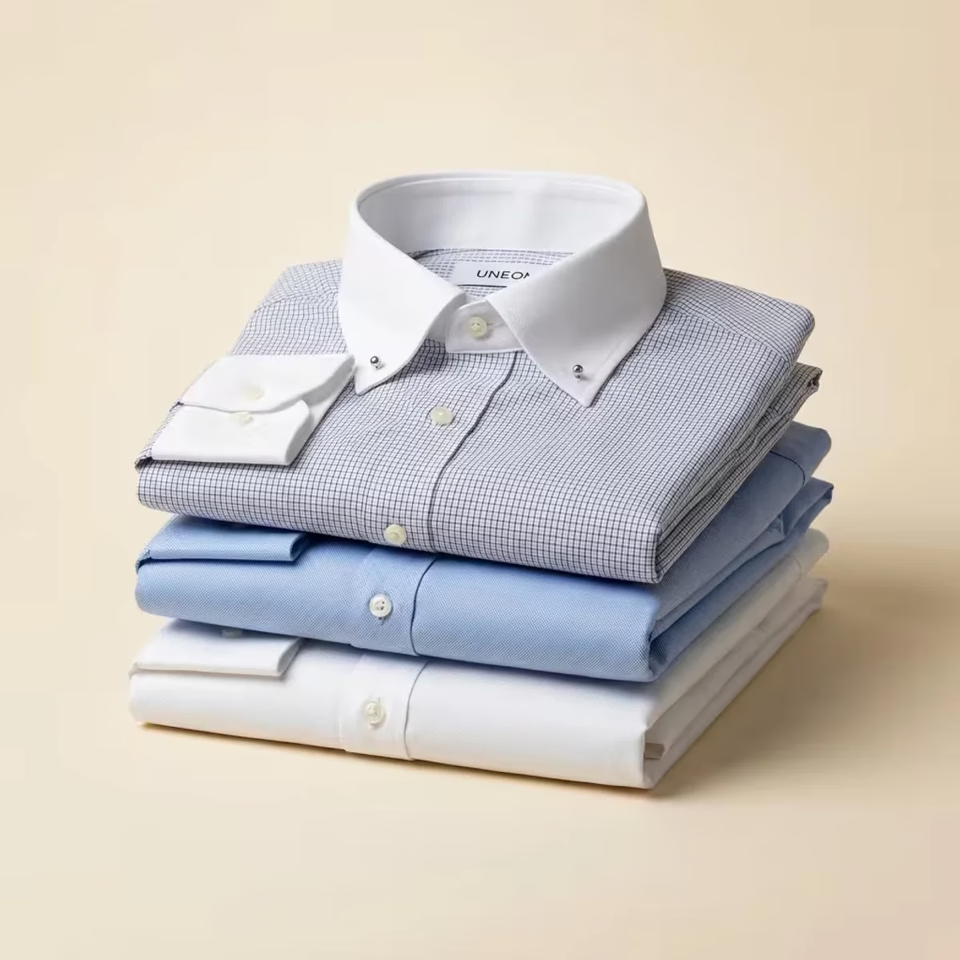
Three fabric families dominate the domestic staff uniform market, and each serves a different operational reality. 100% cotton (poplin weave, 180–200 gsm): the softest hand-feel and highest breathability, preferred for indoor-only roles in air-conditioned residences. The limitation is durability — pure cotton loses tensile strength 15–20% faster than blends under repeated industrial laundering, and colour retention degrades visibly after 40 wash cycles at 60°C. Poly-cotton blend (65% polyester, 35% cotton, twill weave, 200–220 gsm): the workhorse specification. The polyester content delivers wrinkle resistance, shape retention, and colourfastness to ISO 105-C06 Grade 4–5 across 100+ wash cycles. The cotton content provides moisture absorption and comfort against skin in Saudi heat. This is the blend UNEOM specifies for 80% of domestic staff programmes. Jersey knit (95% cotton, 5% elastane, 180 gsm): used for polo-style uniforms in compound and hospitality settings. The stretch content provides comfort during physical work, but the knit construction is less formal than woven alternatives and requires anti-pill treatment with a specified minimum pilling grade to ISO 12945-2 to maintain appearance.
Seasonal weight selection: summer, winter, and transitional
Saudi Arabia's climate demands seasonal thinking in uniform specification — a reality that most suppliers ignore by offering a single year-round weight. Summer specification (April–October, ambient 38–52°C): 180 gsm maximum. The fabric must breathe. We specify open-weave poly-cotton with moisture-wicking inner finish for roles that include any outdoor exposure (compound maintenance, garden-facing housekeeping). For indoor-only roles, standard 200 gsm poplin remains comfortable year-round in air-conditioned environments. Winter specification (November–March, ambient 12–25°C): 240–260 gsm. The heavier weight provides warmth without requiring an additional layer. For outdoor-exposed roles (compound gate staff, garden maintenance), we add a fleece-lined vest as a modular outer layer rather than increasing base garment weight — this preserves mobility while adding thermal protection. Transitional approach: rather than maintaining three seasonal inventories (which triples stock complexity), UNEOM recommends a two-weight system — a 200 gsm year-round base with a 260 gsm winter overlay garment. This reduces SKU count by 40% while covering all climate conditions.
Design specifications: length, sleeves, colours, and modesty
Domestic staff uniform design in Saudi Arabia operates within specific cultural and functional parameters. Length: below-knee (standard) or ankle-length (modest/formal). The below-knee option suits most compound and corporate environments; the ankle-length tunic or dress style is preferred for private household staff. Both options feature side slits (8–12 cm) for mobility. Sleeves: three-quarter (default) or full-length. Three-quarter sleeves provide practical compromise between coverage and heat management; full-length is specified for roles with direct client-family interaction. Both options include turned-back cuffs for rolled adjustment. Colour selection: UNEOM offers 18 stock colourways, but 65% of programme orders concentrate in five colours — navy blue (most popular, hides staining), burgundy, charcoal grey, forest green, and sky blue. Custom Pantone matching is available for orders above 100 units. Modesty integration: all designs accommodate hijab wear with matching head-cover options in the same fabric and colourway. Collar styles are mandarin (closed) or notched (formal), avoiding deep V-necks entirely.
Quality benchmarks and garment lifespan
The difference between a SAR 35 uniform and a SAR 85 uniform is not visible on day one — it becomes visible on day 90. Cheap uniforms fail in predictable ways: colour fading after 20 wash cycles, seam splitting at stress points (underarm, side slits), pilling on poly-blend surfaces, and collar deformation. UNEOM domestic staff uniforms are engineered to the following benchmarks: colour retention to ISO 105-C06 Grade 4 minimum after 80 wash cycles at 60°C; seam strength to ISO 13935-2 (minimum 150 N); pilling resistance assessed to ISO 12945-2 with a minimum agreed pilling grade per fabric, and abrasion resistance tested separately to ISO 12947; dimensional stability after washing to ISO 5077 (maximum 3% shrinkage in any direction). Under these specifications, mean garment lifespan reaches 10–12 months in daily-wear, daily-wash conditions — compared to 3–4 months on unspecified market alternatives. The cost-per-wear calculation overwhelmingly favours the engineered garment: SAR 85 ÷ 300 days = SAR 0.28/day vs SAR 35 ÷ 100 days = SAR 0.35/day.
Bulk procurement for compounds and corporate facilities
Individual uniform purchases — one or two garments at a time from a retail shop — are the most expensive way to buy uniforms. Programme procurement transforms the economics. Compound management companies and corporate facility operators typically manage 20–200 domestic staff, creating volume that unlocks programme-level pricing and operational support. UNEOM compound programmes include: annual contract with fixed per-unit pricing (no seasonal surcharges); quarterly replacement cycle with on-site garment assessment; 48-hour joiner-kit dispatch for new hires (standard sizes XS–4XL held in buffer stock); single invoice consolidation (monthly or quarterly); and a dedicated programme manager as single point of contact. Volume pricing structure: 1–49 units at list price; 50–199 units at 12% programme discount; 200–499 units at 18% discount; 500+ units at custom contract pricing. The operational value exceeds the price discount: facility managers consistently tell us the biggest gain is the administrative time they stop spending on ad-hoc uniform purchases from multiple vendors.
Size guide and ordering: XS to 4XL
Inclusive sizing is not optional — it is a programme requirement. UNEOM domestic staff uniforms are produced in 9 sizes (XS through 4XL), with size distribution data from 500+ programme contracts showing the following demand pattern: XS (4%), S (12%), M (28%), L (26%), XL (18%), 2XL (8%), 3XL (3%), 4XL (1%). Sizes beyond 4XL are produced as made-to-measure at standard programme pricing with a 7-day lead time. Our sizing system uses bust, waist, and hip measurements as primary dimensions, with garment length as a secondary adjustment (standard, petite -3cm, tall +4cm). For programme orders, UNEOM provides a digital sizing kit: a printed measurement guide in Arabic, English, Tagalog, and Bahasa Indonesian (reflecting the four most common languages among domestic staff in Saudi Arabia), plus a video tutorial accessible via QR code. Orders are placed through the programme portal with real-time stock visibility, dispatch tracking, and automated reorder alerts when buffer stock drops below 15% of the programme baseline.
Frequently asked
- What is the average price of a quality maid uniform in Saudi Arabia?
- UNEOM domestic staff uniforms range from SAR 75–120 per piece depending on fabric type and design complexity. Programme pricing (50+ units) reduces this by 12–18%. The cost-per-wear over 10 months is significantly lower than cheap alternatives that need replacing every 3 months.
- Which fabric is best for summer uniforms in Saudi Arabia?
- For summer (38–52°C), we recommend poly-cotton blend at 180 gsm maximum with moisture-wicking inner finish. Pure cotton breathes well but degrades faster under industrial washing. The 65/35 poly-cotton blend offers the optimal balance of comfort and durability.
- Do you offer winter uniforms for domestic staff?
- Yes. Our winter specification uses 240–260 gsm fabric with optional fleece-lined vests for outdoor-exposed roles. We recommend a two-weight system — 200 gsm year-round base plus 260 gsm winter overlay — to reduce inventory complexity by 40%.
- What sizes are available for maid uniforms?
- Standard production covers XS through 4XL (9 sizes). Sizes beyond 4XL are produced as made-to-measure at standard programme pricing with a 7-day lead time. Sizing guides are available in Arabic, English, Tagalog, and Bahasa Indonesian.
- Can you deliver uniforms to all Saudi cities?
- Yes. UNEOM delivers nationwide across 24 Saudi cities. Standard delivery is 48 hours for Riyadh, Jeddah, and Dammam; 72 hours for other cities. Programme clients receive real-time dispatch tracking and automated reorder alerts.