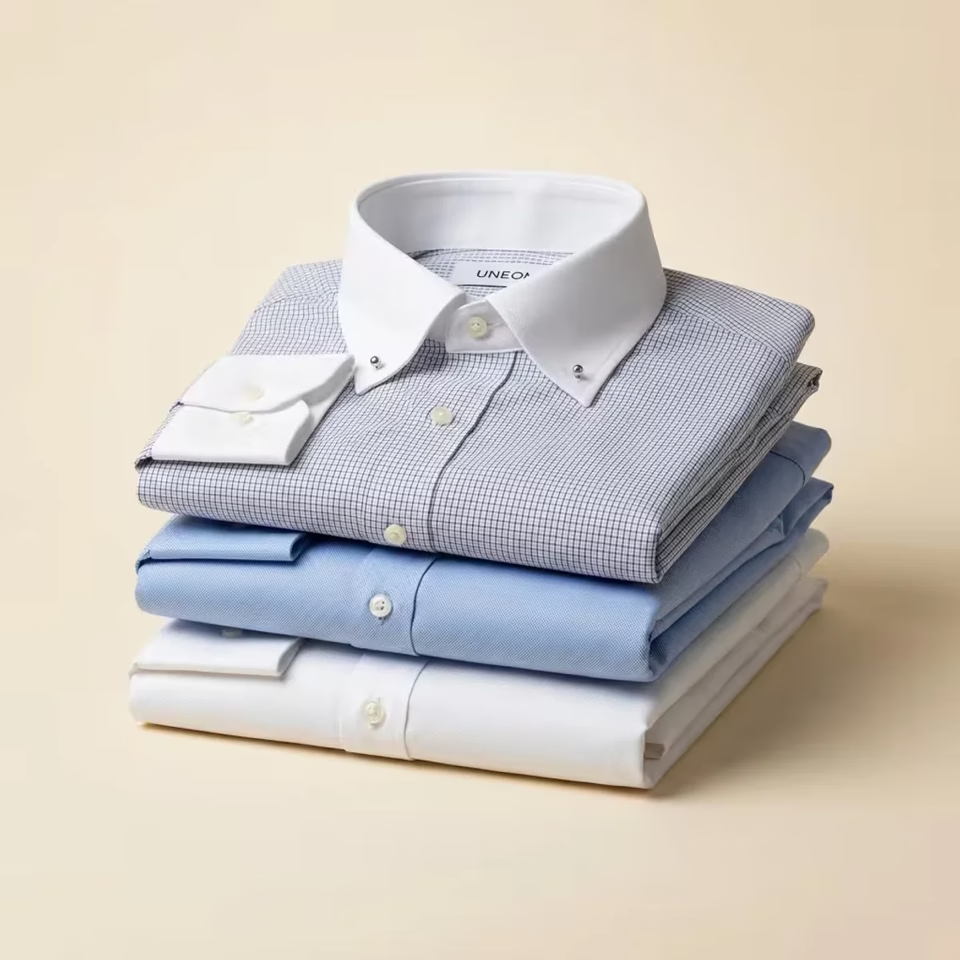
When Employees Don't Like New Uniforms: Handling Resistance to a Uniform Change
Uniform rollouts fail on comfort, fit, modesty and consultation — not stubbornness. A practical change-management approach for Saudi employers facing staff complaints about a new uniform.

Few uniform programs fail on the design. They fail in the weeks after issue, when employees discover the fabric is hot, the fit is wrong, the coverage feels inadequate, or nobody asked them first. Resistance is predictable, and largely preventable — if you treat complaints as specification feedback and plan consultation, wear trials and sizing properly.
Resistance is signal, not defiance
Resistance rarely means employees are being difficult. In most Saudi facilities, the complaints that surface after a uniform launch are describing something real: a collar that chafes across a long shift, a fabric that holds heat in an open courtyard, a cut that rides up when someone reaches overhead, a length that no longer feels appropriate in front of visitors. Treating those signals as attitude problems guarantees they will be repeated privately instead of reported usefully. The more productive framing is that resistance is unpaid inspection work. Employees wear the garment in conditions no showroom fitting can reproduce, and their objections map directly onto the variables procurement already cares about: comfort, durability, safety, dignity and cost of replacement. Programs that log complaints, sort them by cause, and route them to the responsible owner — supplier, sizing process, laundry contract or policy wording — convert friction into specification improvements. Programs that dismiss complaints get quiet non-compliance instead: altered hems, missing jackets, personal shoes and a policy nobody enforces.
Where the objections actually come from
Complaints cluster into a small number of causes, and separating them matters because each has a different fix. Thermal comfort dominates in a climate where outdoor and semi-conditioned work runs through extreme summer heat; heavy constructions, tight weaves and synthetic linings that trap moisture will be rejected regardless of how good the design looks. Fit is the second cluster: garments cut on a single generic block, ordered from a size chart nobody explained, or issued without an exchange route. Modesty and coverage form a third — sleeve and hem length, opacity of light fabrics under bright light, neckline height, and whether the design accommodates hijab, overlayers or looser cuts without looking improvised. Identity and status form a fourth, because staff read colour, quality and insignia as statements about where they sit in the organisation, and a drop in perceived quality is felt as a drop in respect. The fifth is procedural: the garment arrived as an announcement rather than a conversation, and objecting afterwards feels pointless.
Consult before the spec is frozen
The cheapest way to reduce resistance is to spend a small amount of consultation before the specification is frozen. Build a representative panel rather than a volunteer one: include the roles that will actually wear the garment, both genders where relevant, the full range of body shapes, the sites with the hardest conditions, and at least one supervisor who will have to enforce the policy. Tell the panel plainly what is open and what is not — brand colours, safety requirements and regulatory obligations are usually fixed, while fabric weight, closures, pocket placement, sleeve options and layering choices are often genuinely negotiable. Ambiguity about scope creates expectations that cannot be met and produces a second wave of resentment when they are refused. Give the panel real artefacts to react to: swatches they can handle, sample garments they can move in, and photographs of the garment on people who look like the workforce rather than on models. Record what the panel asked for and what happened to each request, because that record becomes your communication material later.
Wear trials that end in decisions
A wear trial is not a fashion show; it is a structured test with a decision at the end. Issue the candidate garments to a cross-section of staff and run them through real conditions: full shifts, the hottest part of the day, the tasks that involve reaching, kneeling, carrying or standing for long periods, and the sites where the fabric meets grease, chemicals, chlorine or sand. Run the garments through the laundry process that will actually be used, industrial or domestic, for enough cycles to reveal shrinkage, colour change, pilling, seam behaviour and how the garment looks at the start of a shift after repeated washing. Collect feedback in a fixed format rather than through informal chatter, so responses can be compared: comfort, freedom of movement, heat, coverage, fastenings, pockets, appearance after washing, and what the wearer would change. Then close the loop honestly. Publish the changes made because of the trial, and explain the constraints behind the requests you could not accommodate.
Sizing: the complaint that returns
Sizing generates more sustained complaint than any other issue, because a poorly fitting garment is uncomfortable every hour of every shift and visible to everyone. Measure people instead of asking them to guess from a chart; a supervised measuring session with a full size set to try on costs far less time than the exchanges it prevents. Expect that one block will not serve everyone, so plan separate men's and women's patterns where appropriate, length options, and modest-fit variants with fuller cuts, longer sleeves and higher necklines offered as standard rather than as a special request that draws attention. Build an exchange window into the rollout and announce it, because staff who know they can swap a size stop hoarding old uniforms. Document a route for pregnancy, medical needs and post-injury accommodation. A supplier manufacturing inside the Kingdom shortens the distance between a documented fit problem and a corrected pattern; UNEOM has produced locally since 2013 under ISO 9001:2015 quality management, using OEKO-TEX Standard 100 certified materials.
Communication that earns adoption
Adoption depends less on the announcement than on the sequence around it. Explain the reason for the change in operational terms staff recognise — safety, hygiene, heat, identification of authorised personnel, brand consistency across sites — rather than in slogans. Name the things that changed because employees asked, and name the person or committee who decided the rest, because anonymous decisions attract more resistance than unpopular ones. Brief supervisors first and equip them with answers, since most objections are raised to a line manager, not to HR. Give a realistic timeline with dates for measuring, issue, exchange and the point at which the policy is enforced, and avoid enforcing before every employee has a correctly fitting garment in hand. Publish the policy in Arabic and English, covering entitlement, replacement, laundering responsibility, grooming standards and the complaint route. Keep the complaint route open after launch and report back on what it produced; a programme that visibly fixes the first wave of problems earns the benefit of the doubt on the second.
Frequently asked
- Why don't employees like the new uniform even when it looks better?
- Appearance is only one of several criteria wearers apply. Staff judge a uniform by how it feels across a full shift in heat, whether it allows the movements their job requires, whether the coverage suits them, and whether they were consulted before the decision. A garment that photographs well but traps heat or fits poorly will still be resisted.
- How do we handle staff uniform complaints without reopening the whole program?
- Sort complaints by cause before responding. Sizing issues go to measurement and exchange, comfort issues to fabric and cut, modesty issues to pattern options, and process issues to communication. Most are resolved without touching the core specification. Publish what you fixed, and explain clearly which constraints — safety, hygiene, brand identity — cannot move.
- When should employees be involved in choosing a new uniform?
- Before the specification is frozen. Consultation after pattern approval and bulk ordering can only produce disappointment. Form a representative panel early, state which elements are genuinely open, let them handle swatches and move in sample garments, and record every request with its outcome. That record becomes the evidence that objections were heard.
- What makes a wear trial useful rather than symbolic?
- A real trial runs candidate garments through full shifts, the hottest hours, the physically demanding tasks and the actual laundering process for enough cycles to show shrinkage, fading and wear. Feedback is collected in a fixed format so responses can be compared, and the trial ends with documented decisions rather than impressions.
- Can a new uniform policy be enforced while complaints are still open?
- Enforce grooming and wear standards only after every employee holds a correctly sized garment and a published exchange route exists. Enforcing earlier punishes people for a supply problem and damages the policy's credibility. Keep the complaint channel open, report what it produced, and apply the standard consistently across sites and seniority levels.