
Lab Coat Standards for Saudi Healthcare & Laboratories: Length, Fabric & Barrier Guide
A procurement guide to lab coats for Saudi hospitals, clinics and laboratories — length conventions, fabric and barrier choice, fit, laundering and embroidery.
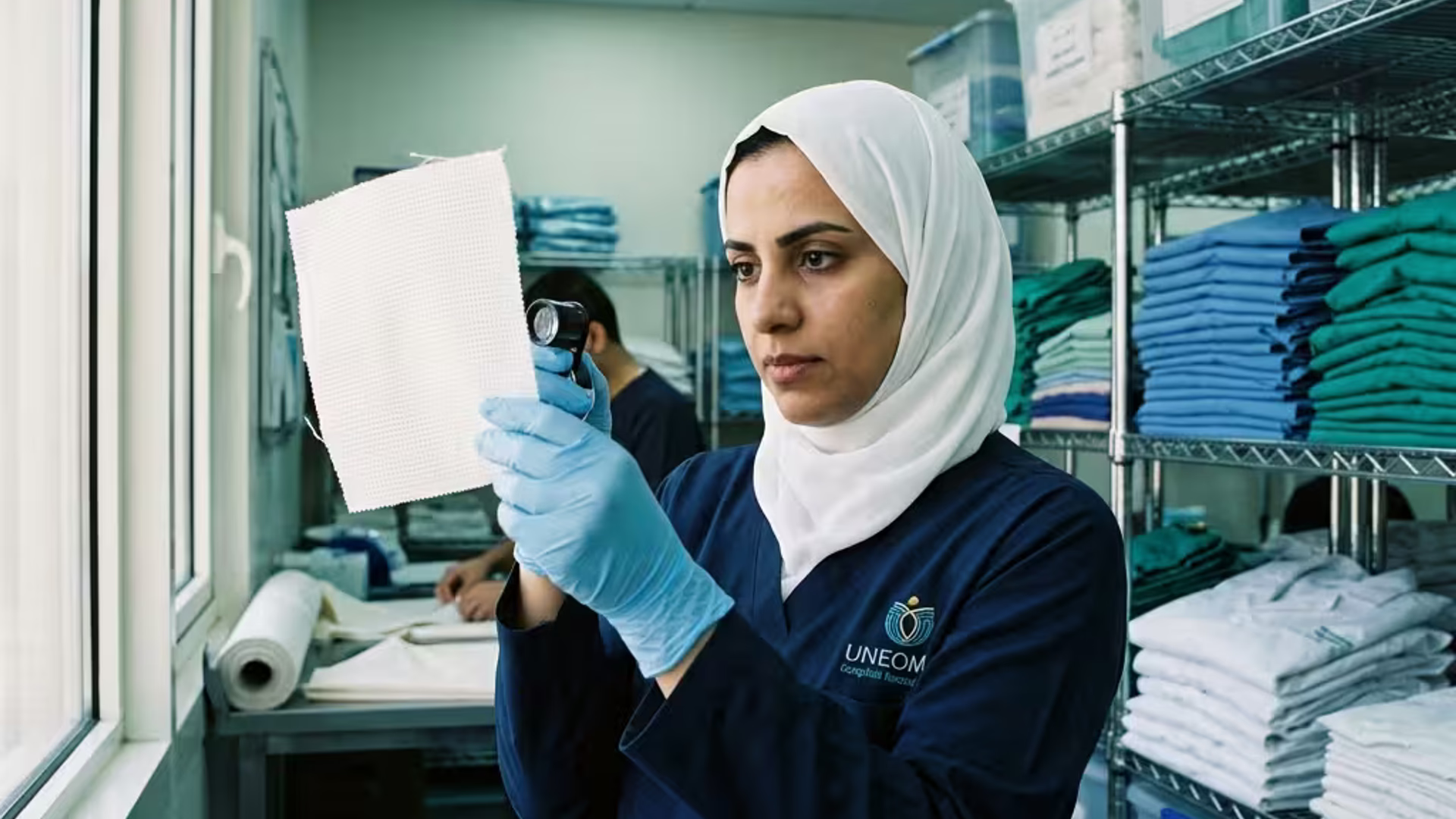
A lab coat is not one garment but a family of them. Length signals role, fabric decides comfort and protection, and the barrier level depends on what the wearer is exposed to. This guide helps Saudi hospitals, clinics, laboratories and medical faculties specify lab coats that survive institutional laundering and still look professional on the ward.
Short, mid or full length: what the cut signals
Length is the first decision because in most teaching hospitals it carries meaning. The full-length coat, falling to or below the knee, is traditionally associated with consultants and senior physicians and offers the widest coverage over clothing. A mid-length or hip-length coat is the common everyday choice for laboratory staff, pharmacists and technicians, giving protection without excess fabric to catch on benches and equipment. Short coats, ending at the hip, have long been used in some institutions to distinguish students and interns from qualified staff. None of this is universal, and Saudi facilities differ; the important thing is that the convention is written into the uniform policy and applied consistently, because staff and patients read length as hierarchy whether or not the policy says so. Decide the convention first, then specify garments to match it, rather than letting each department drift into its own interpretation.
Fabric: the poly-cotton core and its alternatives
The workhorse lab coat fabric is a polyester-cotton blend, and for good reason. Polyester brings dimensional stability, wrinkle resistance, colour retention and the strength to survive repeated hot institutional washing, while cotton contributes breathability and a softer hand against the arms and neck. A polyester-dominant blend holds its crisp white appearance and shape through more wash cycles, which matters when a coat is laundered several times a week. Higher-cotton blends feel cooler and more comfortable through a long shift but crease more readily and tend to show wear sooner. Pure cotton is chosen occasionally for comfort or where an institution prefers a natural fibre, but it shrinks if not properly pre-treated and greys faster under aggressive laundering. For most Saudi facilities the practical answer is a polyester-rich poly-cotton in a weight heavy enough to hang well and stay opaque, without becoming hot to wear indoors.
Barrier and fluid resistance: match the exposure
Not every lab coat needs the same protection, and over-specifying is as wasteful as under-specifying. A standard coat worn for general ward rounds, teaching or light laboratory work is primarily a layer that keeps clothing clean and identifies the wearer. Where staff handle fluids, reagents, stains or cytotoxic material, a fluid-resistant finish or a tighter-woven fabric becomes worth the cost, shedding splashes long enough for the wearer to step away and change. Areas working with solvents or open flames need flame-resistant or at least non-melting fabrics, which rules out pure synthetics for those benches. The correct approach is to map each department against the exposure its staff actually face, then specify a small number of coat types rather than a single compromise garment or a different coat for every room. Confirm any specific protective requirement against your facility policy and the relevant safety standard before ordering.
Sleeves, cuffs and the bare-below-elbow question
Sleeve design is where infection-control practice and laboratory practice pull in different directions. Many clinical settings apply a bare-below-elbow approach for staff in direct patient contact, favouring short sleeves or coats that are removed before examination, on the grounds that cuffs contact patients and are hard to keep clean. Laboratories often want the opposite: long sleeves with knitted or elasticated cuffs that seal the wrist, keep the sleeve out of the specimen and stop splashes reaching the forearm. Both are legitimate for their setting, which is why a facility usually needs more than one sleeve specification. Knit cuffs sit neatly under gloves but hold moisture and need frequent laundering; open cuffs are cooler and dry faster but offer no seal. Decide by task, not by preference, and align the choice with your facility infection-control policy rather than assuming one rule fits the whole building.
Fit, modesty and comfort in a Saudi setting
A lab coat is worn over other clothing, so fit has to be generous enough to layer without pulling across the back and shoulders when reaching or leaning. That is doubly true where staff wear modest attire underneath: coats specified for female staff should allow for longer sleeves and fuller cuts beneath, and many Saudi facilities prefer longer lengths and higher-buttoning fronts as a matter of course. Because interiors are air-conditioned but corridors, ambulance bays and transfers are not, breathability still matters even indoors. Practical details earn their keep every shift: a breast pocket sized for a pen and a badge, deep side pockets that hold a phone securely, a back vent or action pleat for movement, and buttons or press studs that survive laundering. Offering a proper size range, including cuts developed for women rather than downsized men's patterns, does more for daily comfort than any fabric upgrade.
Laundering, whiteness and replacement
Lab coats live or die by the laundry. Institutional washing at high temperature with strong detergents is what keeps them hygienic, and it is also what ages them: whites dull, cuffs fray, and repeated processing gradually weakens fibres. Specifying a fabric engineered for industrial laundering, rather than a retail-grade cloth, is the single most effective way to extend service life. Whiteness is the most visible failure point, so it is worth agreeing at the outset how the facility will handle ink, blood and reagent staining, and at what point a coat is retired rather than re-washed. Building a planned replacement cycle into the programme, with buffer stock for new starters and rapid swaps, prevents the familiar situation where a clinician is the only person on the ward in a visibly grey coat. Track condition by department; high-turnover areas will always consume coats faster than administrative ones.
Embroidery, identification and the programme view
Personalisation is what turns a stock coat into a facility uniform. Embroidered names, titles and department, usually on the left chest alongside the institution logo, help patients identify who is treating them and reduce coats going missing. Embroidery outlasts printing through hot washing, which is why it remains the default for clinical garments, though it needs a stable fabric and a considered thread colour to stay legible on white. Because names change with staff, a sensible programme separates the logo, which can be embroidered on stock, from the individual name, which is added on issue. Keeping a live size and name record, a defined reorder point and an agreed lead time turns lab coats from a recurring scramble into a managed line. As an in-Kingdom manufacturer since 2013 holding ISO 9001:2015 and OEKO-TEX Standard 100 certification, UNEOM specifies and runs these programmes for Saudi facilities end to end.
Frequently asked questions
What length should a lab coat be?
It depends on the role and your facility convention. Full-length coats are traditionally associated with senior physicians and give the widest coverage; mid or hip-length suits laboratory, pharmacy and technical staff; shorter coats have been used to distinguish students. Whatever you choose, write it into policy and apply it consistently.
What is the best fabric for a lab coat?
A polyester-rich poly-cotton blend is the practical default. Polyester gives shape retention, wrinkle resistance and durability through hot institutional laundering, while cotton adds breathability and comfort. Higher-cotton blends feel cooler but crease and wear faster; pure cotton greys sooner under aggressive washing.
Do all lab coats need to be fluid resistant?
No. A standard coat is fine for general rounds, teaching and light lab work. Fluid-resistant finishes are worth the cost where staff handle fluids, reagents or cytotoxic material, and solvent or flame areas need non-melting or flame-resistant fabric. Map each department to its actual exposure.
Should lab coats have long or short sleeves?
Both, for different settings. Clinical areas applying a bare-below-elbow approach favour short sleeves or removing the coat before patient contact. Laboratories usually prefer long sleeves with knit cuffs that seal the wrist and keep the sleeve clear of specimens. Follow your infection-control policy per area.
How often should lab coats be replaced?
There is no fixed interval; it depends on laundering frequency and department. Retire a coat when whiteness, cuffs or fabric integrity fail rather than on a date alone. Plan a replacement cycle with buffer stock so no clinician is left in a visibly worn coat while a reorder is processed.