
Luxury Salon Chain: Multi-City Uniform Standardisation Across 6 Saudi Cities
A 120-staff luxury salon chain operating across 6 Saudi cities replaced three separate uniform suppliers with a single UNEOM programme — achieving 48-hour joiner-kit delivery, 32% brand consistency uplift, and zero supply gaps over 18 months.
- Client
- Premium salon chain — 6 cities, 120 staff, 4 role tiers
- Duration
- 10 weeks (national rollout)
- Headline
- 120 staff
- Scope
- Multi-city programme contract, 4 role tiers, monthly replacement dispatch, quarterly fit reviews

The numbers.
under a single programme contract — with joiner-kit delivery guaranteed within 48 hours to any Saudi city.
in client perception of brand consistency, measured through quarterly NPS surveys across all locations.
across the 18-month programme period — every location fully stocked through monthly replacement dispatch cycles.
The multi-city fragmentation problem
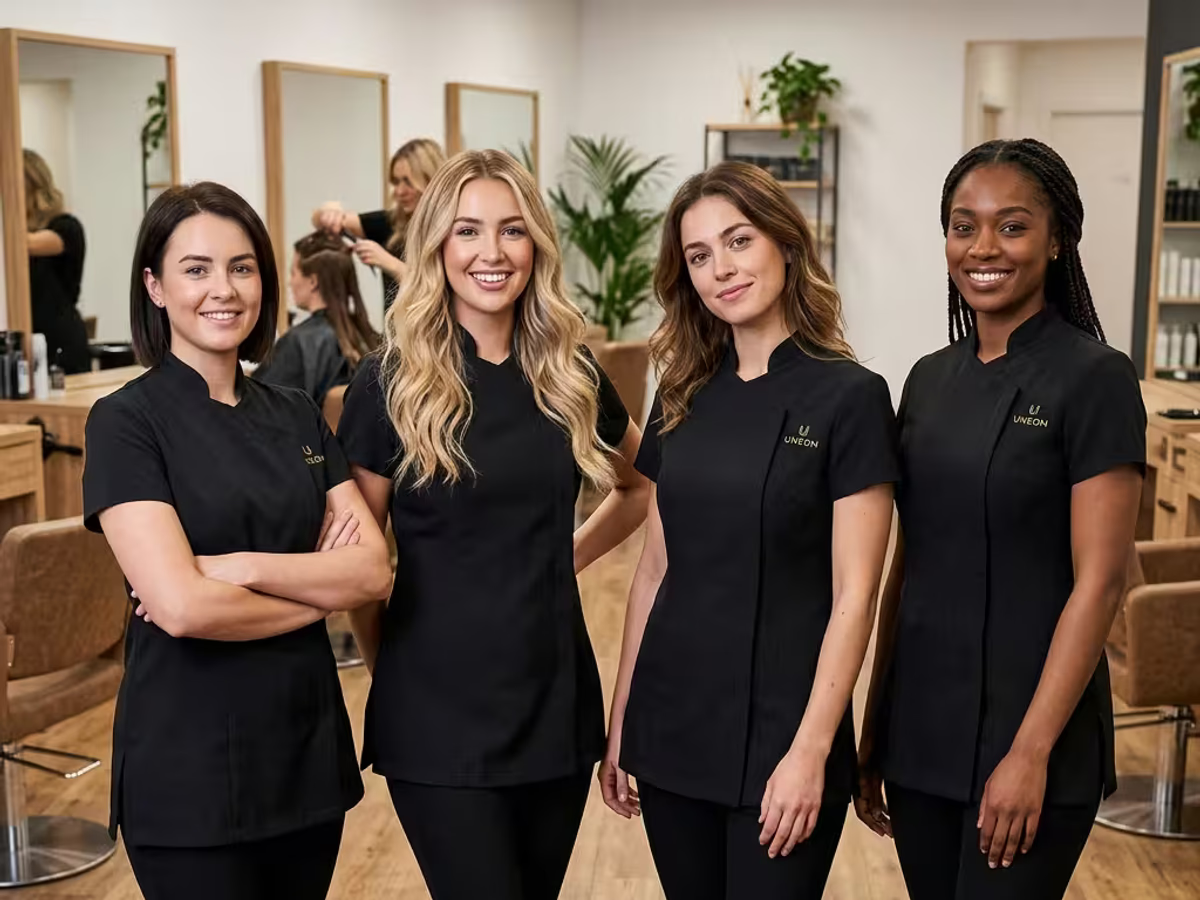
This luxury salon chain had expanded rapidly from a single Riyadh flagship to six locations across Riyadh, Jeddah, Dammam, Khobar, Mecca, and Medina over three years. Each branch manager had independently sourced uniforms from local suppliers, resulting in a visual identity that varied by city. The Jeddah salon used a burgundy palette; Riyadh branches defaulted to black; the Dammam location had adopted a navy variant. Staff transferring between cities looked like they worked for different companies. Customer feedback consistently flagged the disconnect: NPS surveys showed that "inconsistent brand image" was the second most-cited detractor across all locations. The chain's founder recognised that the uniform was the most frequently seen brand asset — visible in every client interaction, social media post, and Google review photo — yet it was the least managed.
The UNEOM audit and design framework
Our programme design team conducted on-site audits at all six locations over five days, documenting existing uniform conditions, staff feedback, and operational requirements. We catalogued 18 distinct garment types across the chain — many incompatible in cut, colour, and fabric quality. Staff interviews revealed that 41% had purchased supplementary items (aprons, wraps, shoes) out-of-pocket to compensate for programme gaps. The design framework we developed was built on four principles: single colourway across all cities (champagne gold with soft charcoal accents); four role-tier differentiations (senior stylists, junior stylists, reception, and support/housekeeping); embroidered crests on every garment standardised to a single production template; and a centrally managed inventory system eliminating branch-level procurement entirely.
Fabric selection for beauty environments
Salon environments present a unique fabric challenge: garments must resist chemical staining (hair dyes, bleach, toners), manage heat from styling tools, maintain aesthetic appeal under harsh LED lighting, and survive aggressive wash protocols. We specified a tri-blend performance fabric (52% polyester, 33% cotton, 15% elastane) with a dual-finish treatment: a chemical-repellent outer layer resistant to salon-grade hydrogen peroxide concentrations up to 12%, and an inner moisture-wicking layer that manages body heat during 8-hour shifts. Colour retention was tested to ISO 105-C06 standards through 300 wash cycles at 60°C with commercial-grade detergent — the champagne gold showed Delta E <1.5 colour shift at the 300-cycle mark, within acceptable luxury brand tolerance. All fabrics received OEKO-TEX Standard 100 certification, critical for garments in constant skin contact during physical work.
National logistics and joiner-kit system
The most complex operational element was building a logistics system that guaranteed uniform availability across six cities with staff turnover rates averaging 22% annually. We established buffer stock at our Riyadh distribution centre covering all four role tiers in sizes XS through 3XL, enabling a 48-hour joiner-kit dispatch SLA to any Saudi city. When a new hire is confirmed, the branch manager submits a digital request through UNEOM's operations portal; the kit is picked, inspected, packaged, and dispatched within 4 hours; and delivery is tracked in real-time with automatic confirmation to the branch. For non-standard sizes (below 2% of requests), we operate a 5-day express production line that handles cutting, construction, and embroidery on an accelerated schedule. Over the first 18 months, we dispatched 87 joiner kits with a 100% SLA compliance rate — zero kits arrived late.
Quarterly programme management
The programme operates on a structured quarterly cycle. Month 1 of each quarter: replacement dispatch — worn, damaged, or faded garments are collected and replaced on a one-for-one basis across all six locations. Month 2: fit review — our garment technician visits each location to assess fit quality, document body changes, and flag any sizing adjustments needed for the next cycle. Month 3: programme review — a formal meeting with the chain's operations director covering cost analysis, quality metrics, staff feedback, and forward planning. This rhythmic structure replaced the previous chaos of ad-hoc purchasing, emergency supplier calls, and branch-level budget overruns. The single operations contact model means the chain's management deals with one UNEOM programme manager instead of six different supplier relationships across six cities.
Brand impact and measured results
At the 12-month mark, the programme's impact was measured across three dimensions. Brand consistency: quarterly NPS surveys showed a 32% increase in responses citing "consistent brand image" across all six locations — the detractor that had previously ranked second was eliminated entirely. Operational efficiency: the chain's COO reported a 40% reduction in time spent managing uniform procurement, freeing branch managers to focus on service delivery. Financial performance: despite the premium fabric specification, the per-staff annual uniform cost decreased by 15% compared to the previous multi-supplier model, driven by bulk pricing, extended garment lifespan, and elimination of emergency procurement premiums. The chain subsequently expanded the programme to two additional locations opened in 2025 — both were operational-ready with full uniform kits on opening day, a first in the chain's expansion history.