Finding the Right Uniform Supplier in Riyadh, Jeddah & Dammam
Seven questions to ask before signing a contract, city-specific considerations for each region, and why 78% of Saudi enterprises switch to programme-based procurement.

Searching "محل الزي الموحد" or "uniform shop near me" returns hundreds of results — shops, tailors, importers, and distributors, all claiming to supply professional uniforms. But the difference between a shop that sells garments and a supplier that manages programmes is the difference between buying a product and buying a service. This guide helps procurement professionals in Riyadh, Jeddah, and Dammam evaluate suppliers using the criteria that matter: fabric certification, production capacity, replacement logistics, and contract transparency.
What separates a professional supplier from a retail shop
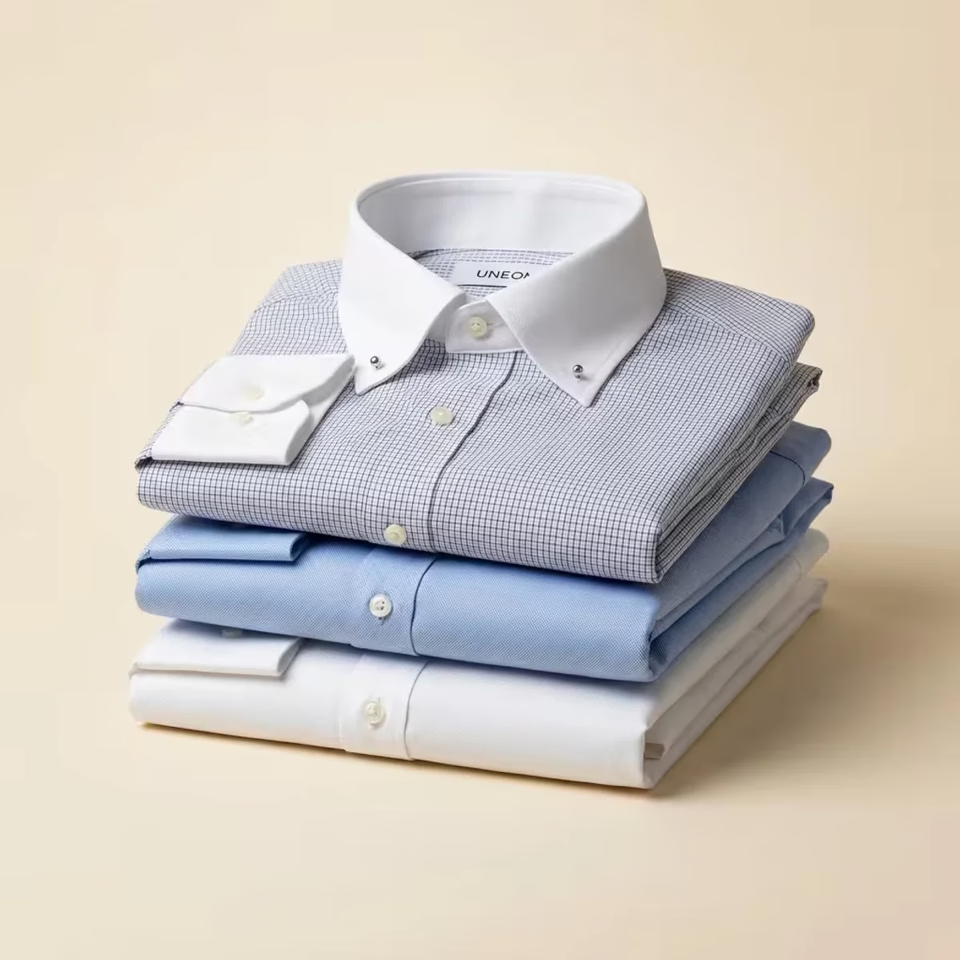
A retail shop sells uniforms off the rack. A professional supplier manages your uniform programme end-to-end. The distinction matters because the total cost of a poorly managed uniform procurement — emergency orders, wrong sizes, inconsistent quality, multiple invoices, and colour mismatches — typically exceeds the garment cost itself. Professional supplier indicators: in-house production facility (not solely import/resale), documented fabric certifications (OEKO-TEX, ISO testing), dedicated account management, programme-level pricing with SLA guarantees, replacement logistics with buffer stock, and verifiable client references across your industry. UNEOM operates across all three criteria: in-Kingdom production for 250,000+ garments annually, ISO-certified fabric testing, and programme management for 500+ active B2B clients across 8 industry sectors. The test is simple: ask for the fabric test certificate. If the supplier cannot provide ISO test data for colour retention, shrinkage, and tensile strength, you are buying unspecified product.
7 questions to ask before signing a contract
1. What fabric certifications do you hold? Look for OEKO-TEX Standard 100 and ISO test reports. 2. What is the replacement turnaround time? Programme suppliers should guarantee 48-hour joiner-kit dispatch. 3. What is your colour-match consistency? Ask for Delta E tolerance — professional suppliers commit to a documented Delta E tolerance across production batches and will state that tolerance in writing before you sign. 4. What is the garment warranty period? Healthcare: 18 months. Corporate: 12 months. Industrial: varies by FR specification. Anything below 6 months signals quality risk. 5. Do you provide size-distribution analysis? A supplier who asks about your workforce demographics before quoting is planning a programme. One who quotes immediately is selling product. 6. What is your production capacity and lead time? Verify they can handle your volume without subcontracting (which introduces quality variability). 7. Can you provide client references in my industry? A supplier experienced in hospitality may not understand manufacturing PPE requirements. Industry expertise matters.
Riyadh: the competitive landscape
Riyadh hosts the highest concentration of corporate uniform demand in the Kingdom — driven by the financial sector, government ministries, healthcare networks, and the retail/hospitality expansion under Vision 2030. Key Riyadh considerations: corporate identity programmes dominate demand (executive suits, front-office uniforms, security guard sets); delivery logistics benefit from central geography (48-hour reach to most Saudi cities); and the competitive environment includes both professional programme suppliers and hundreds of small tailoring shops in the Industrial Area (Al-Sulay). The risk with Industrial Area shops: competitive pricing but no fabric certification, no warranty, and no programme management. For ad-hoc purchases of 10-20 garments, this may be acceptable. For 200+ employee programmes, the absence of quality guarantees creates total-cost risk. UNEOM's Riyadh operation serves 150+ corporate clients with a dedicated distribution centre providing same-day dispatch for standard sizes held in buffer stock.
Jeddah and the Western Region: Hajj season considerations
Jeddah's uniform market is shaped by two forces: the hospitality sector (hotels, restaurants, retail along the Corniche and new entertainment districts) and the annual Hajj/Umrah season that creates massive temporary staffing surges. Hajj season consideration: hotels, transport companies, and service providers in Mecca and Medina hire thousands of temporary staff for 4-8 weeks. These staff need uniform sets immediately — often with 72-hour notice. Suppliers without regional buffer stock cannot serve this demand. UNEOM maintains Hajj-specific buffer inventory: pre-assembled hospitality sets (front desk, housekeeping, F&B, security) in standard sizes ready for 48-hour deployment. During 2025 Hajj season, UNEOM deployed 3,400 temporary-staff uniform sets across 18 hotels. The Western Region also demands cultural sensitivity in design: more conservative modesty specifications for Mecca-based operations, and luxury-focused design for Jeddah's premium hospitality sector.
Dammam and the Eastern Province: industrial requirements
The Eastern Province is Saudi Arabia's industrial heartland — ARAMCO, SABIC, and the Jubail/Yanbu industrial corridors drive demand for specialized workwear that retail shops cannot supply. Eastern Province specifics: FR-rated coveralls specified to the arc-flash category identified by the site's own hazard assessment, hi-vis clothing to EN ISO 20471 Class 2/3, chemical-resistant fabrics for laboratory and processing environments, and HCIS audit-compliant documentation. The supplier qualification bar is highest here — industrial clients require: fabric test certificates with ATPV ratings, garment serialisation for lifecycle tracking, on-site fitting teams for safety-critical measurements, and compliance documentation for quarterly HCIS audits. UNEOM serves 60+ industrial clients in the Eastern Province from a dedicated Dammam distribution centre, with mobile fitting teams deployed weekly to Jubail and Ras Tanura. The 21-day lead time includes on-site measurement, production, and safety certification.
Why 78% switch to long-term programme contracts
UNEOM data across 500+ B2B clients shows a clear pattern: enterprises that start with one-time purchases transition to programme contracts within 18 months, and 78% of programme clients renew. The drivers: predictable budgeting (fixed per-unit pricing with no seasonal surcharges), eliminated procurement overhead (single vendor, single invoice, dedicated account manager), guaranteed quality consistency (same fabric, same construction, same colour across every delivery), built-in replacement logistics (quarterly assessments, buffer stock, 48-hour joiner kits), and total cost reduction (programme clients report 40-66% lower annual uniform costs vs ad-hoc purchasing). The transition is not about loyalty to UNEOM — it is about operational efficiency. Companies that manage uniforms as a programme rather than a purchase reduce the internal resources consumed by 75% while improving garment quality and staff presentation.
Frequently asked
- Where is the best uniform shop in Riyadh?
- For programme-level procurement (50+ employees), UNEOM operates direct from our Riyadh distribution centre with same-day dispatch. For small orders, the Industrial Area (Al-Sulay) has competitive retail options — but verify fabric certifications before purchasing.
- Do you deliver to all Saudi cities?
- Yes. 48-hour delivery in Riyadh, Jeddah, Dammam. 72 hours for other cities across 24 Saudi cities served.
- What minimum order for programme pricing?
- Programme pricing starts at 50 units. Below 50, standard catalogue pricing applies with direct ordering.
- Can you handle Hajj-season rush orders?
- Yes. UNEOM maintains Hajj-specific buffer stock for hospitality sets. 48-hour deployment. 3,400 sets deployed in 2025 Hajj across 18 hotels.
- How do I verify a supplier's fabric quality?
- Ask for ISO test certificates: colour retention (ISO 105-C06), shrinkage (ISO 5077), and tensile strength (ISO 13934). If the supplier cannot produce these, the fabric is unspecified.