Restaurant & F&B Staff Uniforms: A Saudi Operator's Procurement Guide
FOH vs BOH fabric requirements, kitchen heat resistance, stain-release chemistry, hijab-compatible designs, and the lifecycle economics of restaurant uniform programmes.

A chef jacket that survives 300 industrial wash cycles and a hostess blazer that photographs well on Instagram serve two completely different engineering requirements — yet most Saudi restaurant operators buy them from the same supplier using the same specification. This guide separates front-of-house (FOH) from back-of-house (BOH) uniform procurement, specifies the fabric science behind each, and provides the programme framework that 24 UNEOM hotel F&B partners use to maintain consistent brand presentation while managing the highest garment-turnover environment in the hospitality industry.
FOH vs BOH: why one specification fails both
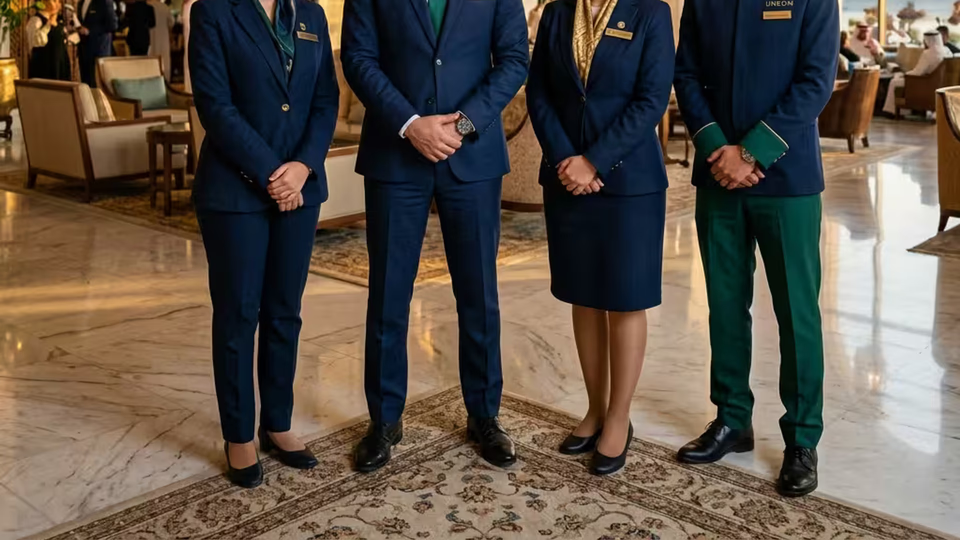
Front-of-house and back-of-house are fundamentally different garment environments. FOH (hosts, servers, sommeliers, managers): the priority is brand presentation. Fabrics must drape well, resist wrinkles through a 10-hour shift, and maintain colour vibrancy under the restaurant's specific lighting profile. Stain resistance is important but secondary to aesthetics. FOH garments are seen by every customer, photographed by guests, and featured in marketing materials. BOH (chefs, line cooks, dishwashers, prep staff): the priority is safety and durability. Fabrics must resist heat exposure (contact with hot surfaces up to 180°C), repel oil and grease splashes, withstand aggressive degreasing detergents at 85°C wash temperatures, and maintain structural integrity after 300+ industrial wash cycles. BOH garments are functional equipment, not brand assets. Buying both from a single "restaurant uniform" specification — as most operators do — means FOH garments are over-engineered for aesthetics and BOH garments are under-engineered for safety. The programme approach: separate specifications, single supplier, unified programme management.
Kitchen fabrics: heat resistance, oil repellence, and flame retardance
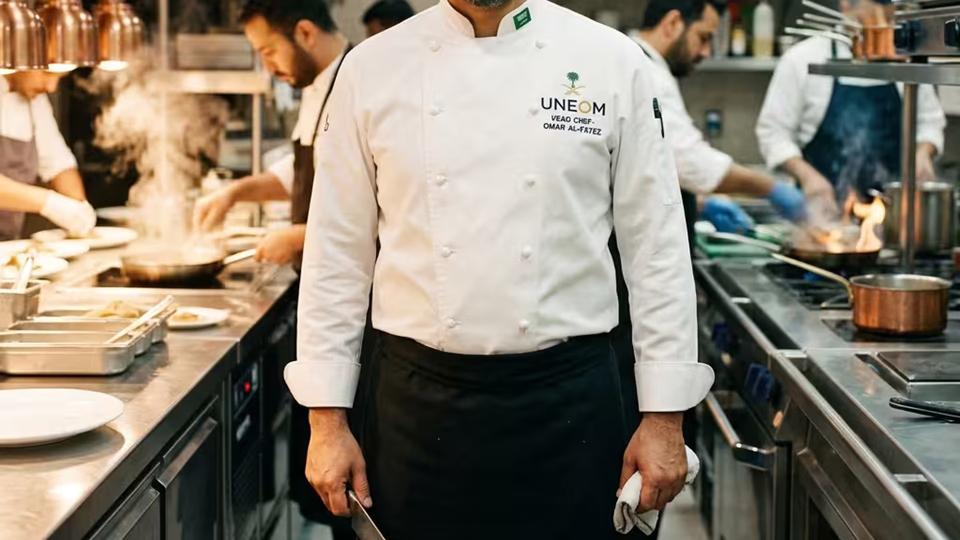
UNEOM BOH specifications use a 100% cotton twill at 240 gsm for chef jackets — not poly-cotton. The reason is safety: polyester melts at approximately 260°C and bonds to skin on contact, creating severe burn injuries. Pure cotton chars rather than melts, providing a critical safety margin in kitchen environments where contact with hot surfaces, open flames, and boiling liquids is routine. The 240 gsm weight provides structural thickness for heat buffering without impeding movement. Additional BOH fabric treatments: (1) Oil-repellent finish (fluorocarbon-free, compliant with OEKO-TEX Standard 100) — causes oil droplets to bead and roll off rather than absorbing into the fabric; (2) Stain-release treatment — allows embedded stains (curry, tomato sauce, coffee) to release during standard washing rather than setting permanently; (3) Chlorine-resistant dye fixation — because commercial kitchen laundry uses chlorine-based sanitising agents that destroy conventional reactive dyes within 20 cycles. Chef jacket closures use knotted fabric buttons, not plastic — plastic buttons crack under industrial press temperatures and create food contamination risk.
Hijab-compatible kitchen design: ventilation meets modesty
Saudi Arabia's F&B workforce is increasingly female, and kitchen uniform design must accommodate hijab wear without compromising safety or hygiene. The engineering challenge is ventilation: kitchens operating at 35–45°C with high humidity create heat stress risk that is amplified by additional head covering. UNEOM's solution: a purpose-engineered kitchen hijab in moisture-wicking mesh (92% polyester, 8% elastane) with antimicrobial treatment. The mesh construction provides airflow while maintaining full coverage. The elastane content ensures a secure fit without pins (which are prohibited in food preparation areas under SFDA guidelines). The hijab is designed to tuck completely inside the chef jacket collar, eliminating loose fabric that could contact cooking surfaces or open flames. It is paired with a skull cap (same mesh construction) worn underneath for hygiene — the skull cap absorbs perspiration and is replaced daily, while the hijab is laundered with the jacket set. This two-layer system was developed in consultation with Saudi female chefs and has been adopted as standard in 12 UNEOM hotel kitchen programmes.
Industrial laundry survival: 300+ cycles without degradation
Restaurant uniforms endure the most aggressive laundry protocols of any industry sector. Commercial kitchen laundry operates at 85°C (vs 60°C for corporate uniforms and 75°C for healthcare), uses chlorine-based sanitising agents, and runs degreasing pre-wash cycles with alkaline detergents at pH 11+. A chef jacket that cannot survive this protocol is not a chef jacket — it is a disposable garment. UNEOM BOH garments are tested to withstand 300 industrial wash cycles at 85°C with chlorine sanitisation. The testing protocol: 50-cycle checkpoint inspections measuring colour retention (Delta E), seam strength (ISO 13935-2), fabric weight change (indicating fibre loss), and dimensional stability. At the 300-cycle mark, acceptable garments show: colour Delta E <3.0 (barely perceptible to the eye); seam strength retention >80% of original; fabric weight loss <5%; dimensional change <3%. FOH garments are specified for 150 cycles at 60°C — a less aggressive protocol reflecting the lighter soiling and gentler laundering of front-of-house operations. The programme replacement cycle reflects these lifespans: BOH every 12 months, FOH every 14–16 months.
Brand identity through uniform: from host to chef
In the Saudi restaurant market — particularly in Riyadh's and Jeddah's competitive dining scenes — uniform design has become a brand differentiator. Guests notice. Social media amplifies it. The most successful restaurant uniform programmes create a visual narrative that flows from the entrance to the kitchen. Host/hostess: the brand's first impression. Tailored blazer or structured vest in the brand's signature colour, paired with pressed trousers or midi skirt. Fabric: wool-polyester blend (55/45) for drape and wrinkle resistance. Servers: the brand's continuous touchpoint. Mandarin-collar shirt or structured polo in a coordinated colourway, with the restaurant's crest embroidered at the chest. Fabric: performance poly-cotton with stretch (72/25/3 cotton-poly-spandex) for 10-hour shift comfort. Bartenders/baristas: visible craft performers. Apron-forward design with custom leather or canvas apron over a brand-coordinated base layer. The apron becomes a signature element. Chef team: increasingly visible in open-kitchen concepts. Chef jackets in the brand's colourway (moving beyond mandatory white) with custom-knotted buttons carrying the restaurant's monogram. UNEOM produces these as coordinated programme sets — ensuring colour consistency across all roles.
Programme economics: per-unit cost vs replacement cost
Restaurant uniform procurement has the highest replacement frequency of any industry UNEOM serves — driven by the aggressive laundry protocols, food staining, and physical wear of kitchen environments. The programme economics favour durability over price. For a 40-staff restaurant (15 FOH + 25 BOH): Ad-hoc purchasing (no programme): average SAR 120/unit, 3 replacements/year for BOH, 2 for FOH. Annual cost: (25 × 120 × 3) + (15 × 120 × 2) = SAR 12,600. Plus emergency procurement at 35% premium: estimated SAR 1,800. Total: SAR 14,400/year. UNEOM programme: SAR 180/unit BOH (12-month lifespan), SAR 160/unit FOH (16-month lifespan). Annual cost: (25 × 180 × 1) + (15 × 160 × 0.75) = SAR 6,300. Programme management fee: SAR 0 (included in unit pricing). Total: SAR 6,300/year. The engineered programme costs 56% less annually despite a 50% higher per-unit price — because the garments last 3–4× longer under the same conditions. UNEOM currently manages F&B uniform programmes for 24 hotel restaurants and 45+ standalone restaurants across the Kingdom.
Frequently asked
- Why shouldn't chef jackets use polyester?
- Polyester melts at approximately 260°C and bonds to skin, causing severe burns. 100% cotton chars rather than melts, providing a critical safety margin in kitchen environments with open flames, hot surfaces, and boiling liquids.
- How long do restaurant uniforms last?
- BOH (kitchen): 12 months under 85°C industrial laundering at 300+ cycles. FOH (service): 14–16 months under 60°C laundering at 150 cycles. Garments bought without a written laundry-protocol specification typically fail far sooner under the same conditions.
- Do you offer hijab-compatible kitchen uniforms?
- Yes. UNEOM produces a purpose-engineered kitchen hijab in moisture-wicking mesh with antimicrobial treatment, designed to tuck inside the chef jacket collar. Adopted as standard in 12 hotel kitchen programmes.
- Can restaurant uniforms be customised with our brand colours?
- Yes. UNEOM offers custom Pantone matching across all restaurant garment types — from chef jackets to hostess blazers. Minimum order for custom colourways: 50 units per style. Lead time: 21 days from colour approval.
- What is the cost difference between programme and ad-hoc purchasing?
- For a 40-staff restaurant, programme procurement costs SAR 6,300/year vs SAR 14,400/year for ad-hoc purchasing — a 56% reduction despite 50% higher per-unit cost, driven by 3–4× longer garment lifespan.