Medical Scrubs Buying Guide: Quality, Price, and What Hospitals Actually Need
Why the cheapest scrubs cost you more, how 65/35 poly-cotton with antimicrobial treatment outperforms alternatives, and the real economics of equipping 50–5,000 clinical staff.

A procurement manager at a 400-bed Riyadh hospital told us: "We replaced scrubs every 4 months and thought that was normal." It is normal — if you buy unspecified fabric from the cheapest supplier. After switching to UNEOM's antimicrobial poly-cotton programme, the same hospital now replaces scrubs every 14 months. The per-unit cost was 40% higher; the annual programme cost was 55% lower. This guide unpacks the lifecycle economics, fabric science, and procurement frameworks that separate professional medical uniform programmes from reactive purchasing.
Why "cheap" costs more: lifecycle cost analysis
The sticker price of a scrub set tells you almost nothing about its actual cost. Consider two scenarios over 24 months for a 200-staff hospital. Option A: SAR 95 scrub set, unspecified poly-cotton, no antimicrobial treatment. Replacement cycle: 4 months. Over 24 months: 6 replacements × 200 staff × SAR 95 = SAR 114,000. Plus emergency procurement surcharges (averaging 35% per unit on rush orders): estimated SAR 8,000. Total: SAR 122,000. Option B: SAR 135 scrub set, UNEOM 65/35 poly-cotton with bonded silver-ion antimicrobial, 18-month warranty. Replacement cycle: 14 months. Over 24 months: 1.7 replacements × 200 staff × SAR 135 = SAR 45,900. Programme pricing (no surcharges): SAR 0. Total: SAR 45,900. The "expensive" option costs 62% less over 24 months. This is not a theoretical exercise — it is operational data from 38 partner hospitals across the Kingdom.
Fabric specification: 65/35 poly-cotton with antimicrobial bonding
The dominant fabric in MoH-compliant scrub programmes is polyester-cotton 65/35 with bonded antimicrobial treatment — and the word "bonded" is critical. Cheaper antimicrobial treatments are applied as surface coatings that wash off within 20–30 laundry cycles. Bonded treatments — specifically silver-ion technology validated against AATCC 100 — integrate the antimicrobial agent into the fibre structure, maintaining efficacy past 80 industrial wash cycles at 75°C. The 65/35 ratio is not arbitrary: 65% polyester provides dimensional stability (less than 2% shrinkage per ISO 5077), wrinkle resistance, and rapid drying — critical when Saudi hospitals run 4.2 wash cycles per shift. The 35% cotton provides moisture absorption, breathability, and comfortable skin contact during 12-hour shifts. Fabric weight: 180–200 gsm. Below 180 gsm, opacity becomes an issue (critical for modesty compliance). Above 200 gsm, the garment becomes uncomfortably warm under surgical lighting and in non-air-conditioned corridors.
The 18-month warranty vs the industry 6-month standard
UNEOM healthcare scrubs carry an 18-month warranty — 6 months above the industry standard, and 12 months above what most suppliers actually deliver. The warranty covers: colour retention (minimum Grade 4 per ISO 105-C06 after 80 cycles); seam integrity (no splitting under normal clinical use); antimicrobial efficacy (verified at 12-month mark against AATCC 100); and dimensional stability (maximum 3% shrinkage in any direction). What the warranty does not cover is instructive: damage from bleach concentrations above the maximum stated on the garment's care label for antimicrobial fabrics and damage from drying temperatures above 80°C. These exclusions exist because they are the two most common causes of premature scrub failure — and identifying them in the warranty terms helps hospitals audit their laundry protocols. Over 24 months of warranty claims data: 2.1% of UNEOM healthcare garments were replaced under warranty, with the most common claim being colour fading on garments exposed to direct sunlight in outdoor break areas.
Hijab-integrated scrubs: design, cost, and demand
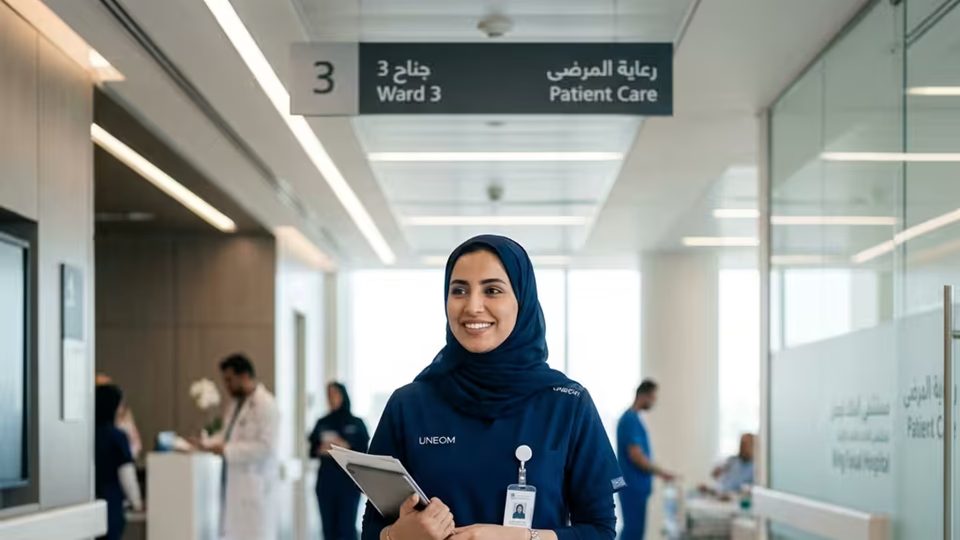
Hijab-integrated scrub tops represent one of the fastest-growing product categories in Saudi healthcare uniforms. The design: a scrub top with an attached head-cover panel that tucks into the neckline, creating a seamless, hygienic, one-piece solution that eliminates the safety risks of loose fabric near clinical equipment. The engineering challenge is infection control: the head-cover must be launderable at the same temperature and cycle as the scrub body (75°C industrial cycle) without differential shrinkage. UNEOM achieves this by cutting both components from the same fabric roll and pre-shrinking before assembly. The attachment uses a snap-button system (not pins, which create puncture contamination risk) allowing the head-cover to be removed for laundering if preferred. Cost impact: hijab-integrated tops carry a 15% premium over standard tops — SAR 20–25 additional per unit — driven by the extra fabric consumption and construction complexity. Demand data: 34% of all UNEOM healthcare scrub orders now include hijab-integrated options, up from 12% in 2020.
Lab coats: Egyptian cotton poplin at 140 thread count
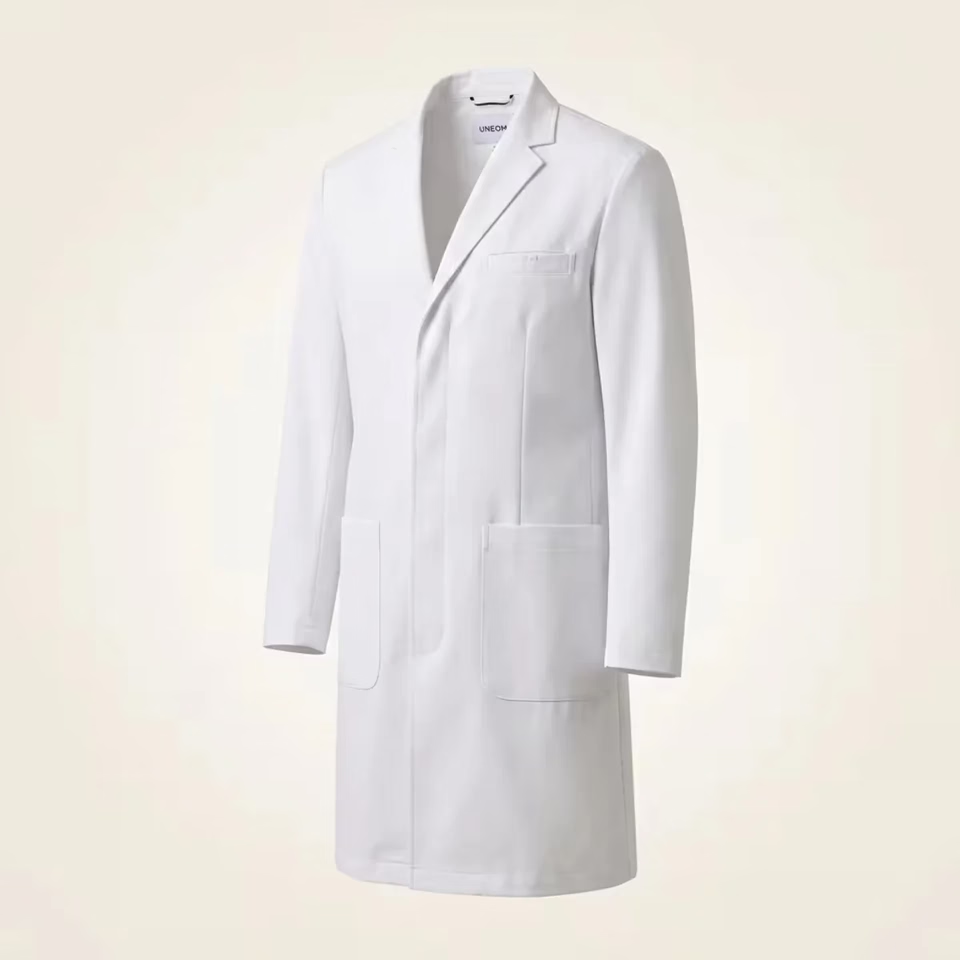
The lab coat is the most visible symbol of clinical authority — and the garment most frequently purchased on appearance alone, without consideration for performance specifications. UNEOM lab coats use 140-thread-count Egyptian cotton poplin with a non-iron finish. The thread count matters: below 120, the fabric feels rough and wrinkles aggressively; above 160, the fabric becomes too delicate for daily clinical use. The 140 count delivers a crisp, professional drape that maintains its pressed appearance through machine washing without ironing. Non-iron finish technology: a resin-based treatment that cross-links cellulose fibres, preventing them from absorbing moisture in a wrinkled configuration. The treatment withstands 60+ wash cycles before requiring reapplication. Weight: 160 gsm — lighter than scrubs because lab coats are worn over other garments and require drape rather than opacity. Stain-release outer finish: resistant to common clinical staining agents (betadine, methylene blue, blood) allowing spot-cleaning between full wash cycles.
Ordering for a full hospital: 50 to 5,000 pieces
Hospital uniform procurement scales non-linearly. A 50-bed clinic and a 1,200-bed hospital require fundamentally different programme architectures. Small facility (50–200 staff): standard programme contract with quarterly delivery, buffer stock at UNEOM's regional distribution centre, and 48-hour joiner-kit dispatch. Lead time from contract signing to first delivery: 18 days. Medium facility (200–800 staff): dedicated production scheduling with size-distribution analysis, on-site fitting clinic (our mobile fitting team visits the facility), department-coded colour differentiation (surgery: ceil blue; emergency: navy; paediatrics: printed patterns), and a quarterly garment-condition audit. Large facility (800–5,000 staff): full programme management including dedicated UNEOM programme manager, integrated ordering system connected to the hospital's HR platform (automatic kit generation on new-hire entry), monthly delivery schedule with department-level distribution, annual programme review with garment-performance analytics, and sustainability reporting (garments recycled vs disposed). Current pricing benchmark: SAR 180 average per-unit for standard healthcare programmes, inclusive of antimicrobial treatment and 18-month warranty.
Frequently asked
- Where can I buy medical scrubs in Riyadh?
- UNEOM operates a direct-to-facility programme with distribution centres in Riyadh, Jeddah, and Dammam. Orders are placed through our digital portal with 48-hour delivery in central region cities. No retail visit required.
- Are cheap scrubs worth buying for a small clinic?
- No. Lifecycle cost analysis shows that SAR 95 unspecified scrubs replaced every 4 months cost 62% more over 24 months than SAR 135 engineered scrubs replaced every 14 months. The math applies regardless of clinic size.
- What is the difference between bonded and coated antimicrobial treatment?
- Coated treatments sit on the fabric surface and wash off within 20–30 cycles. Bonded treatments (silver-ion technology, validated to AATCC 100) integrate into the fibre structure and maintain efficacy past 80 industrial wash cycles at 75°C.
- Do you offer hijab-compatible scrubs?
- Yes. UNEOM produces hijab-integrated scrub tops with attached head-cover panels — launderable at the same 75°C cycle as the scrub body. 34% of our healthcare orders now include this option. Premium: 15% above standard tops.
- What is the lead time for a hospital scrub programme?
- Small facilities (50–200 staff): 18 days from contract to first delivery. Medium facilities (200–800): 21–28 days including on-site fitting. Large facilities (800+): 28–35 days with full programme setup and HR integration.