Hospital Uniform Safety Standards in Saudi Arabia: MoH, SFDA, and SASO
Three Saudi regulators govern hospital uniforms. None of them publishes a single unified document. Here is how to build one.
Three Saudi regulatory bodies govern hospital uniforms: the Ministry of Health for clinical safety, the Saudi Food and Drug Authority for hygiene classification, and the Saudi Standards Organization for textile quality marks. None publishes a single unified specification document. This means every hospital builds its own compliance file — and most do it poorly. The result is procurement decisions based on price rather than performance, audit exposure during CBAHI accreditation cycles, and clinical staff wearing garments that do not meet the combined intent of three regulators. This guide consolidates the requirements into one actionable framework.
MoH: clinical safety and antimicrobial
The Ministry of Health regulatory authority over hospital uniforms derives from its broader mandate over infection prevention and workplace safety in healthcare facilities. The National Infection Prevention and Control Manual, updated in 2023, establishes the clinical framework within which uniform decisions are made. Section 4.3 addresses healthcare worker attire and establishes five key requirements: garments must be clean at the start of each shift, garments must be changed if visibly soiled or contaminated with body fluids, garments must be laundered at the thermal disinfection temperature and hold time set out in the current MoH manual, or at the specified lower temperature combined with appropriate chemical disinfection, garments must not be worn outside the clinical environment, and dedicated changing facilities must be provided. What the manual does not specify is the textile performance standard that garments must meet to support these requirements. A polyester scrub laundered at 71 degrees will survive structurally but may lose antimicrobial treatment after 15 to 20 cycles. A cotton scrub will maintain antimicrobial treatment longer but may shrink beyond wearable dimensions after 30 cycles. The gap between must be laundered at 71 degrees and must perform after laundering at 71 degrees is the space where procurement decisions have consequences. UNEOM addresses this gap explicitly: all healthcare programme garments are tested to maintain declared performance characteristics through a minimum of 75 wash cycles at 71 degrees with standard hospital-grade chemical detergent. The test certificates accompany every programme delivery and are filed as part of the hospital infection control documentation — evidence of compliance that survives CBAHI audit scrutiny. Additionally, our antimicrobial specification requires silver-ion treatment bonded at the molecular level to resist leaching during high-temperature wash cycles, maintaining the bacterial reduction efficacy declared on the fabric's own test certificate throughout the garment's stated service life.
SFDA: hygiene and cross-contamination
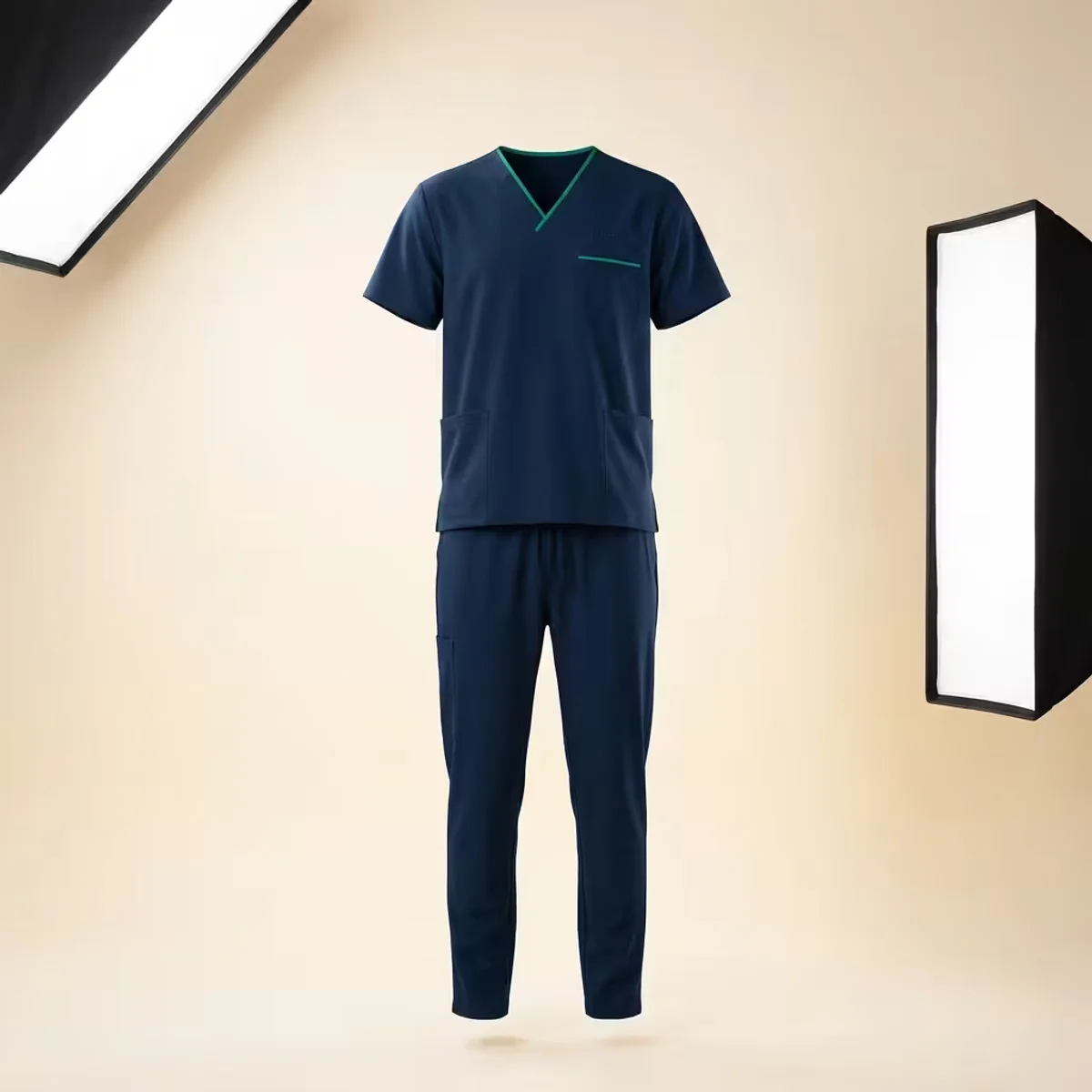
The SFDA relevance to hospital uniforms increased significantly with the 2021 expansion of medical device classification to include certain healthcare textiles. Surgical gowns, isolation gowns, and sterile drapes now fall under SFDA Class I medical device regulation, requiring establishment licensing, product listing, adverse event reporting, and post-market surveillance. Daily-wear uniforms remain classified as textiles unless they carry specific medical claims. The SFDA primary concern with uniforms is cross-contamination — the risk that garments carry pathogens between clinical areas, from hospital to community, or from contaminated surfaces to patient contact zones. The SFDA references the Spaulding Classification for surface contamination risk and expects hospital infection control committees to apply this framework to uniform management. This means hospitals should have documented protocols for garment changing between high-risk and low-risk clinical areas, garment containment during transport from ward to laundry using sealed bags rather than open hampers, and garment segregation in laundry processing with contaminated garments processed separately from routine loads. UNEOM supports SFDA alignment through three garment design features. First, colour-coded piping identifies department assignment, enabling visual verification that a surgical-area nurse is not wearing medical-ward scrubs in the operating theatre. Second, antimicrobial fabric treatment provides a passive barrier during transport, reducing the risk of pathogen transfer between ward and laundry. Third, quick-release closures facilitate rapid garment changes during contamination events — a snap-front tunic can be removed in under 5 seconds without pulling over the head, which is the primary contamination vector during emergency doffing. These features are documented in the programme specification as SFDA-aligned infection control support — language that hospital committees can reference in CBAHI documentation without triggering medical device classification.
SASO: textile quality marks
The Saudi Standards, Metrology and Quality Organization regulates textile quality through standards applying to all textile products imported into or manufactured in Saudi Arabia. The most relevant standards for hospital uniforms include SASO ISO 3758 for care labelling symbols which is mandatory for all garments, SASO ISO 13934-1 for tensile strength and minimum seam integrity requirements, SASO ISO 12945-2 for pilling resistance and appearance retention, and the SASO ISO 105 series for colour fastness to washing, light, perspiration, and rubbing. Compliance with SASO standards is a market access requirement, not a performance differentiator — any legally imported textile product should meet these minimums. However, compliance is frequently incomplete in the healthcare uniform market. A 2024 UNEOM audit of competitor products available to Saudi hospitals found that 23% lacked complete SASO-compliant care labels missing fibre composition or wash temperature symbols, 15% failed pilling requirements at the 2000-cycle mark despite healthcare garments typically undergoing 3000 or more friction cycles per year, and 8% showed colour fastness below Grade 3 after 20 wash cycles against a Grade 4 requirement. These failures persist because enforcement is primarily at the point of import through customs inspection rather than at the point of use in hospital procurement. Hospital procurement teams rarely conduct independent testing; they rely on supplier declarations which may reference SASO compliance without providing test certificates. UNEOM provides SASO test certificates for every fabric used in healthcare programmes, issued by accredited laboratories and refreshed annually. Beyond minimum compliance, our healthcare fabrics exceed SASO requirements on every metric: colour fastness, pilling resistance and tensile strength are specified above the applicable SASO minimums rather than at them, with the actual margin stated on each fabric's test certificate. This margin ensures that garments maintain professional appearance through their full programme lifecycle rather than merely meeting legal minimums at the point of delivery.
Building one consolidated file
Building a single auditable compliance file for hospital uniforms requires consolidating documentation from all three regulatory frameworks into a format that CBAHI auditors, infection control committees, and procurement review boards can reference efficiently. UNEOM's Unified Compliance File template organises documentation into four sections. Section one covers Fabric Specification including SASO test certificates, antimicrobial test reports per ISO 20743, OEKO-TEX Standard 100 certification, and fibre composition analysis. Section two addresses Clinical Alignment with an MoH NIPCM cross-reference matrix showing how each garment specification addresses each relevant manual section, wash protocol validation, and antimicrobial durability documentation through declared wash cycles. Section three covers Regulatory Status including SFDA classification confirmation with supporting rationale, SASO import compliance documentation, and supplier establishment registration. Section four details Programme Operations including size-profiling methodology, replacement SLA documentation, inventory management protocols, contamination-event change-out procedures, and annual programme review schedule. The file is provided in both English and Arabic, maintained by UNEOM quality assurance, and updated quarterly. Hospital clients receive a digital copy integrated with their procurement management system and a physical copy for the infection control committee reference library. In UNEOM experience, hospitals maintaining a Unified Compliance File complete CBAHI uniform-related audit items in an average of 15 minutes versus 2 or more hours for hospitals without consolidated documentation. The file has become a competitive differentiator: three of UNEOM's hospital programme wins in 2025 cited the Unified Compliance File specifically as the deciding factor in supplier selection, ahead of pricing and design considerations. The investment in documentation infrastructure reflects a broader principle: in healthcare procurement, the ability to prove compliance is as valuable as compliance itself.
Frequently asked
- Which Saudi regulator is most important for hospital uniforms?
- All three — MoH governs clinical safety, SFDA governs device classification, and SASO governs textile quality. A compliant uniform programme must satisfy all three simultaneously.
- Do scrubs need SFDA registration?
- Only if they carry medical device claims. Standard scrubs described as textile products with performance features do not require SFDA registration.
- What is the minimum wash temperature for hospital uniforms?
- MoH NIPCM specifies a thermal disinfection cycle, with a lower-temperature alternative combined with chemical disinfection — confirm the exact temperature and hold time against the current edition of the manual. All UNEOM healthcare fabrics are tested to perform through 75 cycles at 71°C.
- How often should hospital uniforms be replaced?
- UNEOM programmes specify annual replacement of the primary set and biannual for the secondary, with 72-hour emergency replacement for damaged items — totalling approximately 75 wash cycles per garment lifecycle.
- What documentation should a hospital keep for uniform compliance?
- A Unified Compliance File covering fabric test certificates, MoH clinical alignment, SFDA classification status, and programme operations — maintained quarterly and available in both English and Arabic.