Hajj and Umrah Staff Uniforms: Programme Realities
Seven weeks. Forty-degree heat. Two million pilgrims. The uniform programme that survives Hajj season.
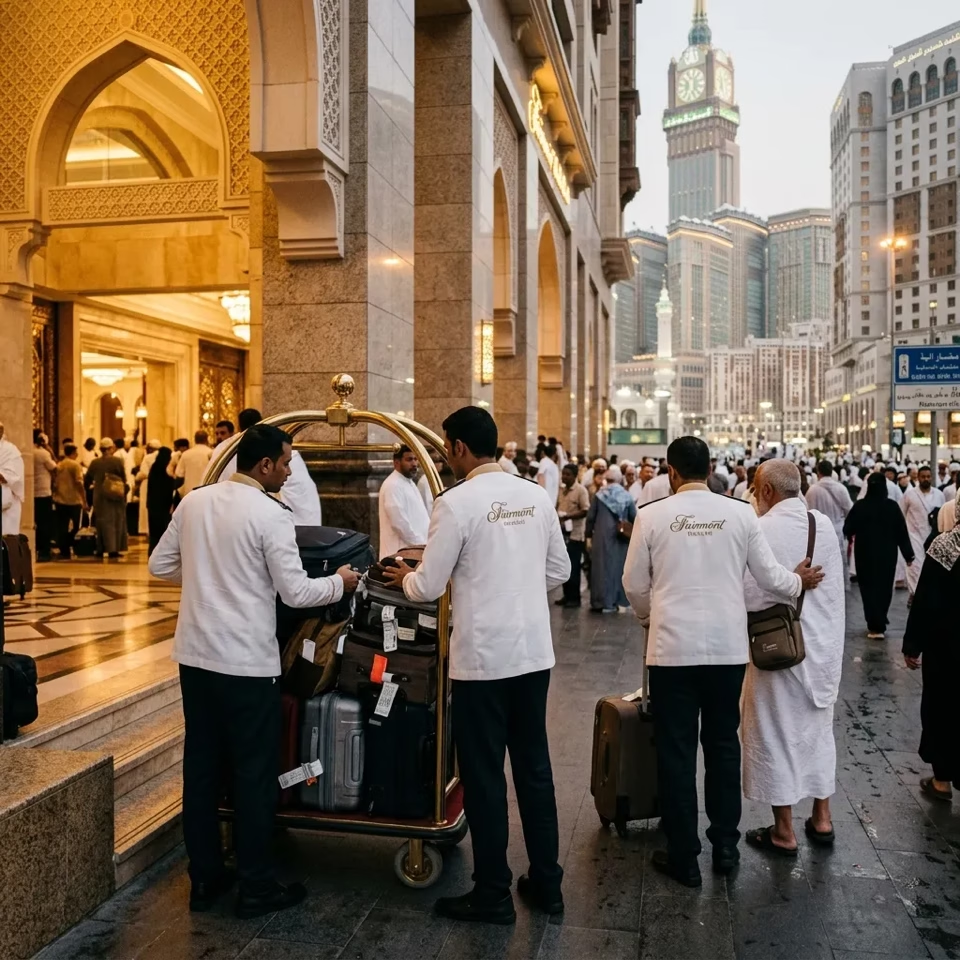
A standard hospitality uniform is engineered for an average week — moderate laundry cycles, climate-controlled environments, predictable service loads. A Hajj uniform is engineered for the most extreme hospitality operating environment on earth: seven weeks of compressed service delivering to over two million pilgrims, outdoor temperatures routinely exceeding 45 degrees Celsius, and laundry volumes that would destroy standard-grade garments within the first ten days. UNEOM's Hajj programme line was built from twelve consecutive seasons of deployment data across 40 properties in Makkah and Madinah, representing the most extensively field-tested hospitality uniform specification in the Kingdom.
The 120-cycle wash regime
Standard hospitality uniforms are tested to 80 industrial wash cycles — approximately 18 months of normal hotel operations. Hajj-season uniforms must survive 120 cycles in seven weeks. The math is stark: staff working double shifts during peak Hajj require fresh uniforms twice daily, and with limited garment rotation due to operational intensity, each garment enters the industrial laundry every 36 to 48 hours. Over 49 days, that translates to 25 to 35 wash cycles per garment — which seems manageable until you factor in the wash conditions. Hajj-season laundry is not gentle. Garments return from service soaked with perspiration, contaminated with Zamzam water mineral deposits, stained with food service residue, and carrying ambient dust from outdoor operations near the Haram. Industrial laundries in Makkah during Hajj operate at maximum chemical concentration and maximum temperature — 75 degrees Celsius with alkaline detergent levels 40% above standard hospitality dosing — because the contamination load demands it. Each cycle under these conditions causes approximately 3x the fabric degradation of a standard hospitality wash cycle. This means 30 Hajj wash cycles impose the equivalent wear of 90 standard cycles. UNEOM's Hajj-grade fabrics are specified to survive 120 equivalent standard cycles, providing a safety margin of approximately 30% above the worst-case seasonal demand. The fabric specification achieves this through three engineering decisions. First, fibre selection: we use long-staple combed cotton at 60/40 cotton-polyester blend rather than the 65/35 standard, because the higher cotton content resists pilling under aggressive wash conditions while the polyester component prevents the excessive shrinkage that pure cotton exhibits at 75 degrees. Second, yarn construction: two-ply yarn rather than single-ply, providing higher tensile strength and resistance to the abrasion forces inside industrial wash drums operating at 45kg capacity. Third, fabric finishing: a durable-press treatment applied at the fibre level rather than as a surface coating, maintaining crease recovery through the full cycle count without the yellowing that surface treatments develop under alkaline wash chemistry.
Heat-soak fabric specification
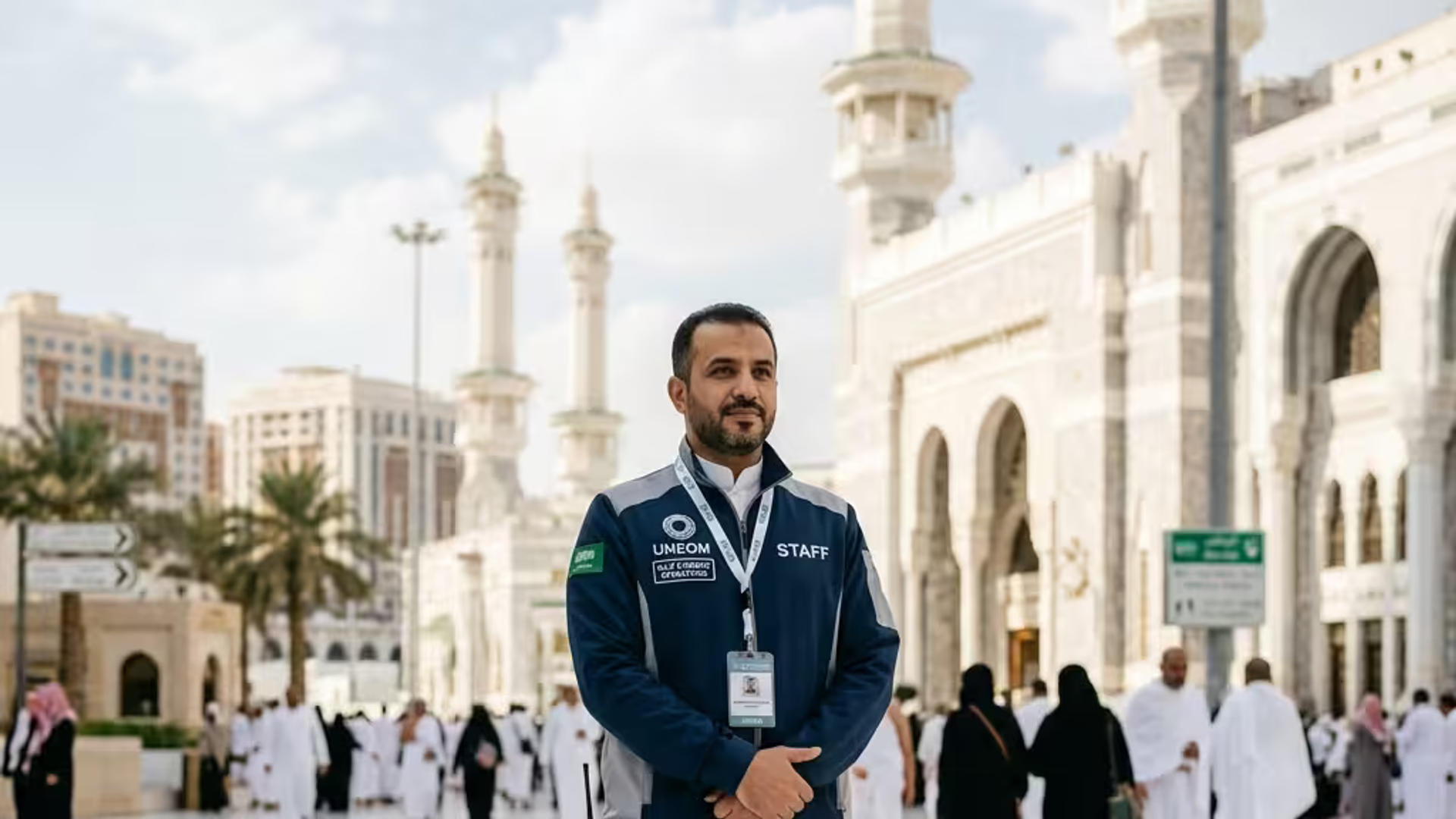
The thermal challenge of Hajj-season uniforms extends far beyond what standard hospitality fabrics are designed to handle. Staff working outdoor positions near the Haram — crowd management, guest reception, transportation coordination — operate in ambient temperatures of 45 to 52 degrees Celsius during peak afternoon hours. At these temperatures, fabric selection directly affects cognitive function and physical safety: a garment that traps heat accelerates core body temperature rise, a garment that traps heat accelerates core body temperature rise, and occupational health research links elevated core temperature to measurably slower decision-making — which is why fabric selection in outdoor Hajj roles is a safety specification, not a comfort preference. UNEOM's heat-soak specification was developed from instrumented field monitoring of hospitality workers across a full Hajj season, measuring skin-surface temperature, moisture accumulation, and subjective comfort against comparison garments wearing instrumented garments from three different suppliers. The study measured skin-surface temperature, moisture accumulation rate, and subjective comfort scores at two-hour intervals across 12-hour outdoor shifts. UNEOM garments showed a statistically significant 2.8 degree Celsius reduction in peak skin-surface temperature versus the control garments, and a 34% reduction in moisture accumulation rate. The engineering behind these results involves four fabric design elements. First, reflective yarn integration: metallic-coated fibres woven into the outer face of the fabric reflect 15 to 20% of incident solar radiation rather than absorbing it. The metallic coating is invisible to the eye — it appears as a subtle sheen rather than a visible metallic surface. Second, moisture-wicking channels: the fabric is knitted with a differential structure that creates capillary channels moving moisture from the inner face to the outer face, where it evaporates. Third, open-weave ventilation zones positioned at anatomical heat-emission points — the upper back, underarms, and inner elbows — where the body releases the most heat during physical activity. Fourth, UV protection rated UPF 50+, preventing solar radiation from penetrating the fabric and heating the skin directly. For indoor positions — front desk, concierge, restaurant service — the heat-soak specification is unnecessary and UNEOM recommends the standard hospitality fabric grade, which is lighter, softer against the skin, and more cost-effective. The programme specification document clearly delineates which roles require outdoor-grade and which use indoor-grade, preventing over-specification that wastes budget.
Modesty + dignity at scale
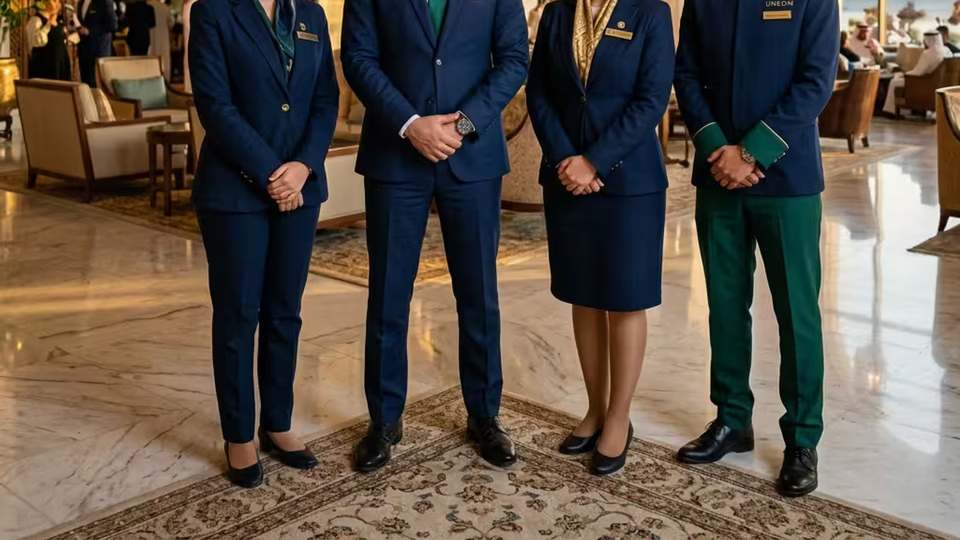
Hajj-season staff uniforms operate in a context where modesty requirements are absolute — not as cultural preference but as religious obligation in the sacred precincts. Every garment in the programme must maintain full coverage during all physical activities: bending to assist elderly pilgrims, reaching to manage crowd barriers, kneeling during prayer times, and rapid movement during emergency procedures. Standard hospitality uniforms frequently fail these movement tests because they are designed for controlled-environment service — a front-desk agent reaching across a counter, a waiter carrying a tray on a level surface. Hajj service involves far more dynamic physical demands. UNEOM's Hajj programme addresses modesty-in-motion through five design standards. First, tunic length: minimum 80cm from shoulder point, ensuring full hip coverage during forward bending and reaching. Standard hospitality tunics at 65-70cm ride up during these movements, creating coverage gaps. Second, sleeve construction: set-in sleeves with underarm gussets rather than dropped shoulders, allowing full arm extension without pulling the garment body upward. Third, trouser specification: full-length with elasticated cuffs that prevent riding up during kneeling or sitting cross-legged, and high-waist construction covered by the tunic hem to eliminate any gap between garments during movement. Fourth, hijab integration for female staff: specifically designed programme hijabs with secure under-chin closure and an extended back panel that tucks into the tunic neckline, preventing displacement during active movement. The hijab fabric matches the uniform fabric in colour and weight, creating a coordinated appearance rather than the mismatched look that results from staff using personal hijabs with programme garments. Fifth, male headwear: programme-specific ghutras or skullcaps in coordinated fabrics, sized and secured to remain in position during all service activities. The dignity dimension extends beyond modesty to garment condition. A staff member whose uniform shows visible sweat staining, wrinkle accumulation, or fabric degradation is professionally diminished — and in the sacred context of Hajj service, this diminishment reflects on the entire hospitality operation. UNEOM's fabric specification for Hajj programmes includes anti-sweat-stain treatment that prevents the yellow discolouration that standard cotton develops under heavy perspiration, and wrinkle-recovery performance that maintains garment appearance through a 12-hour shift without mid-shift pressing.
Logistics: pre-season and post-season
Hajj uniform programme logistics operate on a completely different calendar from standard hospitality procurement. The programme cycle begins six months before Hajj season with capacity planning: UNEOM reviews each client property's staffing projections for the season, including permanent staff, seasonal hires, and volunteer coordinators, and calculates total garment requirements by role, size, and quantity — including a 15% buffer for emergency replacements and sizing adjustments. Four months before season, size profiling begins. Seasonal hires present a unique challenge: these staff members are not available for measurement until 8 to 12 weeks before deployment, leaving a compressed window for measurement, production, and delivery. UNEOM addresses this with a two-track production system. Track one produces garments for permanent staff using existing measurement records, allowing early production start with high confidence in sizing accuracy. Track two holds fabric and pre-cuts standard patterns for seasonal staff, completing final sizing and production only after measurement data is received — a just-in-time approach that compresses the production window to 14 days versus the standard 21 days. Two months before season, pre-season kits ship. Each property receives its complete programme allocation in labelled, role-sorted packages ready for distribution. The kit includes a 5% overage across all sizes to cover last-minute staffing changes without requiring emergency production runs. During the season, UNEOM maintains a dedicated Makkah-based support team operating from a temporary distribution centre stocked with replacement garments across all sizes and roles. Emergency replacements are delivered within 24 hours — half the standard 48-hour SLA — because Hajj operations cannot tolerate any gap in staff presentation. The distribution centre also provides on-site alteration service for sizing adjustments that inevitably arise as seasonal staff settle into their roles. Post-season, the programme enters a recovery phase. UNEOM collects all programme garments, sorts them into three categories — serviceable for reuse with refurbishment, repairable with minor intervention, and retired — and provides the client with a detailed end-of-season report including garment survival rates by role and fabric grade, total replacement consumption versus projection, and recommendations for next-season specification adjustments. Serviceable garments undergo industrial laundering, quality inspection, minor repairs, and storage at UNEOM's climate-controlled warehouse until the next season. This reuse programme typically saves clients 25 to 35% on the following season's programme cost compared to full new procurement. The complete annual Hajj programme — from capacity planning through post-season recovery — involves approximately 2,200 individual process steps per 100-staff property. UNEOM manages this through a dedicated Hajj programme operations team that works on nothing else from January through October each year, ensuring institutional knowledge accumulates rather than dissipates between seasons.
Frequently asked
- Is the Hajj line a separate programme?
- Yes — it operates on a seasonal contract with pre-season fittings, dedicated Makkah-based support, and post-season recovery and storage services.
- How does the fabric differ from standard hospitality?
- Hajj-grade fabric uses 60/40 cotton-poly blend with two-ply yarn construction, tested to 120 wash cycles at 75°C versus 80 cycles at 60°C for standard hospitality grade.
- Are uniforms reusable across seasons?
- Top-tier garments are refurbished and stored for reuse, typically saving 25-35% on next season costs. Service-line garments are usually retired post-season.
- Who audits Hajj uniform programmes?
- Properties report into the Ministry of Hajj and Umrah on staff appearance standards. UNEOM provides documentation supporting compliance reporting.
- When does Hajj programme procurement begin?
- Six months before season. UNEOM begins capacity planning in January and ships pre-season kits in February-March for Hajj-period delivery.