
Cultural Identity in Saudi School Uniforms: Balancing Tradition and Growth
The 2.3x replacement rate, extendable design engineering, and MoE-compliant cuts that save parents money.
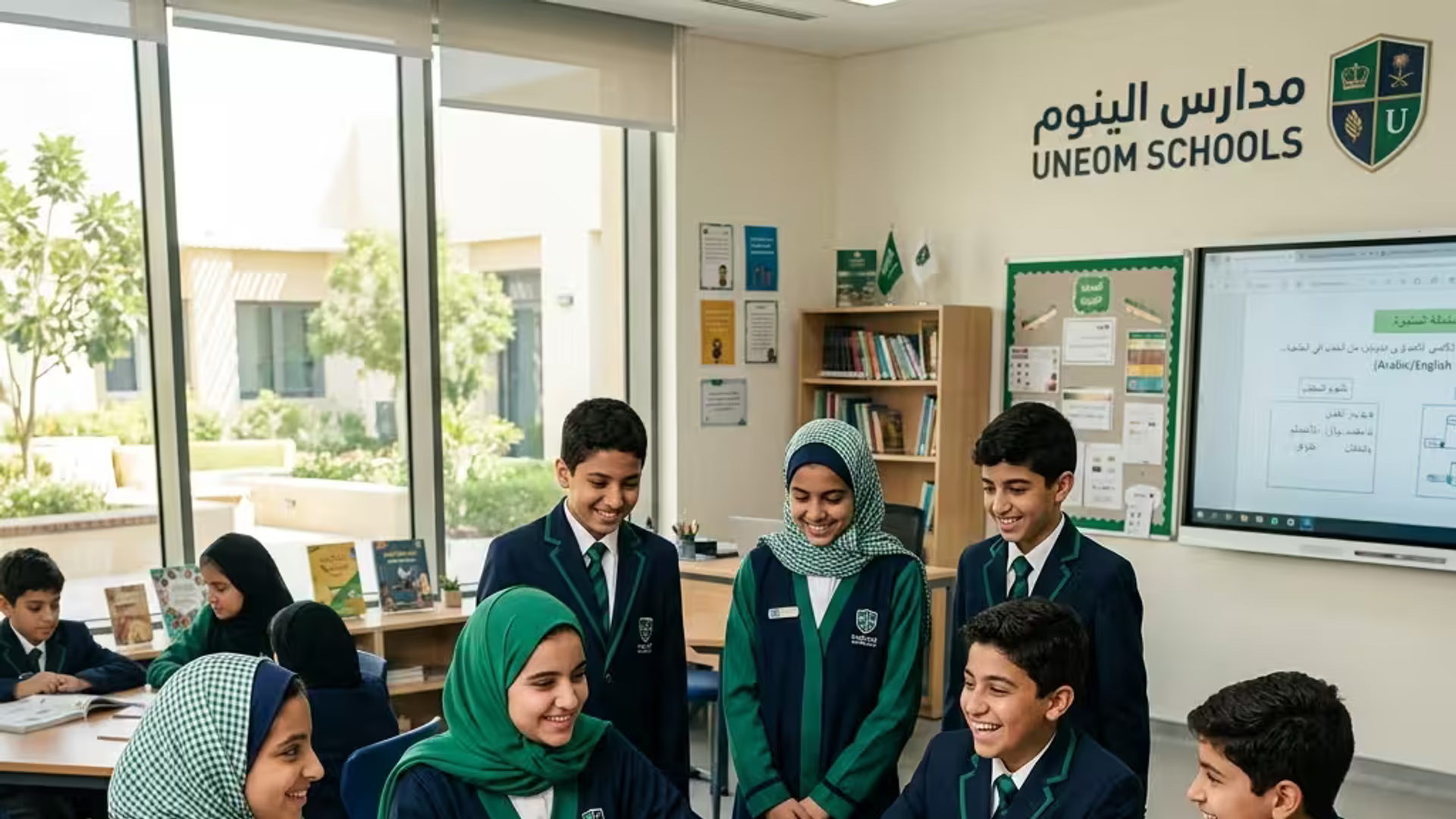
Saudi school uniform procurement represents a unique engineering challenge: designing garments for bodies that grow 5 to 8 centimetres per year, in a climate that degrades fabric at accelerated rates, under Ministry of Education specifications that leave significant room for interpretation. The result is that Saudi parents replace school uniforms an average of 2.3 times per academic year — a replacement rate that reflects design failure rather than student behaviour. UNEOM's education programme reduces this to 1.2 replacements per year through extendable design engineering, climate-appropriate fabric selection, and construction standards calibrated to actual student activity patterns.
The 2.3x replacement number
UNEOM surveyed 1,200 Saudi families across Riyadh, Jeddah, and Dammam in 2024 to understand school uniform purchasing patterns. The average family with two school-age children purchased 4.6 complete school uniform sets per academic year — 2.3 per child. The primary replacement triggers were, in order of frequency: outgrown garments accounting for 42% of replacements, irreversible staining accounting for 28%, seam or closure failure accounting for 18%, and fabric degradation such as pilling and colour loss accounting for 12%. Each replacement trigger points to a specific design failure. Outgrown garments indicate a lack of growth accommodation in the pattern design. Irreversible staining indicates inadequate stain-resistance treatment or inappropriate fabric composition. Seam failure indicates insufficient construction quality at stress points. And fabric degradation indicates incorrect fabric selection for the Saudi climate and laundering conditions. The financial impact on Saudi families is significant: at an average cost of SAR 180 per complete uniform set, 2.3 replacements per child per year translates to SAR 414 per child — or SAR 828 for a two-child family. Over a 12-year school career, a single child's uniform expenditure reaches SAR 4,968. UNEOM's extendable-design programme reduces this to SAR 216 per child per year at 1.2 replacements — a 48% cost reduction that saves a two-child family SAR 396 annually. The extendable-design garments have a slightly higher initial cost — approximately SAR 220 versus SAR 180 for standard construction — but the reduced replacement frequency more than compensates, even in the first year.
Extendable design: what it costs and what it saves
Extendable design is the engineering discipline of building growth accommodation into garment construction without compromising fit or appearance at any point in the garment's lifecycle. UNEOM's approach uses three mechanisms. First, adjustable hem allowances: trouser hems and skirt hems include a 6cm concealed turn-up rather than the standard 3cm. When the student grows, the parent releases the turn-up, extending the garment by 6cm. The concealed construction means the turn-up is invisible when folded — no visible crease line or wear mark distinguishes an extended garment from a newly purchased one. The turn-up is secured with a chain stitch that can be unpicked with a single thread pull, requiring no sewing skills or tools. Second, adjustable waistband systems: trousers and skirts use a concealed elastic panel in the back waistband that provides 8cm of circumferential growth accommodation. The elastic is covered by the garment's outer fabric so it is invisible, and it maintains a flat front profile that looks identical to a fixed waistband. This system accommodates both the gradual growth of the academic year and the more rapid weight changes that occur during Ramadan and summer holiday periods. Third, shoulder construction with growth seams: shirts and jackets include a concealed growth seam at the shoulder that can be released to extend sleeve length by 4cm. The growth seam is a secondary shoulder seam positioned 2cm inside the visible shoulder line, stitched with a contrasting-colour thread that is easy to identify and remove. When released, the sleeve drops 4cm and the armhole adjusts proportionally, maintaining natural sleeve drape rather than creating the awkward hang that occurs when sleeves are simply let down from the cuff. The combined effect of these three mechanisms provides 6cm of length growth, 8cm of circumferential growth, and 4cm of sleeve growth — accommodating approximately 18 months of typical student growth within a single garment purchase. The cost premium for extendable construction is SAR 35 to 45 per garment — the cost of the additional fabric, the concealed elastic system, and the growth-seam construction. Against the SAR 180 per replacement set that the additional growth accommodation eliminates, the return is 4 to 5 times the investment.
MoE-compliant cuts for Saudi schools
The Saudi Ministry of Education uniform specifications establish parameters for colour, general style, and modesty requirements but leave detailed garment specifications to schools and suppliers. This creates inconsistency across the market — different suppliers interpret the same MoE guidelines differently, resulting in significant variation in quality, fit, and durability. UNEOM's MoE-compliant specification establishes a detailed technical standard that exceeds MoE minimums while remaining within the guideline framework. For boys, the primary garment is a thobe-style tunic for formal occasions and a shirt-trouser combination for daily wear. UNEOM's daily-wear specification uses a structured collar shirt in white or light blue with the school logo embroidered at the left breast — the logo positioned 8cm below the shoulder seam and 3cm from the centre-front, consistent across all size grades. The trouser specification uses a flat-front construction with the extendable waistband system described above, in charcoal or navy as specified by the individual school. For girls, the primary garment is a tunic or dress in the school's specified colour with a coordinated hijab option. UNEOM's tunic specification provides coverage to below the knee in the smallest size and proportionally longer in larger sizes, with a raglan sleeve construction that provides better movement range than set-in sleeves for active younger students. The hijab specification offers three styles: a pull-on style for primary-age students with a secure elastic band, a pin-secured style for intermediate students, and a wrap style for secondary students — each providing secure coverage during physical activity while respecting the developmental stage of the student. Fabric selection for all education garments follows a climate-calibrated approach: lighter-weight fabrics at 140gsm for Term 1 (September to November) and Term 3 (March to June), and heavier-weight fabrics at 180gsm for Term 2 (December to February). Schools operating in a single-weight model are specified at 160gsm as a compromise. All fabrics carry OEKO-TEX Standard 100 certification — Class 1 for ages 3 and below, Class 2 for all other school-age children — ensuring verified safety for skin-contact garments worn for extended hours.
Programme delivery for August intake
The Saudi school year begins in late August, and uniform procurement typically compresses into a six-week window from mid-June to early August — creating a demand spike that overwhelms suppliers who have not pre-planned production capacity. UNEOM's education programme operates on an annual contract cycle that begins procurement planning in January, seven months before the school year starts. January to February covers programme specification review: confirming any changes to school colour requirements, logo updates, or size-range adjustments based on the current student body. Schools with high student turnover may also provide projected enrolment data to allow pre-positioning of inventory. March to April is the production window: UNEOM manufactures the full programme allocation for the coming school year, using existing size-profile data for returning students and standard size distributions for projected new enrolments. The production window is strategically positioned to avoid conflict with Ramadan and the summer production slowdown, ensuring consistent factory capacity and quality. May to June is quality assurance and warehousing: finished garments undergo final inspection, OEKO-TEX certification verification, and size-label accuracy checks before being packaged by school, then by grade, then by size for efficient distribution. July is the fitting window: schools schedule fitting sessions where students try on their allocated garments. UNEOM provides on-site fitting teams for schools with 300 or more students; smaller schools receive garments with a 14-day exchange window for size adjustments. Early August is final distribution: all garments are delivered to schools in grade-sorted packages ready for the first day. Any exchange or alteration requirements identified during the fitting window have been processed and the replacement garments are included in the final delivery. This seven-month programme cycle ensures that no family experiences the back-to-school uniform rush that characterises retail uniform procurement. Every student has a properly fitted, quality-verified uniform ready for the first day — and the extendable design features mean they will likely still be wearing that same uniform at the last day of the academic year.
Frequently asked
- How many times do Saudi families replace school uniforms per year?
- The national average is 2.3 times per child per year. UNEOM's extendable-design programme reduces this to 1.2 — a 48% reduction in replacement cost.
- What is extendable design?
- Engineering growth accommodation into garments: 6cm hem extensions, 8cm waist expansion, and 4cm sleeve growth — accommodating 18 months of typical student growth in one purchase.
- Are UNEOM school uniforms OEKO-TEX certified?
- Yes — all education fabrics carry OEKO-TEX Standard 100 certification at Class 1 for ages 3 and under, Class 2 for all other school-age children.
- When should schools start uniform procurement?
- January — seven months before the August school start. UNEOM's annual programme cycle covers specification, production, quality assurance, fitting, and distribution.
- Does UNEOM provide hijab options for school uniforms?
- Yes — three styles matched to developmental stage: pull-on elastic for primary, pin-secured for intermediate, and wrap style for secondary students.