Aviation Uniform Standards in Saudi Arabia: What Riyadh Air Signals for the Industry
GACA-compliant fabric weights, hijab-integration engineering for cabin crew, wrinkle-resistant and flame-retardant specifications, and the 24-month programme cycle.

The launch of Riyadh Air — Saudi Arabia's new flagship carrier — has redefined expectations for aviation uniform design in the Gulf region. The carrier's announcement signalled a deliberate departure from conventional Gulf airline aesthetics, integrating Saudi cultural identity with contemporary performance fabrics. For the broader Saudi aviation industry, including ground handling companies, airport authorities, and private aviation operators, this shift creates new benchmarks. This guide examines the technical standards, cultural requirements, and programme frameworks that govern aviation uniform procurement in the Kingdom.
The new landscape: Riyadh Air and Saudi aviation identity
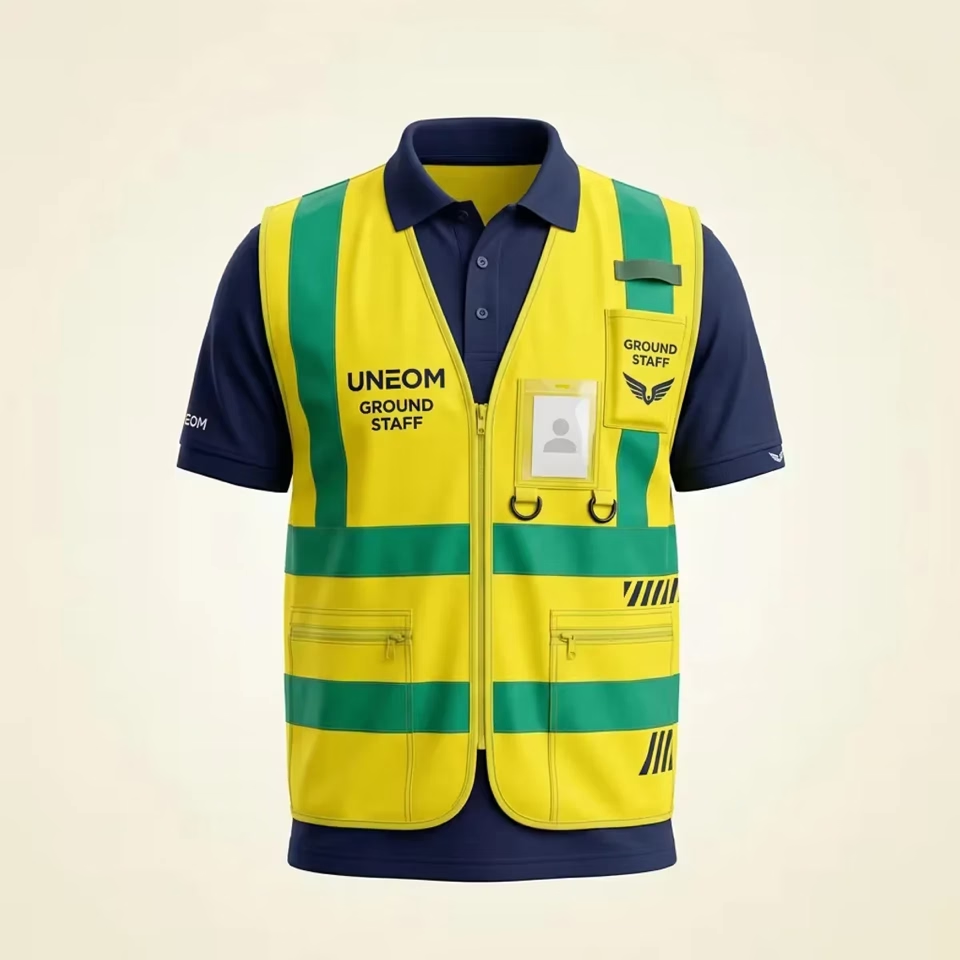
Riyadh Air represents a generational shift in how Saudi aviation approaches uniform design. Traditional Gulf carrier aesthetics — borrowed heavily from European luxury fashion houses — are being replaced by designs that foreground Saudi cultural elements: calligraphic patterns, desert-palette colourways, and modesty-first silhouettes. This has implications beyond one airline. Ground handling companies serving Saudi airports are updating their uniform standards. Private aviation operators are refreshing crew attire. Airport retail staff uniforms are being redesigned. The ripple effect creates procurement opportunities across the aviation ecosystem. UNEOM serves 6 GCC carriers and ground operations teams with programmes that balance three requirements: cultural authenticity (Saudi design language), technical performance (in-flight and ground operational demands), and regulatory compliance (GACA standards for cabin crew garments).
GACA compliance: 180-220 GSM fabric weight specifications
The General Authority of Civil Aviation (GACA) does not prescribe uniform aesthetics but does regulate fabric performance for safety. GACA regulates safety performance rather than fabric weight; in practice crew garments are specified in a mid-weight range that balances structural integrity against cabin thermal comfort — below 180, garments lack structural integrity for emergency procedures; above 220, thermal comfort degrades during extended cabin service. Flame retardance: cabin crew garments must not sustain flame after ignition source removal, per FAR 25.853 (vertical burn test). The fabric must self-extinguish once the ignition source is removed, within the flame-time and burn-length limits set by the applicable vertical-burn airworthiness test. Static dissipation: fabrics must not generate electrostatic discharge in the pressurised cabin environment — critical for fuel-vapour safety during ground operations. UNEOM aviation fabrics use a wool-polyester-elastane blend (55/42/3) at 200 GSM that meets all three requirements: flame self-extinguishment within 1.2 seconds (tested to FAR 25.853), anti-static performance verified to the applicable AATCC surface-resistivity test, with the laboratory report supplied on request, and a weight optimised for 7-12 hour shift comfort at cabin altitudes.
Hijab and modesty in cabin crew design
Saudi aviation is pioneering hijab-integrated crew uniforms at a scale no other market has attempted. The engineering challenges: the head-cover must coordinate with the cabin environment (not impede emergency oxygen mask deployment), maintain professional appearance through 12-hour flights across multiple climate zones, and withstand the same flame-retardance standards as the jacket and trousers. UNEOM's aviation hijab uses the same wool-polyester-elastane base fabric as the uniform set — ensuring identical drape, colour, and flame performance. The construction features a magnetic closure system at the neckline (replacing pins, which create projectile risk during decompression events), internal silicone grip bands (preventing shift during in-flight service movement), and pre-shaped structure (eliminating the need for manual adjustment). The colour management is critical: aviation hijabs must match the jacket colourway to Delta E <1.0 across production batches — tighter than most luxury fashion brands specify. Cultural compliance review: every design is reviewed by a cultural advisory panel before production, ensuring alignment with Saudi modesty standards across all operating environments.
Fabric engineering: wrinkle resistance meets flame retardance
Aviation uniforms face a unique fabric challenge: they must look crisp after 12 hours of cabin service (wrinkle resistance) while meeting stringent flame-retardance requirements — and these two properties traditionally conflict. Wrinkle-resistant treatments often use resin-based finishes that can increase fabric flammability. UNEOM's solution uses a wool-dominant blend (55% wool) that provides natural wrinkle recovery (wool fibres spring back to shape after deformation) combined with inherent flame resistance (wool self-extinguishes due to its high moisture content and nitrogen-rich molecular structure). The 42% polyester adds dimensional stability and dye consistency; the 3% elastane provides stretch recovery for seated comfort during long flights. Additional treatments: moisture-wicking inner finish (crew uniforms absorb perspiration during galley service), anti-static treatment (AATCC 76 compliant), and soil-release finish (allowing spot-cleaning of coffee and food stains between full laundry cycles). Garment construction: fused canvas construction (not glued lining) in blazers and jackets ensures the garment maintains its structured silhouette through the full 24-month programme cycle.
From design to production: the 24-month programme cycle
Aviation uniform programmes operate on 24-month cycles — the longest in any uniform sector. The extended cycle reflects the investment in design (brand identity alignment), production (complex construction), and regulatory compliance (GACA approval). Phase 1 — Concept (Months 1-3): brand alignment workshops, cultural compliance review, fabric selection and testing, initial design concepts. Phase 2 — Development (Months 4-6): prototype construction, fit clinics with crew representatives (minimum 50 crew members across body types), GACA documentation preparation. Phase 3 — Approval (Months 7-8): GACA review and approval, final fabric certification, production specification lock. Phase 4 — Production (Months 9-14): bulk production, 18-point quality inspection per garment, sizing and packaging by crew assignment. Phase 5 — Deployment (Month 15): phased crew rollout with fitting sessions, old-uniform collection and recycling. Phase 6 — Programme Management (Months 16-24): replacement processing, joiner-kit management, quarterly condition assessments, preparation for next-cycle design review. UNEOM's current aviation programme pricing: SAR 650 average per-unit, reflecting premium fabrics and complex construction.
The future: Vision 2030 and sustainable aviation uniforms
Saudi Vision 2030's aviation expansion — Riyadh Air, the NEOM Bay Airport, the King Salman International Airport mega-project — will create demand for 50,000+ aviation uniform sets over the next 5 years. This scale creates an opportunity for sustainability innovation. UNEOM is developing three sustainability initiatives for aviation programmes: recycled-polyester blends (targeting 30% recycled content by 2028 without compromising flame-retardance performance), closed-loop garment recycling (retired crew uniforms are shredded and reprocessed into insulation material rather than sent to landfill), and carbon-offset programme documentation (providing airlines with per-garment carbon footprint data for ESG reporting). The intersection of cultural identity and sustainability will define Saudi aviation uniforms in the next decade — garments that honour Saudi heritage, protect crew safety, and minimise environmental impact. UNEOM's role is to engineer all three simultaneously.
Frequently asked
- What fabric do airlines use for crew uniforms?
- UNEOM uses wool-polyester-elastane (55/42/3) at 200 GSM — self-extinguishing within 1.2 seconds, wrinkle-recovering, and comfortable for 12-hour flights.
- How long is an aviation uniform programme cycle?
- 24 months from concept to end of lifecycle. The longest cycle in uniform procurement due to design complexity and GACA compliance.
- Are aviation uniforms flame retardant?
- Yes. Cabin crew garments must self-extinguish once the ignition source is removed, within the flame-time and burn-length limits of FAR 25.853. UNEOM's wool blend is certified to that test.
- Do Saudi airlines require hijab-integrated uniforms?
- 100% of UNEOM aviation designs include hijab-compatible options with magnetic closures, silicone grip bands, and matching colourway to Delta E <1.0.
- How much do aviation uniforms cost?
- SAR 650 average per-unit for programme contracts, reflecting premium wool-blend fabrics, fused canvas construction, and 24-month warranty.