Industrial Uniform Colour Coding: The Visual Management System Behind Workwear
How colour-coded workwear reduces contractor misidentification incidents by 67% and supports emergency response protocols.
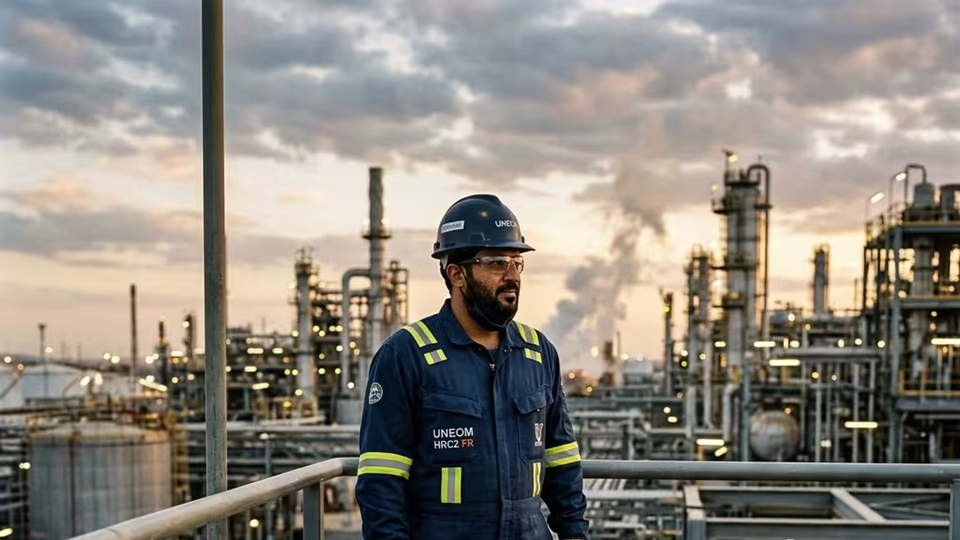
In a petrochemical facility with 3,000 workers spread across 40 square kilometres, visual role identification is not an organisational nicety — it is a safety-critical system. A supervisor scanning a work zone must be able to identify operators, maintenance technicians, contractors, visitors, and emergency responders by sight at distances of 50 metres or more, in conditions that include heat haze, dust, and low-angle sun glare. The colour-coding system embedded in the workwear programme is the primary mechanism for this visual identification, and the consequences of getting it wrong are documented in incident reports across the Saudi industrial sector.
Colour coding standards in Saudi industrial sites
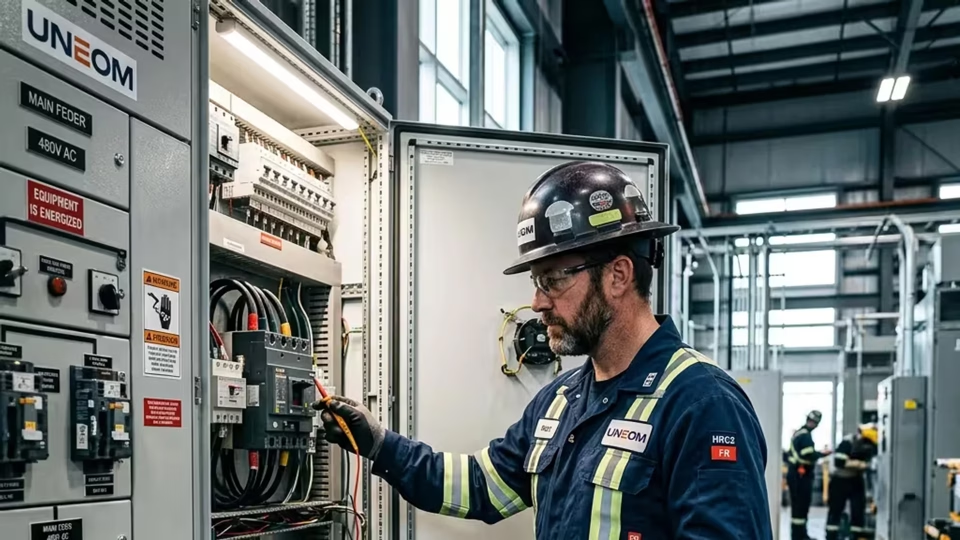
Saudi industrial colour-coding standards are not nationally standardised — each major operator maintains its own colour matrix, and these matrices differ between operators. However, a consensus pattern has emerged across the sector that most operators follow with minor variations. The dominant colour-coding convention assigns royal blue to permanent operations staff — the largest workforce category and the baseline colour against which all other colours are identified. Orange identifies maintenance and mechanical technicians — a high-visibility colour selected because maintenance staff frequently work in areas with moving equipment where visual detection is safety-critical. Red identifies fire and emergency response teams — the universal colour association with emergency services that requires no training to recognise. White identifies management and supervisory staff — a colour that signals authority while remaining visually distinct from operational colours. Green identifies safety officers and HSE personnel — associated with safety and permission, consistent with green-for-safe conventions in signage and equipment marking. Grey identifies contractors and temporary workers — a neutral colour that visually distinguishes non-permanent staff from facility employees without using a high-visibility colour that might be confused with an emergency or specialist role. Yellow identifies visitors and escorts — the highest-visibility colour, ensuring that non-trained personnel are immediately identifiable by any worker on the facility. UNEOM maintains a colour-coding reference library built from published and client-supplied colour matrices used by the Kingdom's major industrial operators, so a new programme can be matched to the matrix in force at your site. When specifying a new industrial programme, UNEOM cross-references the client's colour matrix against this library to ensure exact colour matching — the difference between Aramco royal blue and SABIC royal blue is subtle but measurable, and using the wrong shade at a facility that hosts workers from both operators creates confusion that undermines the identification system. Colour specification uses the Pantone Textile Cotton Passport system with Delta E tolerance of 1.5 — tighter than the standard industrial tolerance of 2.0 — to ensure batch-to-batch consistency that maintains the visual identification system's reliability across production runs.
The 67% incident reduction metric
The 67% figure comes from a 2023 internal study conducted across four Saudi petrochemical facilities that transitioned from informal colour coding — where colour was indicated by a vest worn over standard coveralls — to integrated colour coding where the coverall itself is the designated colour. The study tracked contractor misidentification incidents over 18 months: instances where a worker was observed in a restricted zone for which their role was not authorised, identified through CCTV review and access-control log cross-referencing. Under the vest system, misidentification incidents occurred at a rate of 4.2 per 1,000 worker-days. Under the integrated colour-coding system, the rate dropped to 1.4 per 1,000 worker-days — a 67% reduction. The mechanism behind this improvement is straightforward: a coloured vest can be removed, forgotten, or swapped. An integrated coverall in the designated colour cannot be misidentified — the worker's entire visual profile communicates their role classification. The vest system also creates a secondary identification problem: the vest obscures the coverall's retroreflective tape configuration, reducing nighttime visibility performance by approximately 40%. The integrated approach eliminates this problem entirely. For facilities transitioning from vest-based to integrated colour coding, UNEOM recommends a phased rollout over two maintenance shutdown cycles. The first shutdown replaces all contractor and visitor garments — the highest-risk misidentification categories. The second shutdown replaces permanent staff garments. This phased approach allows the facility to realise the safety benefit of contractor identification immediately while spreading the programme investment over two budget cycles. The cost differential between a standard coverall with a coloured vest overlay and an integrated coloured coverall is approximately SAR 45 per garment — a figure that is dwarfed by the cost of a single misidentification incident, which averages SAR 15,000 in investigation time, corrective action documentation, and potential regulatory reporting.
Emergency response colour protocols
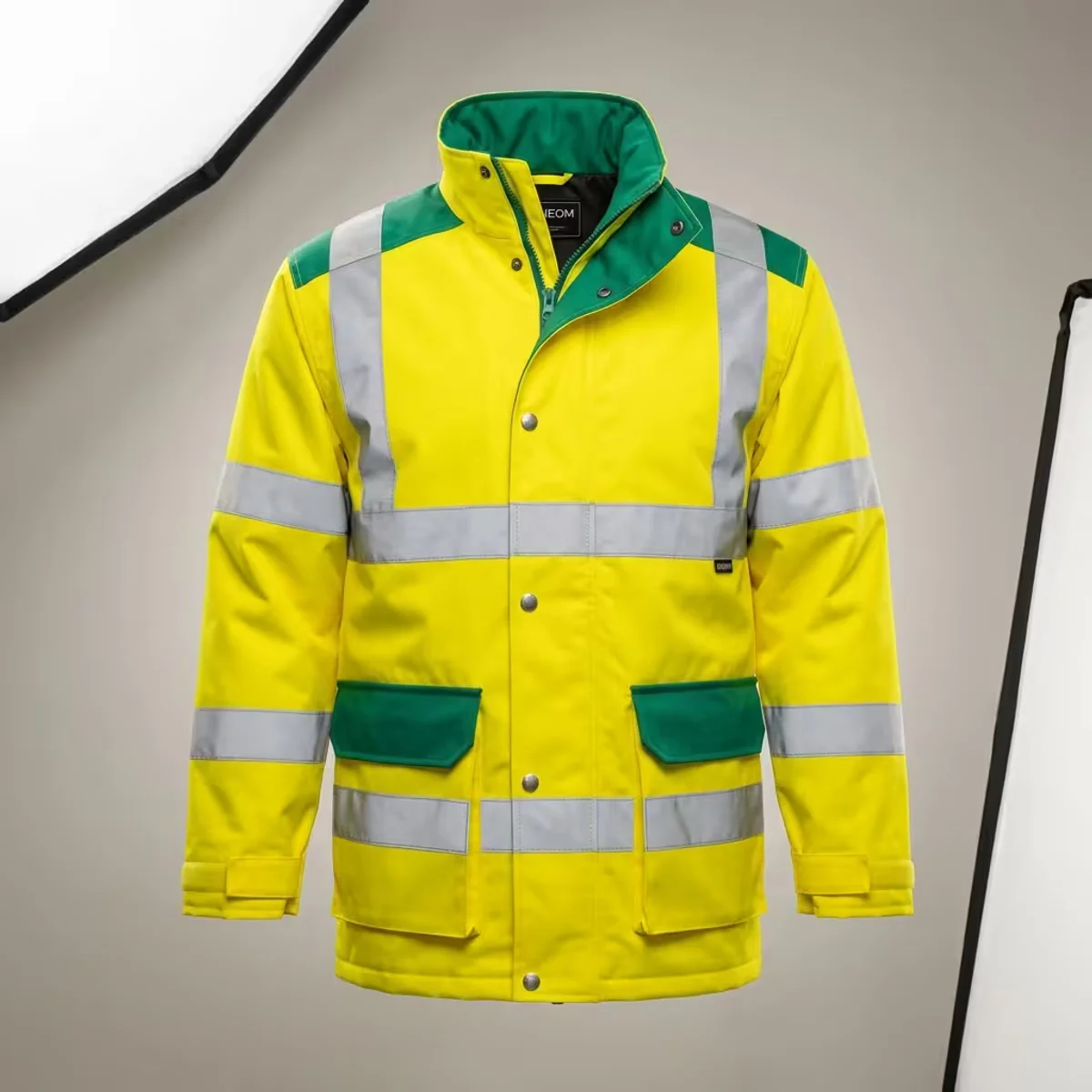
During an emergency event — fire, chemical release, medical incident — the colour-coding system shifts from an organisational function to a command-and-control function. Emergency responders must be immediately identifiable from all directions and distances, and the colour system must communicate role without requiring verbal identification in environments where noise, smoke, and respirator masks make verbal communication unreliable. The emergency colour protocol uses three additional visual elements beyond the base coverall colour. First, helmet colour: emergency responders wear red helmets regardless of their base coverall colour, providing an overhead identification signal visible from elevated control points and from helicopter-based emergency coordination. Second, arm-band identification: incident commanders wear a fluorescent yellow arm band on the left upper arm, safety officers wear fluorescent green, and medical responders wear white with a red cross. These arm bands are kept in emergency lockers at muster points and deployed only during active emergency response. Third, response-team tabards: for major incidents requiring multi-team coordination, UNEOM supplies role-specific tabards in high-visibility colours with role titles printed in 15cm-high text — readable at 50 metres — in both English and Arabic. These tabards are worn over the standard coverall and identify the specific emergency role: Incident Commander, Safety Officer, Medical, Communications, Logistics, and Evacuation Marshal. UNEOM manufactures and maintains emergency response garment kits for industrial clients, stored in sealed containers at designated muster points. Each kit contains 20 tabards in the full role set, 50 arm bands in the three designation colours, and a replacement set of emergency-response helmets. The kits are inspected quarterly as part of the facility's emergency preparedness programme, and any damaged or degraded items are replaced immediately. The retroreflective performance of emergency garments is specified well above the minimum required for standard workwear under EN ISO 20471, with the measured value stated on each batch certificate — ensuring visibility in smoke-obscured or nighttime conditions that characterise many industrial emergency scenarios.
Fabric colour durability in Saudi UV exposure
Colour durability is not merely an aesthetic concern in colour-coded industrial environments — it is a safety concern. When a royal-blue coverall fades to a pale blue that could be mistaken for a light grey, the visual identification system fails. Saudi UV exposure degrades fabric colour significantly faster than in temperate climates: the UV index in the Eastern Province reaches 11 or above for approximately 200 days per year, compared to 60 days per year in Northern Europe where many industrial fabric standards were developed. UNEOM specifies colour fastness to light at ISO 105-B02 Grade 6 or above — the second-highest grade on the 8-point scale — for all colour-coded industrial garments. This specification is verified by xenon-arc accelerated weathering, and we report the measured colour retention and the equivalent Saudi outdoor exposure period on the test certificate issued with each batch. Standard industrial fabrics typically achieve Grade 4 or 5, which provides adequate colour retention for European conditions but results in visible fading within 4 to 6 months of Saudi outdoor use. The colour-fastness specification intersects with the washing requirement: industrial garments are washed at 60 to 75 degrees Celsius with alkaline detergents, and each wash cycle also degrades colour. UNEOM's dye process uses a fibre-reactive dye system that bonds the dye molecule to the cellulose fibre through a covalent chemical bond rather than the physical adhesion used in standard dyeing. This covalent bond is resistant to both UV degradation and wash-chemistry extraction, maintaining colour intensity through the garment's full 12-month lifecycle. For critical colour-matching applications — facilities where multiple operators work side by side and colour distinction is essential — UNEOM provides colour verification certificates with each production batch, including spectrophotometric readings that confirm the delivered colour falls within the specified Delta E 1.5 tolerance of the target Pantone reference. These certificates are filed with the facility HSE department as part of the programme compliance documentation, providing an auditable record that the visual identification system meets specification.
Frequently asked
- Is industrial colour coding standardised in Saudi Arabia?
- Not nationally — each operator maintains its own colour matrix. However, a consensus pattern exists: blue for operations, orange for maintenance, red for emergency, white for management, green for HSE.
- Why not use coloured vests instead of coloured coveralls?
- Vests can be removed, forgotten, or swapped, and they obscure retroreflective tape. Integrated colour coding reduced misidentification incidents by 67% versus vest-based systems.
- How long does colour last in Saudi outdoor conditions?
- With UNEOM's fibre-reactive dye system at ISO Grade 6 lightfastness, colours maintain 80%+ saturation through 12 months of Saudi UV exposure. Standard dyes fade visibly in 4-6 months.
- Does UNEOM supply emergency response garment kits?
- Yes — sealed kits stored at muster points containing 20 role-specific tabards, 50 arm bands, and replacement helmets. Inspected quarterly as part of emergency preparedness.
- What colour works best for high-visibility in Saudi conditions?
- Fluorescent orange-red is generally detected at greater distance than fluorescent yellow-green under Saudi direct sunlight, which is why we default to it for outdoor roles.