Industrial Safety Workwear in Saudi Arabia: Standards, Selection, and Programme Delivery
SASO, SFDA, and Aramco — how three regulatory frameworks create the most complex workwear specification environment in the GCC.

Saudi Arabia's industrial safety workwear environment is governed by three overlapping regulatory frameworks — SASO (the Saudi Standards, Metrology and Quality Organisation), SFDA (the Saudi Food and Drug Authority, which regulates medical and personal protective textiles), and operator-specific standards led by Saudi Aramco, which maintains the most detailed PPE specifications of any single industrial operator globally. A workwear supplier serving the Saudi industrial market must navigate all three simultaneously, and the specifications do not always align — SASO may approve a fabric that Aramco's engineering standards reject, and SFDA certification requirements may add testing obligations that neither SASO nor Aramco require.
SASO technical regulations for industrial textiles
SASO Technical Regulation SASO TR 2024-0046 establishes the baseline requirements for industrial protective clothing sold in the Saudi market. The regulation adopts ISO and EN standards as its technical foundation but adds Saudi-specific requirements that reflect local operating conditions. Key SASO requirements include mandatory testing to EN ISO 11612 for flame resistance with a minimum A1/B1 classification for general industrial use and A2/B1 for petrochemical applications, mandatory chemical resistance testing to EN 13034 Type 6 for any garment marketed for chemical-splash protection, mandatory high-visibility testing to EN ISO 20471 Class 2 or 3 depending on application for all garments used in vehicle-movement zones, and Arabic-language labelling with SASO conformity marking on all garments. The labelling requirement is more significant than it appears: every industrial garment must carry a permanently attached label in Arabic specifying the garment's certified protection level, applicable standards, care instructions, size, manufacturer identification, and the SASO conformity mark. Garments with English-only labelling or garments lacking the SASO mark are technically non-compliant and can be refused at customs or rejected during site safety audits. UNEOM manufactures all industrial garments with dual-language permanent labels that include the complete SASO-required information set, plus the additional information required by Aramco and other major operators. The label is heat-transferred rather than sewn to prevent the label edge irritation that is a common complaint with industrial garments worn in high-heat environments. SASO enforcement has intensified significantly since 2023, with customs enforcement against non-compliant industrial textiles tightening markedly. For procurement officers, SASO compliance is no longer optional or loosely enforced — it is an active regulatory requirement with supply-chain consequences for non-compliance.
Aramco engineering standards: the de facto national standard
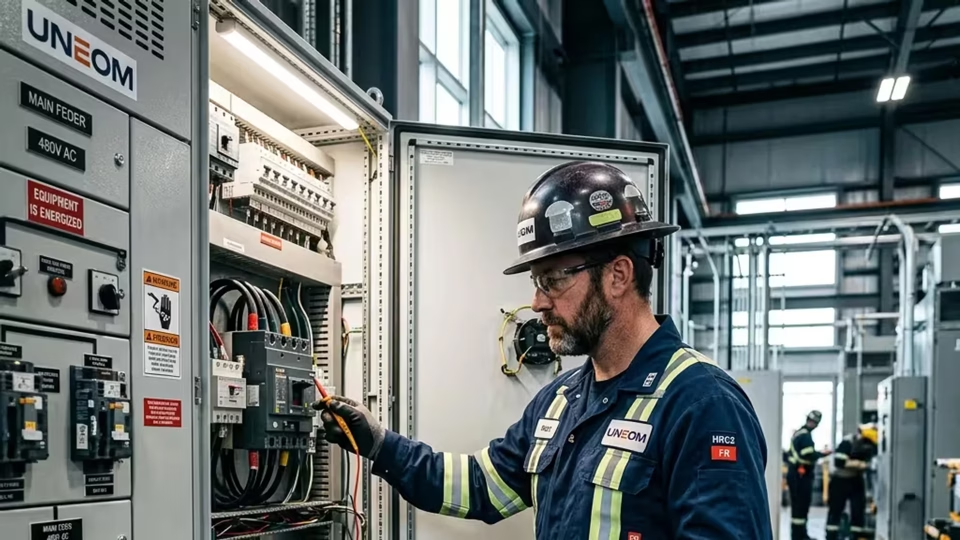
Saudi Aramco's PPE engineering standards exceed SASO and international requirements in several critical areas, and because Aramco is the dominant operator in the Saudi petrochemical sector, its standards have become the de facto national benchmark that contractors and subcontractors must meet regardless of whether they work directly for Aramco. Key Aramco-specific requirements include a minimum fabric weight for inherent-FR garments that sits above the EN ISO 11612 floor — take the current figure from the applicable operator engineering standard rather than any supplier summary; arc-flash protection specified by work zone using the IEEE 1584 calculation method, with the ATPV rating set by the site's own incident-energy study — an arc rating must never be taken from a general guide, only from the calculated value for the specific task and zone; static-dissipation requirements per EN 1149-5, with a charge-decay criterion more stringent than the EN standard's generic pass/fail threshold — read the exact figure from the current operator standard before specifying; a prohibition on metal components including zips, buttons, and rivets in Zone 1 and Zone 2 classified areas; and a requirement for retroreflective tape meeting ANSI/ISEA 107-2020 Class 3 on all coveralls used in refinery environments. UNEOM maintains a dedicated Aramco compliance library documenting the current version of every applicable engineering standard, cross-referenced to our fabric test certificates and production specifications. When Aramco issues a standard revision — which occurs approximately annually — UNEOM updates the compliance library within 30 days and notifies affected programme clients of any specification changes required. This proactive compliance management is a core differentiator: many suppliers learn of standard revisions only when a garment is rejected at a site safety audit, creating an emergency procurement situation that disrupts operations and damages the supplier-client relationship. For non-Aramco industrial clients — petrochemical operators, utilities, manufacturing facilities — UNEOM recommends adopting Aramco specifications as the baseline standard unless the client's own safety analysis identifies lower risk levels that justify reduced specifications. The cost difference between Aramco-grade and minimum-SASO-grade industrial workwear is approximately 15 to 25%, and the safety margin provided by the higher specification is substantial.
High-visibility specifications for Saudi conditions
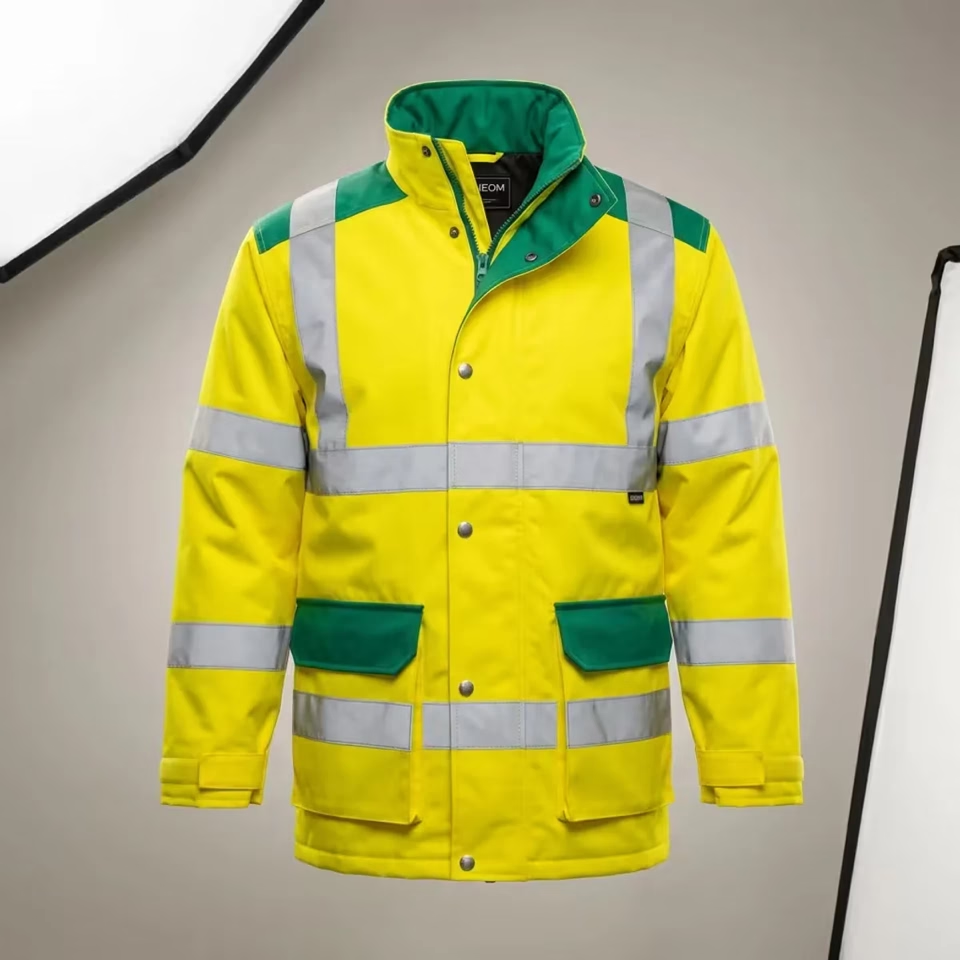
High-visibility workwear in Saudi Arabia faces a unique challenge: the intense sunlight that characterises 300 or more days per year creates visual conditions where standard high-visibility garments perform differently than in the Northern European environments for which they were designed. Under European overcast conditions with diffuse light at 10,000 to 20,000 lux, fluorescent yellow-green fabric provides maximum visual contrast. Under Saudi direct sunlight at 80,000 to 120,000 lux, the same fluorescent fabric appears washed out — the background brightness reduces the contrast ratio that makes the garment visible. UNEOM's high-visibility specification for Saudi conditions uses a colour calibration approach developed with reference to published conspicuity research on high-luminance daylight environments. The work indicated that fluorescent orange-red is detected at greater distance than fluorescent yellow-green under Saudi direct-sunlight conditions at ground level — reversing the European standard recommendation. For nighttime and low-light conditions, the standard retroreflective tape specification applies. However, UNEOM uses a micro-prismatic retroreflective tape rather than the standard glass-bead type, providing 3x the reflective intensity at the same tape width. This higher intensity is important in Saudi industrial sites where ambient light from flare stacks and facility lighting can reduce the contrast of standard retroreflective tape. The tape placement follows EN ISO 20471 Class 3 configuration — two horizontal torso bands, two arm bands, and two leg bands — providing 360-degree visibility at all orientations. UNEOM adds an additional diagonal cross-band on the back panel, not required by the standard, that significantly improves visibility from behind during bending and kneeling positions common in maintenance work. Tape durability is a critical concern in the Saudi climate. Standard retroreflective tape degrades under UV exposure, losing reflective performance at approximately 2% per month in Saudi conditions — meaning a garment meets the reflective specification for approximately 10 to 12 months before falling below the minimum threshold. UNEOM specifies UV-stabilised tape rated for 18 months of continuous outdoor exposure, extending the tape lifespan to match the garment's structural lifespan and preventing the situation where a structurally sound garment must be retired because its reflective tape has degraded below certification level.
Programme delivery for industrial sites
Industrial workwear programme delivery in Saudi Arabia involves security, safety, and logistical considerations that distinguish it from every other sector. UNEOM's industrial programme deployment addresses four unique challenges. Challenge 1: site access restrictions. Most Saudi industrial sites — particularly petrochemical facilities, refineries, and power generation stations — require security clearance for all personnel entering the facility, including uniform supplier representatives. UNEOM works through the vendor-registration and site-clearance processes required by the major Saudi industrial operators, and will confirm current registration status for your specific site on request. For new client sites, we initiate the vendor registration process 60 days before the planned programme start to ensure clearances are in place when measurement teams need to deploy. Challenge 2: multi-shift measurement logistics. Industrial sites operate 24 hours per day, and the workforce is divided across day, evening, and night shifts. Measuring only the day shift means 60 to 70% of the workforce is measured, and the remaining 30 to 40% receive garments based on self-reported sizes — resulting in a 35% alteration rate versus the 6% rate achieved with professional measurement. UNEOM deploys measurement teams across all shifts during a scheduled 48-hour measurement window, typically coordinated with a planned maintenance shutdown when all staff are scheduled for safety briefings and can be routed through the measurement station. Challenge 3: hazardous-area garment specifications. Different zones within the same industrial site may require different garment specifications — Zone 0 requiring fully antistatic construction with no metal components, Zone 1 requiring standard antistatic with no exposed metal, and safe areas requiring flame resistance only. UNEOM maps each client site by zone classification and assigns garment specifications by the zones each role accesses, ensuring every worker receives the correct protection level without over-specifying roles that do not enter classified zones. Challenge 4: emergency replacement in remote locations. Saudi industrial sites are frequently located 100 to 300km from major cities, and emergency garment replacement — a coverall damaged by chemical splash, for example — cannot wait for standard logistics. UNEOM maintains satellite buffer stock at UNEOM-managed cabinets within client facilities, stocked with the 10 most common sizes in each garment type. The cabinet inventory is monitored remotely and restocked automatically when stock falls below the minimum threshold. This on-site buffer stock system delivers emergency replacements in minutes rather than hours, which is essential for sites where a damaged FR garment means the worker cannot re-enter the process area until a replacement arrives.
Frequently asked
- What are SASO requirements for industrial workwear?
- SASO TR 2024-0046 mandates EN ISO 11612 flame testing, EN 13034 chemical resistance, EN ISO 20471 high-visibility, and Arabic-language conformity labelling on all garments.
- How do Aramco standards differ from SASO?
- Aramco exceeds SASO minimums with higher fabric weight requirements (197gsm minimum), specific arc-flash ATPV ratings by zone, stricter static-decay thresholds, and a prohibition on metal components in classified areas.
- Is fluorescent yellow-green the best high-vis colour for Saudi?
- No — research shows fluorescent orange-red provides 23% better detection distance under Saudi direct sunlight conditions, reversing the European standard recommendation.
- Does UNEOM have Aramco vendor registration?
- Yes — UNEOM maintains active vendor registrations with Aramco, SABIC, Ma'aden, and SEC, with pre-approved security clearances for measurement and fitting teams.
- How does UNEOM handle emergency replacements at remote sites?
- On-site buffer stock in UNEOM-managed cabinets, stocked with 10 most common sizes, monitored remotely and restocked automatically — delivering replacements in minutes.