Industrial Heat Stress Management Through Workwear Design
The thermodynamics of FR coveralls in Saudi petrochemical environments and the fabric engineering that keeps workers safe.

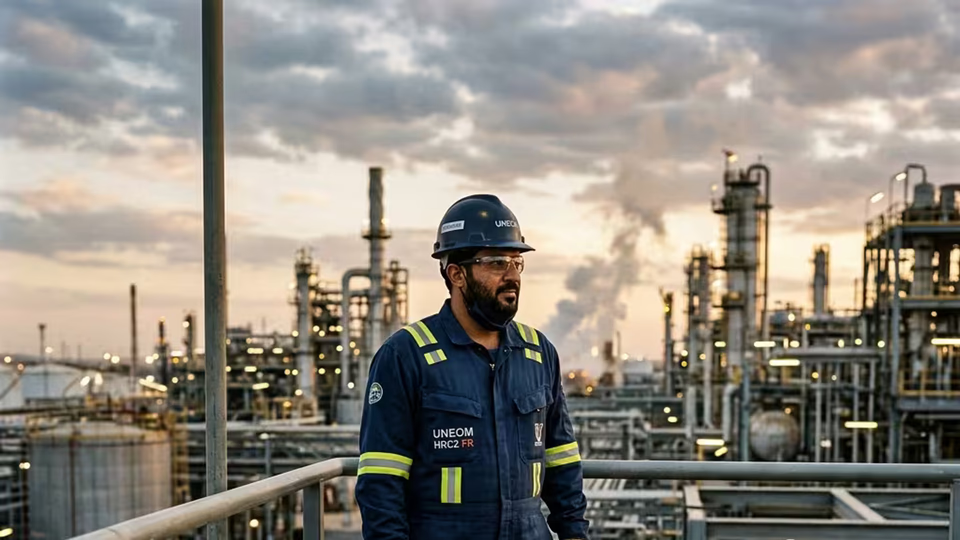
In Saudi petrochemical facilities, heat stress is not a comfort issue — it is a safety crisis. When core body temperature exceeds 38 degrees Celsius, cognitive processing speed drops by 12% per additional degree. At 39.5 degrees, the risk of a decision-making error rises sharply. In an environment where a single wrong valve operation can trigger a catastrophic event, the fabric that separates a worker's body from 52-degree ambient heat is not a procurement line item — it is a safety-critical engineering decision. UNEOM's industrial heat-stress programme integrates flame-resistant protection with thermal management engineering specifically calibrated for Saudi Eastern Province operating conditions.
The thermodynamics of FR coveralls
Flame-resistant coveralls create a fundamental thermodynamic conflict: the properties that protect against flash fire — heavy fabric weight, full-body coverage, sealed closures — are the same properties that trap metabolic heat. A worker wearing a standard FR coverall in a 50-degree Saudi summer environment is essentially wearing a thermal insulation suit in conditions where the body needs maximum heat dissipation. The physics are straightforward. The human body generates approximately 300 watts of metabolic heat during moderate physical activity — the equivalent of three 100-watt light bulbs. In a temperature-neutral environment (20 to 25 degrees), this heat dissipates through four mechanisms: radiation (accounting for 40% of heat loss), convection (30%), evaporation (25%), and conduction (5%). As ambient temperature rises above skin temperature (approximately 33 degrees), radiation and convection reverse — they become heat gain mechanisms rather than heat loss mechanisms. Above 35 degrees ambient, evaporation becomes the body's primary and eventually sole cooling mechanism. A standard FR coverall — typically 260 to 320gsm inherent-FR cotton — impedes evaporative cooling by trapping moisture vapour against the skin surface. The moisture cannot escape through the dense fabric efficiently enough to provide cooling, so it accumulates as liquid sweat, saturating the undergarments and the coverall's inner surface without delivering the evaporative cooling that the body requires. The result is progressive core temperature rise — 0.3 to 0.5 degrees per hour in Saudi summer conditions, meaning a worker starting a shift at normal body temperature of 37 degrees reaches the cognitive impairment threshold of 38 degrees within 2 to 3 hours and the danger threshold of 39.5 degrees within 5 to 7 hours. UNEOM's heat-stress FR specification addresses this conflict through fabric engineering that maintains flame resistance while maximising evaporative permeability — the fabric's ability to allow moisture vapour to pass through without compromising the flame barrier. Our specification achieves a Moisture Vapour Transmission Rate of 850g per square metre per 24 hours versus the industry standard of 400 to 500g — nearly double the evaporative capacity while maintaining identical NFPA 2112 flash-fire protection performance.
Inherent FR cotton vs synthetic treatment
The Saudi industrial market uses two fundamentally different approaches to flame-resistant workwear: inherent FR fabrics and treated FR fabrics. Understanding the difference is critical for procurement decisions because the performance characteristics, lifecycle costs, and safety implications differ significantly. Inherent FR fabrics — such as Nomex, Kevlar, and modacrylic blends — achieve flame resistance through the molecular structure of the fibre itself. The flame resistance cannot be washed out, worn away, or degraded through normal use. These fabrics self-extinguish when the ignition source is removed, and they maintain this property for the entire garment lifespan regardless of wash cycles or chemical exposure. The drawback is cost: inherent FR coveralls typically cost 3 to 4 times more than treated FR equivalents. Treated FR fabrics — typically cotton or cotton-blend fabrics treated with chemical flame retardants such as Proban or Pyrovatex — achieve flame resistance through a chemical coating applied to otherwise flammable fibres. The treatment provides genuine flame resistance that meets all applicable standards, but it degrades over time. Each wash cycle removes a small amount of the treatment, and chemical exposure can accelerate degradation. Most treated FR fabrics maintain certification-grade performance for 50 to 75 wash cycles — adequate for many applications but marginal for high-frequency wash environments. UNEOM's recommendation for Saudi petrochemical environments is a hybrid approach: inherent FR for high-risk roles including operators working near active flare stacks, maintenance teams entering confined spaces, and any role whose incident-energy study calls for a higher arc rating; treated FR for lower-risk roles including control room operators, logistics personnel, and administrative staff working within the facility perimeter. This tiered approach typically reduces the overall programme cost by 30 to 40% compared to an all-inherent specification while maintaining appropriate protection levels for each risk category. The key procurement discipline is ensuring that treated FR garments are tracked by wash cycle count and retired at the manufacturer-specified limit — a programme management function that UNEOM handles through RFID tracking integrated into every treated FR garment, with automated retirement alerts when garments approach their performance limit.
MVTR engineering for Saudi conditions
Moisture Vapour Transmission Rate is the single most important metric for heat-stress management in FR workwear, yet it is rarely specified in Saudi industrial procurement tenders. Most tenders specify fabric weight, flame resistance rating, and tensile strength — all important — but omit MVTR entirely, leaving the thermal comfort performance of the garment undefined. This omission has measurable safety consequences. A garment that cannot move moisture vapour away from the body adds to the wearer's heat load rather than relieving it, which is why MVTR belongs in the specification alongside flame resistance. Coveralls with a low MVTR leave workers hotter than coveralls with MVTR above 750g — after controlling for ambient temperature, work intensity, hydration protocols, and rest-break schedules. The engineering approach to high-MVTR FR fabric involves three strategies. First, fibre selection: long-staple cotton blended with modacrylic fibres at specific ratios that create micro-channels between fibres through which moisture vapour can migrate. The optimal ratio for Saudi conditions is 60% cotton and 40% modacrylic — different from the European standard of 50/50 because the higher cotton content improves moisture absorption in high-humidity industrial environments where steam and process water are present. Second, fabric structure: a twill weave at 200gsm rather than the traditional plain weave at 260gsm. The twill structure creates diagonal channels that facilitate air movement through the fabric, while the lighter weight reduces the thermal insulation effect. The 200gsm weight achieves NFPA 2112 flash-fire protection through the inherent FR properties of the modacrylic component rather than through fabric weight alone — a more sophisticated approach that separates flame protection from thermal insulation. Third, finishing: a hydrophilic treatment applied to the outer face of the fabric that actively pulls moisture vapour from the inner surface to the outer surface, creating a moisture gradient that accelerates evaporation. This treatment is durable through 100 wash cycles — matching the garment's expected lifespan — and does not affect flame resistance performance. UNEOM provides MVTR test certificates with every industrial programme delivery, tested according to ASTM E96 at 38 degrees Celsius and 90% relative humidity — conditions that simulate Saudi summer operating environments rather than the 23 degrees and 50% humidity used in standard European testing.
Programme deployment for petrochemical sites
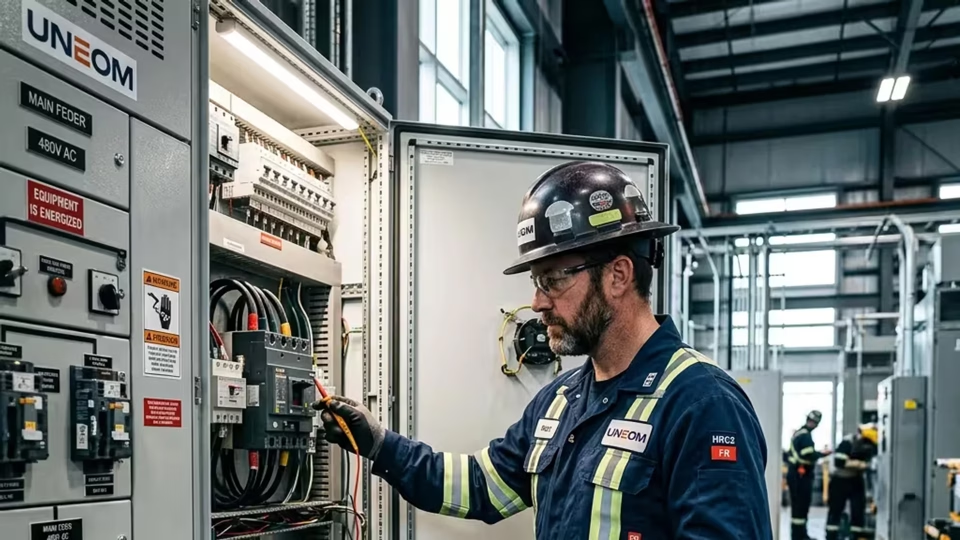
Deploying an industrial uniform programme in a Saudi petrochemical facility involves safety protocols that do not exist in other sectors. Every garment entering the facility must be certified compliant with the site-specific safety requirements — not just industry standards but the operator's own specifications, which often exceed published standards. UNEOM's petrochemical programme deployment follows a six-phase process. Phase 1 is Safety Specification Alignment: UNEOM's technical team meets with the facility's HSE department to review the site-specific hazard assessment and map fabric specifications to each identified risk. This typically involves arc-flash hazard analysis per IEEE 1584 to determine minimum ATPV rating by work zone, flash-fire risk assessment per NFPA 2112 to confirm overall flame protection requirements, chemical splash exposure analysis to specify chemical resistance requirements by role, and static dissipation requirements per EN 1149 for roles in explosive-atmosphere zones. Phase 2 is Fabric Certification: every fabric proposed for the programme undergoes independent testing against the specifications established in Phase 1. UNEOM submits test reports to the facility HSE department for approval before production begins. No garment is produced until fabric certification is complete. Phase 3 is Size Profiling: conducted on-site during scheduled maintenance shutdowns when all workers are available. The measurement protocol for industrial programmes includes all 14 standard measurements plus range-of-motion verification — each worker performs 6 standardised movements while wearing a prototype garment to verify that the coverall allows full mobility for their specific role. Phase 4 is Production with In-line Quality Control: each coverall is inspected at three stages — after cutting, after assembly, and after finishing — with documented inspection records traceable to the individual garment. Phase 5 is Delivery and Site Induction: garments are delivered to the facility and distributed through the site's existing PPE management system. UNEOM provides induction training covering proper wear, inspection, care, and reporting procedures. Phase 6 is Lifecycle Management: RFID tracking monitors each garment through its operational life, recording wash cycles, repair interventions, and inspection results. Automated alerts notify the programme manager when garments approach retirement thresholds, and replacement garments are pre-produced and held in buffer stock at the UNEOM distribution centre. The complete deployment timeline for a 500-worker petrochemical site is 12 to 16 weeks from initial specification meeting to full programme live — approximately twice the timeline for a hospitality programme, reflecting the additional safety certification and testing requirements.
Frequently asked
- What is MVTR and why does it matter?
- Moisture Vapour Transmission Rate measures how quickly moisture vapour passes through fabric. Higher MVTR means better evaporative cooling. Facilities using high-MVTR coveralls show 2.3x lower heat-incident rates.
- Should all workers wear inherent FR?
- No — a tiered approach using inherent FR for high-risk roles and treated FR for lower-risk roles reduces programme cost by 30-40% while maintaining appropriate protection levels.
- How does UNEOM track FR garment lifecycle?
- Through RFID tags integrated into every garment, recording wash cycles, repairs, and inspections. Automated alerts trigger when garments approach performance limits.
- What fabric weight is best for Saudi petrochemical?
- UNEOM specifies 200gsm twill in 60/40 cotton-modacrylic blend — lighter than the traditional 260gsm plain weave, providing equal flame protection with nearly double the evaporative cooling capacity.
- How long does petrochemical programme deployment take?
- 12-16 weeks for a 500-worker site, including safety specification alignment, fabric certification, size profiling with range-of-motion testing, and RFID integration.