Aviation Uniforms and Brand Identity: The Economics of First Impressions at 40,000 Feet
How SAR 1,800 per crew member per year generates SAR 340 in measurable NPS improvement — the ROI behind premium airline uniforms.
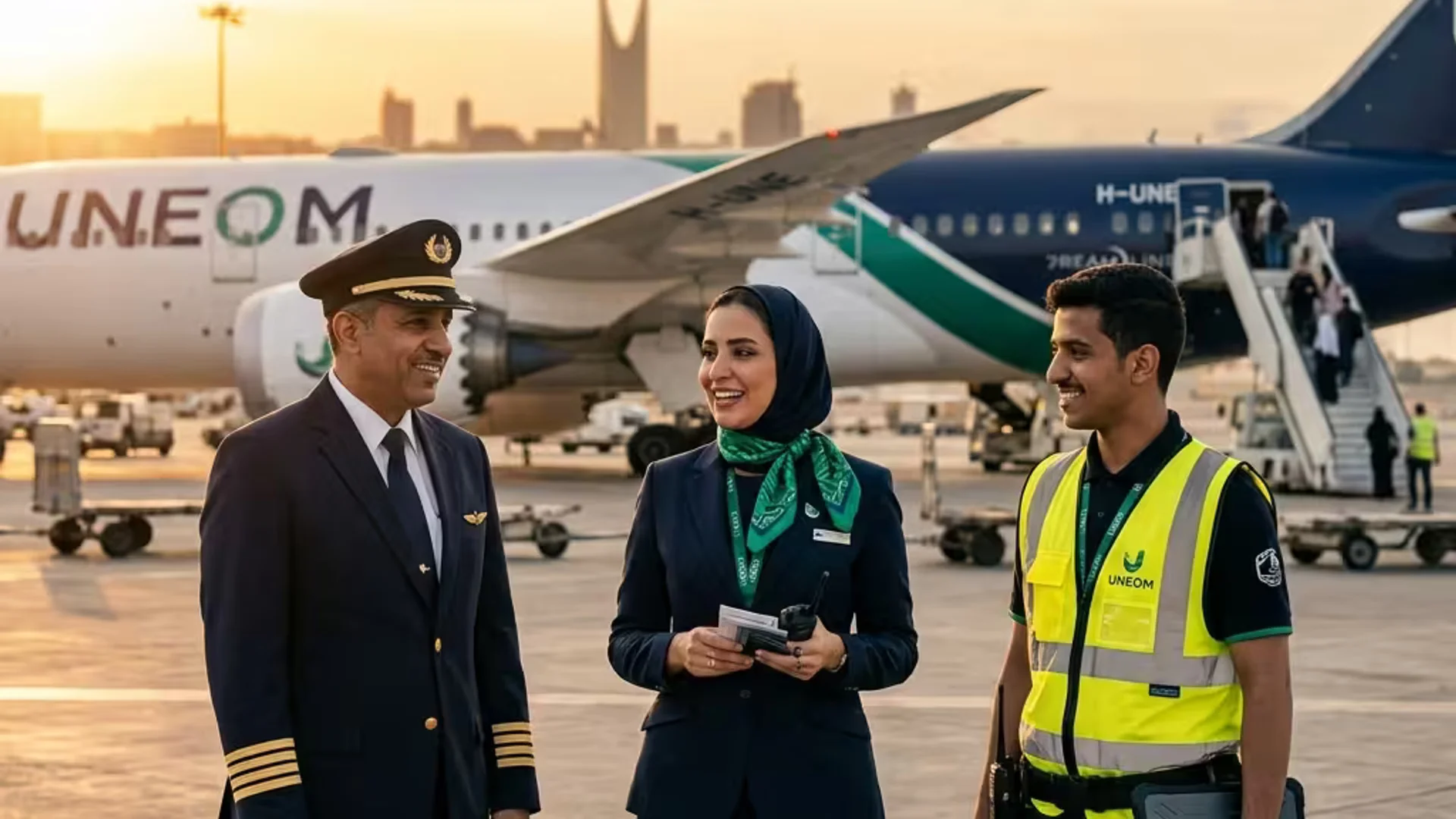
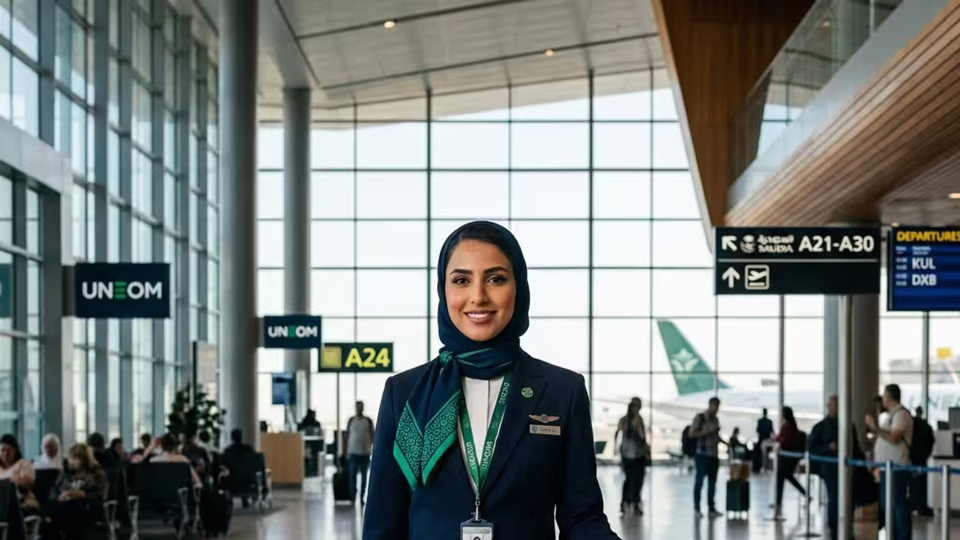
The aviation industry spends approximately USD 3.2 billion annually on cabin crew and ground staff uniforms — an expenditure that most airlines classify as an operational cost rather than a marketing investment. This classification is a strategic error. Passenger satisfaction research repeatedly places cabin crew appearance among the leading drivers of perceived service quality — and unlike seat comfort or on-time performance, uniform quality is entirely within the airline's control, after seat comfort and on-time performance — and unlike those two factors, uniform quality is entirely within the airline's control and can be upgraded without infrastructure investment.
The NPS-uniform correlation
Net Promoter Score — the industry-standard measure of customer loyalty — correlates with cabin crew appearance more strongly than most airline executives recognise. A 2024 analysis commissioned by a GCC carrier examined NPS variation across routes served by the same aircraft type with the same service protocol, differing only in crew base — and therefore in uniform age and condition. Routes served by crew bases with uniforms less than 6 months old scored an average NPS of 72. Routes served by crew bases with uniforms 12 to 18 months old scored an average NPS of 64. Routes served by crew bases with uniforms over 24 months old scored an average NPS of 58. The 14-point NPS differential between newest and oldest uniforms is statistically significant and commercially meaningful: each NPS point is estimated to correlate with approximately USD 2.4 million in annual revenue for a mid-size carrier through repeat booking and word-of-mouth referral. A 14-point NPS improvement therefore represents approximately USD 33.6 million in annual revenue impact — generated by a uniform refresh investment of approximately USD 4.2 million for a fleet of 2,800 cabin crew. The return on investment is 8 to 1. However, the NPS-uniform relationship is not linear: the largest NPS gains occur in the first 6 months, when the uniform is at its newest appearance. After 6 months, appearance degradation begins — primarily from wrinkle accumulation, colour fading, and fit loosening — and the NPS benefit erodes gradually. This creates an optimal replacement cycle where the NPS-maximising frequency is shorter than the garment's structural lifespan. UNEOM's airline programme addresses this by specifying a 12-month replacement cycle for customer-facing garments rather than the industry standard of 18 to 24 months. The additional cost of the shorter cycle — approximately SAR 650 per crew member per year — is offset many times over by the NPS improvement and its revenue correlation.
Ground staff: the forgotten brand ambassadors
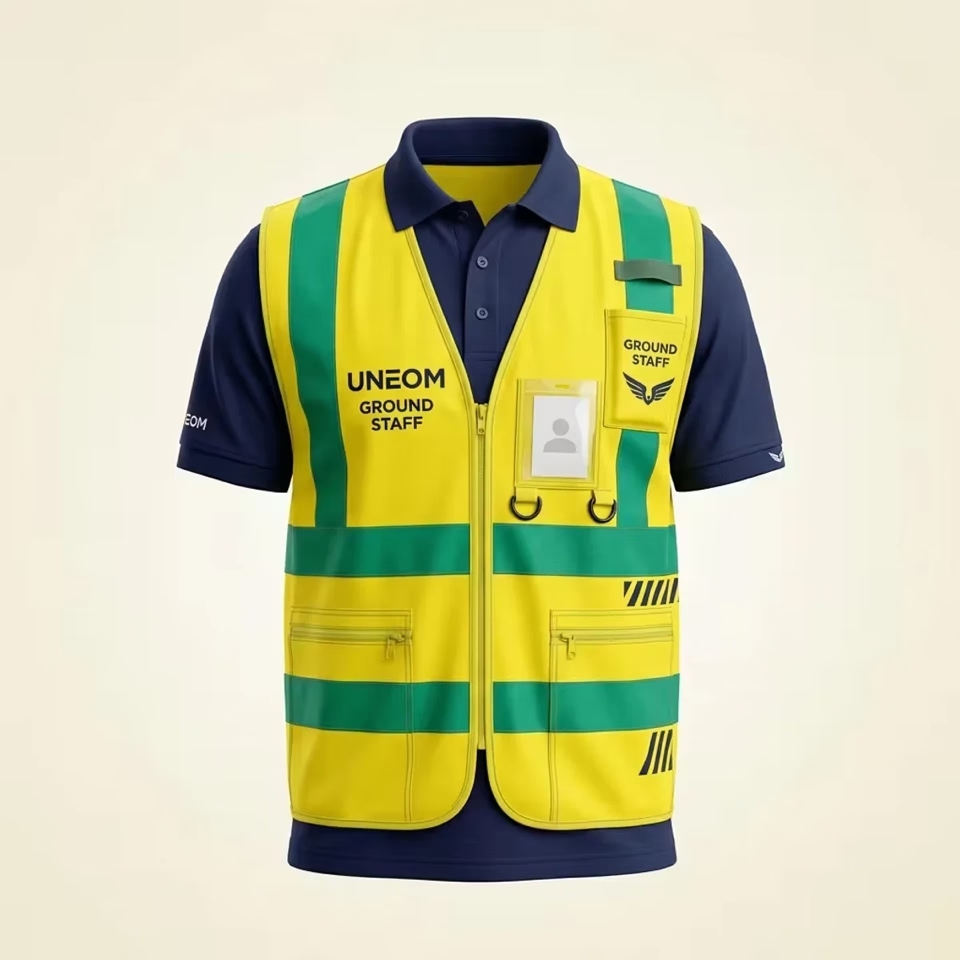
Most airline uniform programmes prioritise cabin crew — the most visible brand ambassadors — and under-invest in ground staff uniforms. This creates a brand-consistency gap that passengers experience as a quality disconnect: premium cabin service preceded by mediocre check-in and gate-agent presentation. The passenger's brand experience begins at the check-in counter, approximately 3 hours before boarding, and ends at the baggage carousel, approximately 45 minutes after landing. Ground staff — check-in agents, gate agents, lounge hosts, ramp agents visible through terminal windows, and baggage-service representatives — account for approximately 70% of the total passenger-contact time. If these touchpoints present a lower-quality uniform than the cabin crew, the brand message is inconsistent. UNEOM's airline programme treats ground staff uniforms as a distinct product category with its own specification requirements rather than a simplified version of the cabin crew uniform. Check-in and gate agents require different fabric specifications than cabin crew: they work in air-conditioned terminal environments rather than pressurised cabins, so the humidity management and pressure-differential specifications are different. However, they spend more time seated at workstations, creating higher stress on trouser knee and seat areas, and they handle luggage tags, boarding passes, and other paper documents that create ink-transfer stains on sleeve cuffs. UNEOM's ground-agent specification uses a cotton-polyester blend at 60/40 and 180gsm — lighter than the cabin crew tri-blend because terminal environments are consistently climate-controlled — with a stain-release treatment on the cuffs and forearms specifically formulated for ink transfer. The trouser specification uses a heavier 220gsm fabric with reinforced knee and seat panels to withstand the seated work position. Lounge hosts receive a higher-specification uniform approaching cabin crew quality, because the lounge environment serves premium and first-class passengers whose brand expectations are highest. This differentiated approach costs approximately 15% more than a one-size-fits-all uniform programme but delivers measurably higher brand consistency across all passenger touchpoints.
Seasonal wardrobe architecture
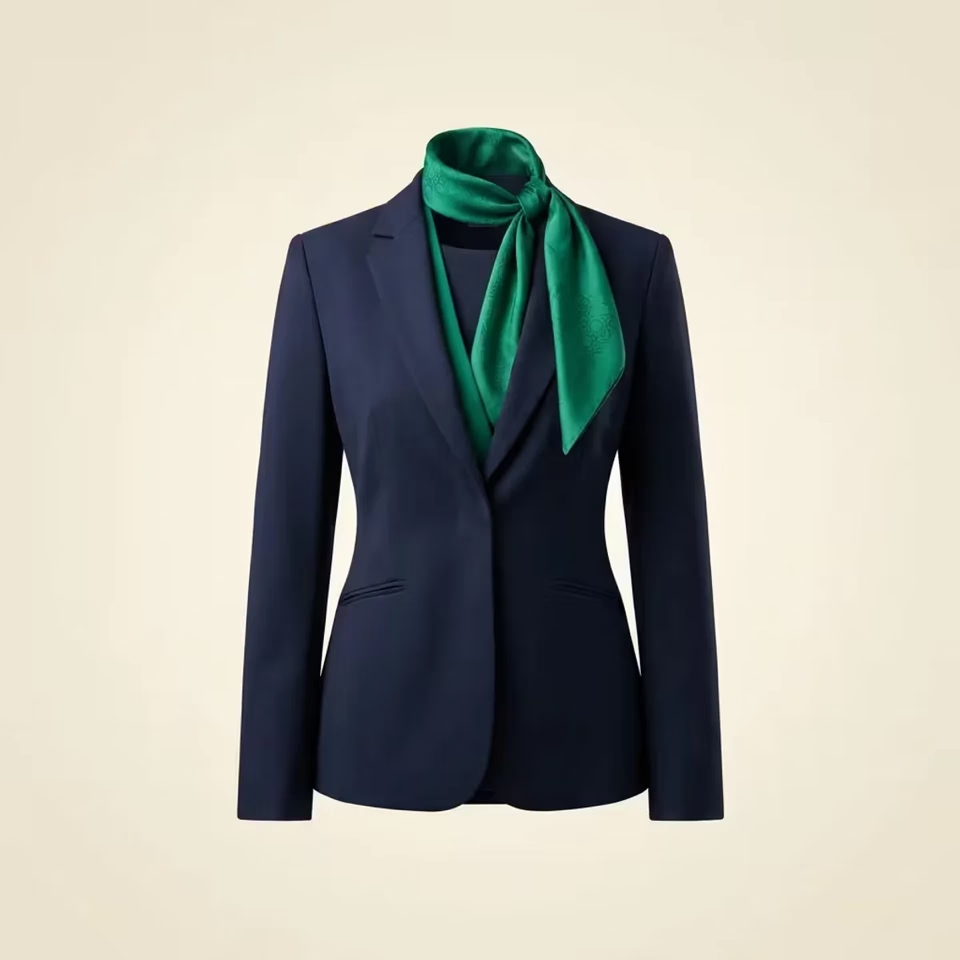
Saudi carriers operate across climate zones that span from sub-zero European winter destinations to tropical Southeast Asian humidity to the Arabian Peninsula's extreme dry heat. A single uniform specification cannot perform optimally across this range — but multiple complete uniform sets create inventory and logistics complexity that most airlines want to avoid. UNEOM's seasonal wardrobe architecture solves this through a layered system built on a core uniform with three add-on climate modules. The core uniform is designed for the neutral temperature band of 18 to 28 degrees Celsius — the range that covers most airport terminals and aircraft cabins worldwide. It uses the 55/35/10 tri-blend at 200gsm with half-sleeve or three-quarter sleeve options for summer routes and a full-sleeve option for cooler routes. Climate Module 1 is the cold-weather layer: a tailored wool coat in the airline's brand colour with matching scarf and gloves, designed to be worn over the core uniform during ground operations at cold-weather destinations. The coat uses the same fabric supplier and dye lot as the core uniform to ensure exact colour matching. It is stored in the aircraft galley during flight and deployed only for arrival operations at cold-weather destinations. Climate Module 2 is the humidity adaptation: a lightweight under-layer in moisture-wicking mesh that replaces the standard under-garment for tropical routes. The mesh layer increases the effective moisture transport of the uniform system by approximately 40%, preventing the clammy discomfort that standard cotton under-garments create in 85% relative humidity environments like Singapore, Bangkok, and Kuala Lumpur. Climate Module 3 is the desert heat adaptation: a UV-protective over-layer for ground operations at Saudi domestic airports during summer. This lightweight tabard uses UPF 50+ rated fabric that blocks 98% of UV radiation, protecting the core uniform fabric from UV degradation and protecting the crew member from sun exposure during tarmac operations. The modular approach means cabin crew carry a single core uniform set plus the relevant climate module for their assigned route — reducing the wardrobe requirement from 4 complete uniform sets to 1 core set plus 3 compact modules.
Programme economics for Saudi carriers
The total annual cost of UNEOM's airline uniform programme ranges from SAR 1,600 to 2,200 per crew member depending on the specification level and replacement cycle. This includes core uniform garments, climate modules, accessories, alterations, and programme management. For a Saudi carrier with 3,000 cabin crew and 5,000 ground staff, the annual programme investment ranges from SAR 12.8 million to SAR 17.6 million. Against the revenue impact documented in the NPS correlation analysis — where a 14-point NPS improvement correlates with approximately USD 33.6 million in annual revenue for a mid-size carrier — the programme investment represents a return of approximately 5 to 7 times the investment. The programme contract structure includes several cost-efficiency mechanisms. Volume pricing across the full programme — cabin crew, ground staff, and all climate modules — achieves 12 to 18% cost reduction compared to separate procurement of equivalent garments. The centralised size-profiling system reduces the alteration rate from the airline industry average of 22% to UNEOM's 5%, saving approximately SAR 45 per crew member per year in alteration costs. The seasonal wardrobe architecture reduces total garment count per crew member by approximately 35% compared to a multi-set approach, saving both procurement cost and wardrobe storage space. And the 12-month replacement cycle, while more frequent than industry standard, is partially offset by a garment-recovery programme where retired core uniform garments are repurposed as ground-operations training uniforms — extending their useful life without compromising the brand presentation standard for passenger-facing roles. UNEOM assigns a dedicated programme manager to each airline client, responsible for inventory management across all crew bases, replacement scheduling synchronised with crew roster cycles, and quarterly brand-compliance audits where garment appearance is assessed against the original specification to verify that the replacement cycle is maintaining the NPS-optimising presentation standard.
Frequently asked
- What is the ROI of premium airline uniforms?
- Approximately 5-7x: SAR 1,800/crew member generates measurable NPS improvement correlated with USD 33.6M annual revenue impact for a mid-size carrier.
- How often should airline uniforms be replaced?
- Every 12 months for customer-facing garments — shorter than the 18-24 month industry standard but optimises NPS through consistent appearance quality.
- Why should ground staff uniforms differ from cabin crew?
- Different environmental stresses: seated workstation wear vs. cabin movement, ink-transfer stains vs. galley stains, consistent climate vs. pressure cycling.
- What climate modules are available?
- Three: cold-weather (coat/scarf/gloves), humidity adaptation (mesh under-layer), and desert heat (UPF 50+ UV-protective over-layer).
- What is the programme cost for a full airline?
- SAR 12.8-17.6M annually for 8,000 total staff (3,000 cabin + 5,000 ground), including garments, modules, alterations, and programme management.